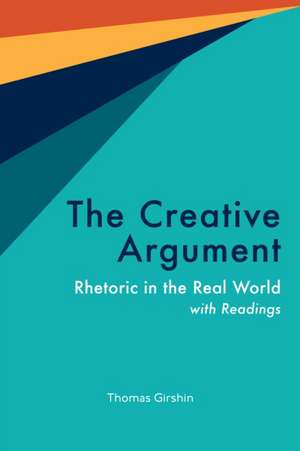
The Creative Argument: Rhetoric in the Real World, with Readings
Autor Thomas Girshinen Limba Engleză Paperback – 22 apr 2024
Preț: 192.95 lei
Preț vechi: 246.66 lei
-22%
Puncte Express: 289
Carte disponibilă
Livrare economică 09-23 noiembrie
Livrare express 23-29 octombrie pentru 88.62 lei
Livrare prin curier în România Termenul estimat este afișat lângă disponibilitate.
Transport gratuit de la 400.00 lei Plată online sau ramburs, în funcție de opțiunile comenzii.
Retur gratuit în 14 zile Comandă securizată și suport în română.
Specificații
ISBN-13: 9781647921651
ISBN-10: 1647921651
Pagini: 376
Ilustrații: ~38 halftones, charts, and diagrams
Dimensiuni: 152 x 229 x 21 mm
Greutate: 0.5 kg
Editura: Hackett Publishing Company,Inc
Colecția Hackett Publishing Company, Inc.
Locul publicării:United States
ISBN-10: 1647921651
Pagini: 376
Ilustrații: ~38 halftones, charts, and diagrams
Dimensiuni: 152 x 229 x 21 mm
Greutate: 0.5 kg
Editura: Hackett Publishing Company,Inc
Colecția Hackett Publishing Company, Inc.
Locul publicării:United States
V-ar putea interesa
-
 The Art of RhetoricAristotlePreț: 28.01 lei
 -
 Think Again: How to Reason and ArgueWalter Sinnott-Armstrong-19%Preț: 63.45 lei78.59 lei
 -
 Oxford Guide to Effective Argument and Critical ThinkingColin Swatridge-19%Preț: 92.93 lei114.43 lei
 -
 Preț: 114.43 lei
 -
 Thinking from A to ZNigel WarburtonPreț: 214.25 lei
 -
 Speaking Your MindRebecca StottPreț: 287.23 lei
 -
 Good ArgumentsRichard A HollandPreț: 140.12 lei
 -
 Critical Thinking: A Concise GuideTracy BowellPreț: 372.76 lei
 -
 Preț: 359.32 lei
 -
 Reason and ArgumentRichard Feldman-9%Preț: 576.02 lei632.99 lei
 -
 Advanced Creative Nonfiction: A Writer's Guide and AnthologyDr Sean Prentiss-13%Preț: 173.86 lei199.70 lei
 -
 -11%Preț: 121.26 lei136.66 lei
 -
 -9%Preț: 113.10 lei124.79 lei
 -
 Philosophical Writing - An Introduction, 5th EditionA. P. MartinichPreț: 253.39 lei
 -
 -25%Preț: 464.47 lei618.50 lei
 -
 The Argument ToolboxK. J. Peters-22%Preț: 236.77 lei302.25 lei
 -
 Speaking of Writing: A Brief Rhetoric - with MLA 2021 UpdateAllegra Goodman-16%Preț: 349.55 lei417.46 lei
 -
 Persuasion: History, Theory, PracticeGeorge Pullman-22%Preț: 196.81 lei253.00 lei
 -
 -44%Preț: 66.37 lei117.62 lei
 -
 Aristotle's Guide to Self-PersuasionJay HeinrichsPreț: 134.18 lei
Recenzii
"For faculty, The Creative Argument's careful organization provides a blueprint for the semester or supplemental material for generating lectures and learning activities. For students, the efficient chapters, thoughtful readings, and refined explanations make reading and learning nearly effortless. The Creative Argument is the best way to get students to quickly understand how and why argument is paramount for personal and societal growth. This is the book to excite students about writing, research, and argument."
—Tyrell Stewart-Harris, Cornell University
". . . not only provides timely, provocative readings, it offers students and their teachers flexible, non-template heuristics for argumentation that are anything but generic. I can imagine using this book in a variety of contexts but believe it would be particularly helpful for new instructors still trying to find their rhythm in the classroom. It illustrates that rather than a finite set of skills that are rote or drill-based, argumentation is a flexible, creative art."
—Kelly Kinney, University of Wyoming
"Sound, sophisticated, clear, and comprehensive. Concepts and key terms are defined clearly and discussed cogently in every chapter. The selected sample arguments that head each chapter, both historical and contemporary, are in every case striking and appropriate examples of relevant terms and concepts taken up in the chapter. The author's tone/voice/style throughout is engaging—down-to-earth, familiar, transparent. His style goes a long way to making the complex subject matter as palatable as can be.
“Girshin offers a deep dive into nearly every relevant dimension of contemporary rhetoric, introducing as he goes a substantial rhetorical vocabulary, drawn mainly from modern and contemporary thinkers (such as Toulmin). In this respect, the scope of the text is impressive and would likely be of interest to both undergraduate and graduate students of rhetoric; there’s no ‘dumbing down,’ no didacticism, in style or substance, which is quite refreshing.”
—Tom Kerr, Ithaca College
—Tyrell Stewart-Harris, Cornell University
". . . not only provides timely, provocative readings, it offers students and their teachers flexible, non-template heuristics for argumentation that are anything but generic. I can imagine using this book in a variety of contexts but believe it would be particularly helpful for new instructors still trying to find their rhythm in the classroom. It illustrates that rather than a finite set of skills that are rote or drill-based, argumentation is a flexible, creative art."
—Kelly Kinney, University of Wyoming
"Sound, sophisticated, clear, and comprehensive. Concepts and key terms are defined clearly and discussed cogently in every chapter. The selected sample arguments that head each chapter, both historical and contemporary, are in every case striking and appropriate examples of relevant terms and concepts taken up in the chapter. The author's tone/voice/style throughout is engaging—down-to-earth, familiar, transparent. His style goes a long way to making the complex subject matter as palatable as can be.
“Girshin offers a deep dive into nearly every relevant dimension of contemporary rhetoric, introducing as he goes a substantial rhetorical vocabulary, drawn mainly from modern and contemporary thinkers (such as Toulmin). In this respect, the scope of the text is impressive and would likely be of interest to both undergraduate and graduate students of rhetoric; there’s no ‘dumbing down,’ no didacticism, in style or substance, which is quite refreshing.”
—Tom Kerr, Ithaca College