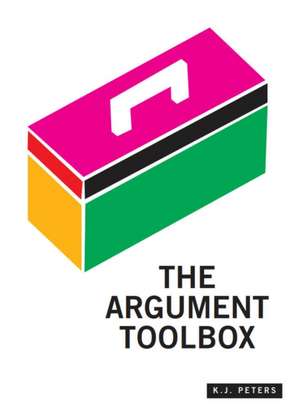
The Argument Toolbox
Autor K. J. Petersen Limba Engleză Paperback – 15 mar 2022
Preț: 236.77 lei
Preț vechi: 302.25 lei
-22%
Puncte Express: 355
Carte disponibilă
Livrare economică 09-23 noiembrie
Livrare prin curier în România Termenul estimat este afișat lângă disponibilitate.
Transport gratuit de la 400.00 lei Plată online sau ramburs, în funcție de opțiunile comenzii.
Retur gratuit în 14 zile Comandă securizată și suport în română.
Specificații
ISBN-13: 9781554815166
ISBN-10: 1554815169
Pagini: 232
Ilustrații: 20 illustrations
Dimensiuni: 152 x 229 x 16 mm
Greutate: 0.54 kg
Editura: BROADVIEW PR
Colecția Broadview Press
Locul publicării:Peterborough, Canada
ISBN-10: 1554815169
Pagini: 232
Ilustrații: 20 illustrations
Dimensiuni: 152 x 229 x 16 mm
Greutate: 0.54 kg
Editura: BROADVIEW PR
Colecția Broadview Press
Locul publicării:Peterborough, Canada
V-ar putea interesa
-
 The Craft of Research, Fifth EditionWayne C. BoothPreț: 112.29 lei
 -
 Persuasive WritingPeter FrederickPreț: 90.39 lei
 -
 Preț: 225.85 lei
 -
 Critical Thinking: A Concise GuideTracy BowellPreț: 372.76 lei
 -
 Reason and ArgumentRichard Feldman-9%Preț: 576.02 lei632.99 lei
 -
 -21%Preț: 498.10 lei630.51 lei
 -
 -13%Preț: 573.35 lei659.02 lei
 -
 -9%Preț: 516.76 lei567.86 lei
 -
 -9%Preț: 113.10 lei124.79 lei
 -
 -14%Preț: 140.88 lei164.69 lei
 -
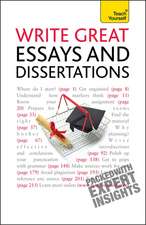 Write Great Essays and Dissertations: Teach YourselfHazel Hutchison-27%Preț: 78.12 lei106.99 lei
 -
 An Invitation to DebateBen Voth-16%Preț: 147.23 lei175.42 lei
 -
 -24%Preț: 351.77 lei463.69 lei
 -
 The Argument HandbookK. J. Peters-8%Preț: 364.60 lei396.30 lei
 -
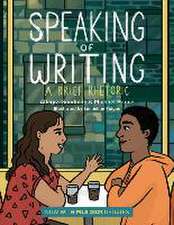 Speaking of Writing: A Brief Rhetoric - with MLA 2021 UpdateAllegra Goodman-16%Preț: 349.55 lei417.46 lei
 -
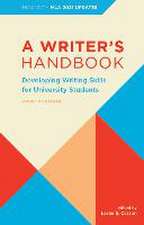 -21%Preț: 122.13 lei154.23 lei
 -
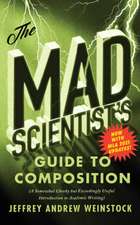 The Mad Scientist’s Guide to Composition - MLA 2021 UpdateJeffrey Andrew WeinstockPreț: 231.46 lei
 -
 Persuasion: History, Theory, PracticeGeorge Pullman-22%Preț: 196.81 lei253.00 lei
 -
 -22%Preț: 192.95 lei246.66 lei
Recenzii
Drawing on the pedagogy, rhetorical theory, and student editor insights of The Argument Handbook, The Argument Toolbox is a very concise resource designed to help writing and composition students build persuasive arguments in various genres. Like the more comprehensive text, The Argument Toolbox is organized and designed so that students can zero in on the content they need to respond to an assignment when faced with a blank screen, a hard deadline, and a skeptical audience.
“The Argument Toolbox provides easy access to the most valuable tools found throughout The Argument Handbook. Those tools include the three helpful lenses for viewing arguments—invention, audience, and authority—as well as the boxed sets of step-by-step instructions for helping students apply rhetorical concepts for persuasively composing their arguments in multiple genres of writing. The more compact Argument Toolbox also preserves the flexible modular organization of the Handbook, thus allowing instructors a wide range of pedagogical options and offering students an abundance of composition resources ready to hand.” — Steven Mailloux, Professor Emeritus, University of California, Irvine
“Building on his prior work with classical argument theory, here K.J. Peters provides a compact, well-organized, and student-friendly guide to demystifying academic argument forms with the aid of rhetorical concepts. The ‘toolbox’ image in the book’s title emphasizes its practicality, which I admire!” — Patricia Bizzell, Distinguished Professor of English Emerita, College of the Holy Cross
“The Argument Toolbox provides easy access to the most valuable tools found throughout The Argument Handbook. Those tools include the three helpful lenses for viewing arguments—invention, audience, and authority—as well as the boxed sets of step-by-step instructions for helping students apply rhetorical concepts for persuasively composing their arguments in multiple genres of writing. The more compact Argument Toolbox also preserves the flexible modular organization of the Handbook, thus allowing instructors a wide range of pedagogical options and offering students an abundance of composition resources ready to hand.” — Steven Mailloux, Professor Emeritus, University of California, Irvine
“Building on his prior work with classical argument theory, here K.J. Peters provides a compact, well-organized, and student-friendly guide to demystifying academic argument forms with the aid of rhetorical concepts. The ‘toolbox’ image in the book’s title emphasizes its practicality, which I admire!” — Patricia Bizzell, Distinguished Professor of English Emerita, College of the Holy Cross
Cuprins
Preface
Chapter 1 Building Arguments: An Introduction
Index
Chapter 1 Building Arguments: An Introduction
- Module I-1: Argument Defined
- Module I-2: Invention and Research: How Will You Find Ideas and Evidence?
- Module I-3: What You Need to Know about Writing in Universities and Colleges
- Module II-1: Elements of Effective Invention
- Module II-2: Invention Strategies
- Module II-3: Using Research to Find and Develop Ideas
- Module II-4: Using Databases and Search Engines
- Module II-5: Organizing Your Research
- Module II-6: How Do I Evaluate Sources?
- Module II-7: Avoiding Plagiarism
- Module II-8: Integrating Sources Authoritatively
- Module III-1: Rhetorical Situation Defined
- Module III-2: Audience Defined
- Module III-3: Analyzing an Audience
- Module III-4: Using Appeals, Media, and Conventions to Influence Your Audience
- Module IV-1: Framing Your Subject
- Module IV-2: Primary and Secondary Stasis Questions
- Module IV-3: Building an Argument Using Stasis Questions
- Module V-1: What Audiences Expect of a State-the-Facts Argument
- Module V-2: A State-the-Facts Genre: Research Paper
- Module V-3: What Audiences Expect of a Definition Argument
- Module V-4: A Definition Genre: Research Paper
- Module V-5: What Audiences Expect of a Causal Argument
- Module V-6: A Causal Argument Genre: Research Paper
- Module V-7: What Audiences Expect of an Analysis and Evaluation
- Module V-8: An Analysis and Evaluation Genre: Review of a Cultural Event
- Module V-9: What Audiences Expect of a Proposal
- Module V-10: A Proposal Genre: Position Paper
- Module VI-1: Logical Fallacies Defined
- Module VI-2: Awkwardness and Flow Defined
- Module VI-3: Using Visuals in Your Argument
- Module VI-4: Using Design Conventions in Your Argument
- Module VI-5: Proofreading Your Argument
- Module VII-1: MLA Style for In-Text Citations
- Module VII-2: MLA List of Works Cited
- Module VII-3: APA Style for In-Text Citations
- Module VII-4: APA List of References
Index