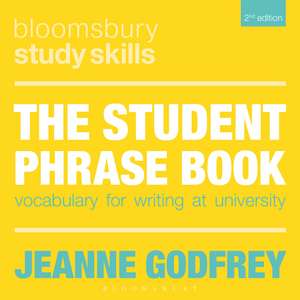
The Student Phrase Book: Vocabulary for Writing at University: Bloomsbury Study Skills
Autor Jeanne Godfreyen Limba Engleză Paperback – 16 ian 2020
Observăm că una dintre cele mai mari provocări pentru studenți nu este lipsa ideilor, ci dificultatea de a le exprima într-un registru academic riguros. The Student Phrase Book abordează direct această problemă, începând cu secțiuni fundamentale despre definirea scopului și a ariei de cercetare (Aim and scope). Spre deosebire de un dicționar clasic, această lucrare din seria Bloomsbury Study Skills funcționează ca un manual de utilizare a limbajului, oferind peste 2.000 de termeni integrați în propoziții model, facilitând înțelegerea nuanțelor de conotație și a structurilor de tip colocație.
Structura cărții urmărește progresia logică a unei lucrări universitare: de la stabilirea temei și a metodologiei, până la analiza datelor și exprimarea imparțialității sau a criticilor. Această a doua ediție aduce o componentă practică esențială prin introducerea exercițiilor de verificare, transformând volumul dintr-un simplu ghid de referință într-un instrument activ de învățare. Jeanne Godfrey își valorifică aici expertiza de peste două decenii în centrele de scriere academică, oferind o resursă mai aplicată decât Writing for University, care se concentra pe procesul general de redactare.
În comparație cu The Only Academic Phrasebook You'll Ever Need de Luiz Otavio Barros, care oferă în principal șabloane de propoziții, volumul de față este mai detaliat în ceea ce privește contextul și utilizarea corectă a vocabularului, incluzând și avertismente despre greșelile frecvente. De asemenea, deși acoperă o arie similară cu Phrasebook for Writing Papers and Research in English, abordarea lui Godfrey este mai pedagogică, fiind adaptată specific nevoilor studenților aflați la începutul parcursului universitar care trebuie să navigheze între rigoarea științifică și claritatea exprimării.
Din seria Bloomsbury Study Skills
- nou
 Preț: 135.30 lei
 - 18%
 Preț: 151.22 lei
 - 14%
 Preț: 135.39 lei
 - 24%
 Preț: 172.46 lei
 -
 Preț: 182.27 lei
 - nou
 Preț: 121.19 lei
 - 20%
 Preț: 162.49 lei
 -
 Preț: 241.52 lei
 - 22%
 Preț: 117.26 lei
 - 21%
 Preț: 140.28 lei
 - 21%
 Preț: 132.33 lei
 - 23%
 Preț: 111.92 lei
 - 18%
 Preț: 103.24 lei
 - 25%
 Preț: 167.82 lei
 - 21%
 Preț: 125.89 lei
 - 20%
 Preț: 137.73 lei
 - 18%
 Preț: 117.74 lei
 - 21%
 Preț: 153.47 lei
 - 21%
 Preț: 119.69 lei
 - 20%
 Preț: 123.73 lei
 - 16%
 Preț: 136.25 lei
 - 17%
 Preț: 118.47 lei
 - 16%
 Preț: 130.66 lei
 - 20%
 Preț: 117.56 lei
 - 18%
 Preț: 136.02 lei
 - 21%
 Preț: 159.64 lei
 - 26%
 Preț: 171.86 lei
 -
 Preț: 88.09 lei
 - 18%
 Preț: 123.85 lei
 - 17%
 Preț: 105.96 lei
 - nou
 Preț: 104.87 lei
 - 21%
 Preț: 127.49 lei
 - 22%
 Preț: 118.67 lei
 - 29%
 Preț: 126.13 lei
 - 20%
 Preț: 164.10 lei
 - 25%
 Preț: 230.77 lei
 -
 Preț: 222.60 lei
 - 25%
 Preț: 222.91 lei
 - 18%
 Preț: 200.69 lei
 -
 Preț: 203.52 lei
 - 25%
 Preț: 222.36 lei
 -
 Preț: 201.96 lei
 -
 Preț: 222.91 lei
 -
 Preț: 201.79 lei
 -
 Preț: 223.76 lei
 - 12%
 Preț: 222.50 lei
 -
 Preț: 236.73 lei
 - 27%
 Preț: 162.79 lei
Preț: 133.42 lei
Preț vechi: 168.88 lei
-21%
Carte disponibilă
Livrare economică 18 mai-01 iunie
Livrare express 01-07 mai pentru 63.59 lei
Specificații
ISBN-10: 1352008335
Pagini: 272
Dimensiuni: 188 x 188 x 16 mm
Greutate: 0.41 kg
Ediția:2nd ed. 2020
Editura: Bloomsbury Publishing
Colecția Bloomsbury Academic
Seria Bloomsbury Study Skills
Locul publicării:London, United Kingdom
De ce să citești această carte
Recomandăm această carte oricărui student care dorește să elimine incertitudinea din scrierea eseurilor și proiectelor de licență. Prin cele 2.000 de expresii gata de utilizat și noile exerciții practice, cititorul câștigă precizie terminologică și un stil academic fluid. Este un ghid esențial pentru a trece de la un vocabular general la unul specializat, necesar succesului în învățământul superior.
Descriere
This is an ideal reference guide for students of all disciplines and levels who are required to complete written assignments as part of their course. It is also a valuable resource for students looking to fine tune their vocabulary for job searches, interviews and writing for professional purposes.
New to this Edition:
- Now contains practice exercises so readers can test their understanding as they goRefreshed, more reader-friendly text design
Cuprins
TOPIC, AIM AND ARGUMENT
1. Topic
2. Aim and scope
3. Proposition and argument
DEFINITIONS AND CLASSIFICATION
4. Brief definitions
5. Classification and characteristics
METHODOLOGY, METHOD AND FINDINGS
6. Methodology, model and method
7. Data, findings, problems and anomalies
AMOUNT, LEVEL AND PROPORTION
8. Amount, level, proportion and distribution
9. Adequate and inadequate amounts
CONTEXT, NORMS, RISK AND THREAT
10. Context, occurrence, norms and deviation
11. Advantage, disadvantage, risk and threat
COMMUNICATION, UNDERSTANDING AND POSITION
12. Communication, expression, signification and portrayal
13. Knowledge, understanding, way of thinking and belief
14. Position, point of view, impartiality and bias
15. Time, sequence, duration and frequency
16. Change, movement, trend and tendency
ENCOURAGEMENT, ALLOWANCE AND PREVENTION
17. Encouragement and improvement, discouragement and deterioration
18. Allowance, prevention, exclusion and elimination
ORIGIN, CAUSE, EFFECT AND LOGICAL RELATIONSHIP 19. Origin, cause and effect
20. Connection, compatibility, reciprocity and lack of relationship
COMPARISON, SIMILARITY AND DIFFERENCE21. Comparison, similarity, equivalence, convergence and balance
22. Difference, differentiation, diversity and divergence
ANALYSIS OF EVIDENCE AND ARGUMENTS,
23. Analysis of evidence and identification of argument flaws
24. Grouping of authors' ideas and identification of common themes
EVALUATION OF EVIDENCE AND ARGUMENTS
25. Authors' evaluations of each other
26. Your positive evaluation of evidence and arguments
27. Your negative evaluation of evidence and arguments
28. Your agreement, disagreement, and counterarguments
IMPORTANCE, IMPLICATIONS AND CONCLUSIONS
29. Linking evidence to theory and practice
30. Importance, significance and dominance
31. Influence and impact
CONCLUSIONS, CLARIFICATION AND FUTURE ACTION
32. Conclusions, implications and new ideas
33. Qualifying conclusions and degrees of certainty
34. Summary, clarification and restatement of position
35. Recommendations, advice and solutions
APPENDICES
Latin abbreviations and phrases
Word class: a brief explanation
Index: word table
Index: alphabetical