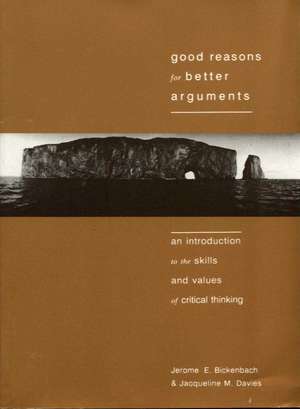
Good Reasons for Better Arguments: An Introduction to the Skills and Values of Critical Thinking
Autor Jerome E. Bickenbach, Jacqueline M. Daviesen Limba Engleză Paperback – 19 sep 1996
Subliniem, încă de la prima parcurgere, importanța exercițiilor practice și a studiilor de caz care transformă Good Reasons for Better Arguments dintr-un manual teoretic într-un instrument de lucru interactiv. Autorii, Jerome E. Bickenbach și Jacqueline M. Davies, au structurat volumul astfel încât studenții să poată trece imediat de la conceptele de bază la aplicarea lor, oferind o secțiune generoasă de răspunsuri la finalul textului pentru autoevaluare. Credem că această abordare facilitează o învățare activă, esențială în deprinderea abilităților de analiză logică.
Ceea ce distinge acest titlu de introducerile standard în logică este ancorarea sa în valorile filozofice ale comunicării. Notăm cu interes modul în care autorii integrează „raționalitatea comunicativă” a lui Habermas și principiile aristotelice pentru a demonstra că un argument bun nu este doar valid din punct de vedere formal, ci și relevant social și etic. Cartea extinde cadrul propus de Critical Thinking: An Introduction to the Basic Skills de William Hughes prin adăugarea unei dimensiuni interpersonale: argumentarea este văzută ca un act de persuasiune transparentă, unde echilibrul dintre rațiune și emoție este recunoscut ca fiind necesar.
Structura este riguros organizată în faze de învățare. Primele capitole definesc etosul gândirii critice, urmate de o analiză detaliată a structurii argumentelor (simple și complexe) și a rolului limbajului în definirea sensului. În contextul operei lui Jerome E. Bickenbach, această lucrare rafinează precizia conceptuală întâlnită în Canadian Cases in the Philosophy of Law, mutând focusul de la jurisprudență către bazele universale ale raționamentului corect. Este o resursă care pregătește cititorul nu doar pentru examene, ci pentru o participare informată la discursul public.
Preț: 464.86 lei
Preț vechi: 597.64 lei
-22%
Carte disponibilă
Livrare economică 18 mai-01 iunie
Livrare express 01-07 mai pentru 84.12 lei
Specificații
ISBN-10: 1551110598
Pagini: 408
Dimensiuni: 165 x 229 x 19 mm
Greutate: 0.65 kg
Editura: BROADVIEW PR
Colecția Broadview Press
Locul publicării:Peterborough, Canada
V-ar putea interesa
-
 -40%Preț: 728.03 lei1205.32 lei
 -
 ConditionalsMichael Woods-15%Preț: 296.68 lei349.67 lei
 -
 A Structural Account of MathematicsCharles S. Chihara-14%Preț: 367.23 lei428.18 lei
 -
 Saving Truth From ParadoxHartry FieldPreț: 348.20 lei
 -
 New PragmatistsCheryl Misak-5%Preț: 281.72 lei297.84 lei
 -
 New Essays on the Knowability ParadoxJoe Salerno-14%Preț: 679.95 lei790.64 lei
 -
 -14%Preț: 580.97 lei675.55 lei
 -
 The Knowability ParadoxJonathan L. Kvanvig-9%Preț: 358.09 lei392.12 lei
 -
 -14%Preț: 615.41 lei715.58 lei
 -
 The Theory of DescriptionsG. Stevens-15%Preț: 619.35 lei728.64 lei
 -
 Tricking the TallymanJacqueline DaviesPreț: 43.36 lei
 -
 The Truth about TalentJacqueline DaviesPreț: 309.60 lei
 -
 MetalogicHunterPreț: 254.55 lei
 -
 The Lemonade WarJacqueline DaviesPreț: 51.24 lei
 -
 The Lemonade CrimeJacqueline DaviesPreț: 50.66 lei
 -
 The Boy Who Drew BirdsJacqueline DaviesPreț: 106.54 lei
 -
 Introducing Logic - compactDan CryanPreț: 61.41 lei
De ce să citești această carte
Această carte este ideală pentru studenții și profesioniștii care doresc să își rafineze capacitatea de a construi și evalua argumente. Dincolo de logica formală, cititorul câștigă o înțelegere profundă a modului în care limbajul și contextul social modelează validitatea unei idei. Este o recomandare excelentă pentru cei care caută un echilibru între exerciții practice imediate și o fundamentare filozofică solidă a gândirii critice.
Despre autor
Jerome E. Bickenbach este un distins profesor și cercetător, activ în cadrul departamentelor de Științe ale Sănătății și Politici de Sănătate la Universitatea din Lucerna și la Swiss Paraplegic Research din Elveția. Cu o carieră academică începută la Queen’s University, Bickenbach s-a specializat în filozofia dreptului, etică și politici publice. Expertiza sa vastă este reflectată în lucrări precum Disability and Justice și Ethics, Law, and Policy, unde explorează intersecția dintre normele juridice și valorile umane. În Good Reasons for Better Arguments, el aplică rigoarea analitică specifică domeniului juridic în pedagogia gândirii critice.
Recenzii
If this text is distinctive in the extent to which it deals with the theory and the values of critical thinking, it is also noteworthy for the thorough grounding it provides in the skills of deductive and inductive reasoning; the authors present the reader with useful tools for the interpretation, evaluation and construction of arguments. A particular feature is the inclusion of a wide range of exercises, rich with examples that illuminate the practice of argument for the student. Many of the exercises are self testing, with answers provided at the back of the text; others are appropriate for in-class discussion and assignments. Challenging yet accessible, Good Reasons for Better Arguments brings a fresh perspective to an essential subject.
Descriere
If this text is distinctive in the extent to which it deals with the theory and the values of critical thinking, it is also noteworthy for the thorough grounding it provides in the skills of deductive and inductive reasoning; the authors present the reader with useful tools for the interpretation, evaluation and construction of arguments. A particular feature is the inclusion of a wide range of exercises, rich with examples that illuminate the practice of argument for the student. Many of the exercises are self testing, with answers provided at the back of the text; others are appropriate for in-class discussion and assignments. Challenging yet accessible, Good Reasons for Better Arguments brings a fresh perspective to an essential subject.
Cuprins
1. CRITICAL THINKING: WHAT AND WHY
- What’s in a Name?
- Critical Thinking and the Search for Good Reasons
- Who’s to Say What a Good Reason Is?
- Good Reasons, Better Arguments and Rationality
- Rational Discourse: Giving Reasons
- Communicatively Rational Speech Acts, or Good Reasons for Better Arguments
- Communicative Norms: Expectations and Obligations
- Comprehensibility
- Sincerity
- Transparent Persuasion: The Goal of Better Arguments
- A Brief Overview of this Book
Exercises
- Critical Thinking Skills, Phase 1: Argument Structure and Construction
- The Argument: Form and Function
- Arguments and Non-arguments
- Arguments and Opinions
- Arguments, Explanations and Definitions
- Units of Meaning
- Standard Form for Simple Arguments
- Enthymemes and the Principle of Charity
- Standard Form for Complex Arguments
- Expressing Yourself in Argument Form
Exercises
- Language as Context
- Definitions: Explaining Meaning
- Definitions: Arguing Meaning
- Paradigm Case/Counter-example
- Genus/Differentia
- Understanding Conditionals and the Relationship of Implication
- Language and the Gap between Intention and Communication
- Ambiguity
- Vagueness
- Euphemism and Hyperbole
- Jargon and Obfuscation
- Disempowering Language
- Linguistic Considerations in the Construction of Your Own Arguments
Exercises
- Phase 2: Evaluating Arguments
- Arguments, Arguers and Conclusions: Where to Start Your Evaluation
- Facts, Values and Opinions: Are They All Open to Evaluation?
- The Normativity of Argument Evaluation
- What Are Good Enough Arguments Good Enough For?
- General Criteria of Argument Evaluation
- Acceptability
- Relevance
- Sufficiency
- Cogency: The Overall Judgement
- A Few More Words on Expressing Yourself in Argument Form
Exercises
- Fallacy-Spotting and Building a Better Argument
- Dubious Premises
- Premises that Mean Too Much, or Not Enough
- Premises Bearing Illicitly Imported Assumptions
- Irrelevance
- Irrelevant Attacks on the Source of Opinion
- Illegitimate Manipulation of Emotion
- Changing the Subject
- Improper Appeals to Authority
- Hasty Conclusions and Suppressed Evidence
- Building a Better Argument
Exercises
- Three Modes of Argumentation
- Aspects of Deductive Reasoning
- Validity
- Categorical Logic
- Translation
- Venn Diagrams
- Immediate Inferences
- Syllogisms
- Fallacies of Distribution and Other Violations of the Rules for Syllogisms
- Propositional Logic
- The Strengths and Weaknesses of Deduction
Exercises
- Induction and Reasoning from Observation
- Enumerative Induction
- Representative Sampling and Justified Confidence in Induction
- Reasoning about Causation
- Types of Causes
- Inductive Justification and Scientific Methods
Exercises
- The Scope of Practical Reasoning
- Intersubjectivity, Open-endedness and Criterial Reasoning
- Conductive Reasoning
- Reasoning from Analogy
- Communicative Rationality: The Sufficiency Criterion in Practical Reasoning
Exercises
Appendix A: Procedure for Standardizing Complex Arguments
Appendix B: Procedure for Expressing Yourself in Argument Form
Index