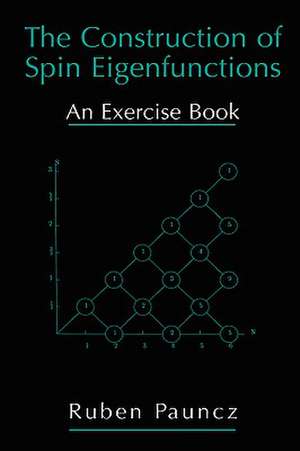
The Construction of Spin Eigenfunctions
Autor Ruben Paunczen Limba Engleză Hardback – 30 iun 2000
Preț: 716.84 lei
Preț vechi: 843.34 lei
-15%
Puncte Express: 1075
Carte tipărită la comandă
Livrare economică 07-21 decembrie
Livrare prin curier în România Termenul estimat este afișat lângă disponibilitate.
Transport gratuit pentru acest produs Plată online sau ramburs, în funcție de opțiunile comenzii.
Retur gratuit în 14 zile Comandă securizată și suport în română.
Specificații
ISBN-13: 9780306464003
ISBN-10: 0306464004
Pagini: 208
Ilustrații: XI, 192 p.
Dimensiuni: 157 x 235 x 17 mm
Greutate: 0.41 kg
Ediția:2000
Editura: Springer
Locul publicării:New York, NY, United States
ISBN-10: 0306464004
Pagini: 208
Ilustrații: XI, 192 p.
Dimensiuni: 157 x 235 x 17 mm
Greutate: 0.41 kg
Ediția:2000
Editura: Springer
Locul publicării:New York, NY, United States
V-ar putea interesa
-
 Quantum Theory: A Very Short IntroductionJohn Polkinghorne-20%Preț: 56.69 lei70.53 lei
 -
 -29%Preț: 590.25 lei835.89 lei
 -
 Molecular Quantum MechanicsPeter W. Atkins-19%Preț: 546.70 lei674.94 lei
 -
 Radioactivity: A Very Short IntroductionClaudio Tuniz-19%Preț: 57.46 lei71.12 lei
 -
 Quantum Mechanics: Theory and ExperimentMark Beck-23%Preț: 956.43 lei1242.11 lei
 -
 -9%Preț: 927.72 lei1019.47 lei
 -
 Models for Bonding in ChemistryValerio MagnascoPreț: 375.58 lei
 -
 Molecular Symmetry & Group TheAlan VincentPreț: 348.38 lei
 -
 The Computation of Chemical EquilibriaVan Zeggeren FPreț: 379.31 lei
 -
 PolaronsDavid Emin-11%Preț: 652.97 lei733.68 lei
 -
 Liquid Surfaces and InterfacesPeter S. Pershan-9%Preț: 1158.63 lei1273.21 lei
 -
 -18%Preț: 1225.61 lei1494.65 lei
 -
 Discovering ChemistryWeinhold-8%Preț: 589.65 lei640.93 lei
 -
 Molecular Electronic-Structure TheoryTrygve Helgaker-19%Preț: 596.41 lei736.31 lei
 -
 -18%Preț: 728.04 lei887.84 lei
 -
 Sulfur-Centered Reactive Intermediates in Chemistry and BiologyC. ChatgilialogluPreț: 389.30 lei
 -
 Chemical & Biochemical Kinetics: New PerspectivesGennady Zaikov-26%Preț: 798.94 lei1074.88 lei
 -
 Radiation: What You Need to KnowAmanda E Lehtinen-27%Preț: 899.61 lei1226.44 lei
 -
 INTRO TO INTERFACES & COLLOIDS,ANBerg John CPreț: 516.23 lei
Public țintă
ResearchCuprins
1. The Spin Operator and Spin Functions.- 1.1 Introduction.- 1.2 Spin operators and Pauli matrices.- 1.3 Spin functions.- 1.4 The Dirac identity.- 1.5 Square brackets of spin functions.- 1.6 Graphical representation of the primitive spin functions.- 2. Genealogical Construction of Spin Eigenfunctions.- 2.1 Addition theorem of angular momenta.- 2.2 Addition theorem of spin forNelectrons.- 2.3 The spin degeneracy.- 2.4 Branching diagram symbol.- 2.5 Special properties of the branching diagram functions.- 2.6 The coefficient of a primitive spin function in a given branching diagram function.- 3. Serber Spin Functions.- 3.1 Serber spin functions.- 3.2 Geminal spin product functions. Serber path diagram.- 3.3 Serber branching diagram.- 3.4 Recursion formulas for the highest component.- 3.5 Special properties of the Serber functions.- 3.6 The coefficient of a geminal product in a given Serber function.- 3.7 The algorithm of Carrington and Doggett.- 4. Projected Spin Eigenfunctions.- 4.1 Projection operator.- 4.2 Expanded form of the projected function (Löwdin).- 4.3 Projection of other primitive functions.- 4.4 Relation between the projected functions and the branching diagram functions.- 4.5 Calculation of the overlap matrix of the projected functions.- 5. Spin-Paired Spin Eigenfunctions.- 5.1 Spin-paired spin functions.- 5.2 The Rumer algorithm for the selection of linearly independent spin-paired spin functions.- 5.3 Extended Rumer diagrams (Simonetta).- 5.4 The leading term (Simonetta).- 5.5 Linear independence of spin-paired eigenfunctions.- 5.6 Overlap integrals between Rumer functions..- 6. The Symmetric Group.- 6.1 Basic notions of the symmetric group.- 6.2 Classes of the symmetric group.- 6.3 Representations of the symmetric group.- 6.4 Young tableaux.- 6.5Young’s orthogonal representation.- 6.6 The conjugate representation.- 6.7 The symmetric group algebra.- 6.8 The Young operator.- 7. Representations of SNGenerated by Spin Eigenfunctions.- 7.1 Representations of the symmetric group generated by the branching diagram functions.- 7.2 Yamanouchi-Kotani method for the representations.- 7.3 Branching diagram functions and Young tableaux.- 7.4 Representations of SNgenerated by the projected spin functions.- 7.5 Calculations of A(P) by the Rettrup-Pauncz algorithm.- 7.6 Correspondence between spin-paired functions and Young tableaux.- 7.7 Generation of projected spin functions by Young operators.- 8. Combination of Spatial and Spin Functions.- 8.1 Introduction.- 8.2 Antisymmetric wave function.- 8.3 Combination of spatial and spin functions.- 8.4 Representations of SNby the spatial functions ? jiS.- 9. Calculation of the Hamiltonian Matrix.- 9.1 Spin-free Hamiltonian.- 9.2 Branching diagram spin functions.- 9.3 The determinantal form of the wave function.- 9.4 Serber spin functions.- 9.5 Projected spin functions.- 9.6 Valence—bond spin function.- 9.7 Many—configuration wave functions.- 10. Spin-Coupled Functions.- 10.1 Introduction.- 10.2 Historical development.- 10.3 Spin—coupled wave functions.- 10.4 Spin—coupled valence—bond method.- 10.5 Core—valence separation.- 10.6 SPINS, computer program.- 11. Solutions to the Exercises.- 11.1 Chapter 1.- 11.2 Chapter 2.- 11.3 Chapter 3.- 11.4 Chapter 4.- 11.5 Chapter 5.- 11.6 Chapter 6.- 11.7 Chapter 7.- 11.8 Chapter 8.- 12. Index.