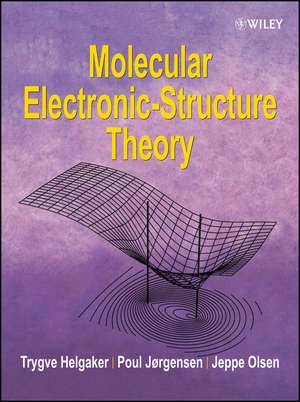
Molecular Electronic-Structure Theory
Autor Trygve Helgaker, Jeppe Olsen, Poul Jørgensenen Limba Engleză Paperback – feb 2013
Evoluția chimiei cuantice ab initio în ultimele decenii a transformat domeniul dintr-o disciplină pur teoretică într-un instrument predictiv esențial, capabil să rezolve probleme chimice anterior insolubile prin metode riguroase de mecanică cuantică. Remarcăm cum Molecular Electronic-Structure Theory reușește să capteze această tranziție, oferind o fundamentare tehnică exhaustivă a metodelor computaționale moderne. Lucrarea semnată de Trygve Helgaker, Poul Jørgensen și Jeppe Olsen se distinge prin rigoarea cu care tratează a doua cuantificare cu adaptarea spinului și evaluarea integralelor moleculare, elemente critice pentru orice cercetător care dorește să înțeleagă arhitectura software-ului de chimie cuantică. Suntem de părere că valoarea adăugată a acestui volum rezidă în echilibrul dintre teorie și validare empirică. Subliniem faptul că autorii nu se limitează la modele teoretice abstracte, ci utilizează exemple numerice reale pentru a ilustra punctele forte și limitările fiecărei metode, de la teoria perturbațiilor până la funcțiile de undă corelate explicit. Această ediție extinde cadrul propus de Modern Quantum Chemistry de Attila Szabó cu date noi din perspectiva tehnicilor de scalare liniară și a metodei multipolilor rapizi (FMM), esențiale pentru studiul sistemelor moleculare de mari dimensiuni. Structura este una progresivă, pornind de la Hartree-Fock și culminând cu teoria configurației-interacțiune și coupled-cluster, oferind în același timp instrumente de calibrare pentru atomizarea energiilor și entalpiilor de reacție. Este, fără îndoială, o resursă de referință care definește standardul actual în teoria structurii electronice.
Preț: 595.29 lei
Preț vechi: 734.93 lei
-19%
Carte indisponibilă temporar
Specificații
ISBN-10: 1118531477
Pagini: 944
Dimensiuni: 189 x 246 x 50 mm
Greutate: 1.68 kg
Editura: Wiley
Locul publicării:Chichester, United Kingdom
V-ar putea interesa
-
 Classical MechanicsGeorge Hrabovsky-32%Preț: 63.31 lei92.54 lei
 -
 Quantum MechanicsLeonard Susskind-30%Preț: 65.63 lei93.77 lei
 -
 Special Relativity and Classical Field TheoryLeonard Susskind-29%Preț: 66.72 lei94.39 lei
 -
 A Level Advancing Physics for OCR B: Year 2John MillerPreț: 363.74 lei
 -
 The Science of the Perfect SwingPeter Dewhurst-12%Preț: 305.43 lei348.35 lei
 -
 The Story of SpinSin-itiro TomonagaPreț: 279.41 lei
 -
 -30%Preț: 742.06 lei1061.78 lei
 -
 Theoretical MinimumLeonard SusskindPreț: 104.70 lei
 -
 Lectures on Quantum MechanicsPaul A M Dirac-20%Preț: 56.47 lei70.70 lei
 -
 Mathematics for Quantum ChemistryJay Martin AndersonPreț: 79.59 lei
 -
 Quantum Mechanics in Simple Matrix FormThomas F Jordan-19%Preț: 84.23 lei104.16 lei
 -
 -32%Preț: 104.78 lei153.19 lei
 -
 Modern Quantum ChemistryAttila Szabó-24%Preț: 172.70 lei226.44 lei
 -
 The Road to RealityRoger PenrosePreț: 199.59 lei
 -
 General Theory of RelativityP. A. M. DiracPreț: 259.95 lei
 -
 Nuclear PhysicsW. HeisenbergPreț: 106.94 lei
 -
 The Principles of Quantum MechanicsP. A. M. DiracPreț: 238.63 lei
 -
 Lectures on Quantum Mechanics and Relativistic Field TheoryP. A. M. DiracPreț: 70.47 lei
 -
 Preț: 230.33 lei
 -
 Introduction to Contextual Maths in ChemistryFiona DickinsonPreț: 179.20 lei
 -
 RelativityAlbert EinsteinPreț: 54.42 lei
 -
 Three Lectures on Complexity and Black HolesLeonard Susskind-15%Preț: 401.71 lei472.59 lei
 -
 General Principles of Quantum MechanicsWolfgang Pauli-18%Preț: 853.85 lei1041.28 lei
 -
 PEREGRINATIONS FROM PHYSICS TO PHYLOGENYPhua Kok Khoo-18%Preț: 793.73 lei967.96 lei
Public țintă
Graduates and Advanced Undergraduates doing courses in Chemistry and Molecular Physics. Reference book for Researchers in the field of Quantum Chemistry.De ce să citești această carte
Această lucrare este esențială pentru doctoranzii și cercetătorii în chimie cuantică și fizică moleculară care au nevoie de o înțelegere profundă a metodelor ab initio. Cititorul câștigă nu doar o bază teoretică solidă, ci și capacitatea practică de a evalua critic precizia calculelor computaționale prin exercițiile și soluțiile detaliate oferite, transformând teoria abstractă în competență analitică aplicabilă.
Despre autor
Trygve Helgaker este profesor la Departamentul de Chimie al Universității din Oslo, Norvegia, fiind un nume de referință în dezvoltarea metodelor de structură electronică. Alături de el, Poul Jørgensen și Jeppe Olsen, ambii activând în cadrul Departamentului de Chimie al Universității din Aarhus, Danemarca, formează o echipă de autori cu o vastă experiență în cercetarea fundamentală și didactică universitară. Expertiza lor colectivă acoperă arii vaste, de la dezvoltarea de algoritmi pentru seturi de baze Gaussiane până la rafinarea teoriilor de corelație electronică, contribuțiile lor fiind fundamentale pentru progresul chimiei computaționale contemporane.
Descriere scurtă
This is the first comprehensive up-to-date and technical work to cover all the important aspects of modern molecular electronic-structure theory. Topics covered in the book include:
- Second quantization with spin adaptation
- Gaussian basis sets and molecular-integral evaluation
- Hartree-Fock theory
- Configuration-interaction and multi-configurational self-consistent theory
- Coupled-cluster theory for ground and excited states
- Perturbation theory for single- and multi-configuration states
- Linear-scaling techniques and the fast multiple method
- Explicitly correlated wave functions
- Basis-set convergence and extrapolation
- Calibration and benchmarking of computational methods, with applications to molecular equilibrium structures, atomization energies and reaction enthalpies.
This book is a must for researchers in the field of quantum chemistry as well as for nonspecialists who wish to acquire a thorough understanding of ab initio molecular electronic-structure theory and its applications to problems in chemistry and physics. It is also highly recommended for the teaching of graduates and advanced undergraduates.
Cuprins
Overview xxv
Programs used in the preparation of this book xxix
1. Second Quantization 1
1.1 The Fock space 1
1.2 Creation and annihilation operators 2
1.3 Number-conserving operators 6
1.4 The representation of one- and two-electron operators 9
1.5 Products of operators in second quantization 14
1.6 First- and second-quantization operators compared 18
1.7 Density matrices 19
1.8 Commutators and anticommutators 25
1.9 Nonorthogonal spin orbitals 27
2. Spin in Second Quantization 34
2.1 Spin functions 34
2.2 Operators in the orbital basis 35
2.3 Spin tensor operators 41
2.4 Spin properties of determinants 46
2.5 Configuration state functions 51
2.6 The genealogical coupling scheme 53
2.7 Density matrices 61
3. Orbital Rotations 80
3.1 Unitary transformations and matrix exponentials 80
3.2 Unitary spin-orbital transformations 86
3.3 Symmetry-restricted unitary transformations 89
3.4 The logarithmic matrix function 93
4. Exact and Approximate Wave Functions 107
4.1 Characteristics of the exact wave function 107
4.2 The variation principle 111
4.3 Size-extensivity 126
4.4 Symmetry constraints 135
5. The Standard Models 142
5.1 One- and N-electron expansions 143
5.2 A model system: the hydrogen molecule in a minimal basis 146
5.3 Exact wave functions in Fock space 162
5.4 The Hartree-Fock approximation 167
5.5 Multiconfigurational self-consistent field theory 176
5.6 Configuration-interaction theory 181
5.7 Coupled-cluster theory 186
5.8 Perturbation theory 192
6. Atomic Basis Functions 201
6.1 Requirements on one-electron basis functions 201
6.2 One- and many-centre expansions 203
6.3 The one-electron central-field system 204
6.4 The angular basis 207
6.5 Exponential radial functions 218
6.6 Gaussian radial functions 229
7. Short-Range Interactions and Orbital Expansions 256
7.1 The Coulomb hole 256
7.2 The Coulomb cusp 259
7.3 Approximate treatments of the ground-state helium atom 262
7.4 The partial-wave expansion of the ground-state helium atom 267
7.5 The principal expansion of the ground-state helium atom 273
7.6 Electron-correlation effects summarized 278
8. Gaussian Basis Sets 287
8.1 Gaussian basis functions 287
8.2 Gaussian basis sets for Hartree-Fock calculations 288
8.3 Gaussian basis sets for correlated calculations 300
8.4 Basis-set convergence 315
8.5 Basis-set superposition error 327
9. Molecular Integral Evaluation 336
9.1 Contracted spherical-harmonic Gaussians 336
9.2 Cartesian Gaussians 338
9.3 The Obara-Saika scheme for simple integrals 344
9.4 Hermite Gaussians 349
9.5 The McMurchie-Davidson scheme for simple integrals 352
9.6 Gaussian quadrature for simple integrals 357
9.7 Coulomb integra;s over spherical Gaussians 361
9.8 The Boys function 365
9.9 The McMurchie-Davidson scheme for Coulomb integrals 372
9.10 The Obara-Saika scheme for Coulomb integrals 381
9.11 Rys quadrature for Coulomb integrals 387
9.12 Scaling properties of the molecular integrals 398
9.13 The multipole method for Coulomb integrals 405
9.14 The multipole method for large systems 417
10. Hartree-Fock Theory 433
10.1 Parametrization of the wave function and the energy 433
10.2 The Hartree-Fock wave function 438
10.3 Canonical Hartree-Fock theory 443
10.4 The RHF total energy and orbital energies 450
10.5 Koopmans' theorem 454
10.6 The Roothaan-Hall self-consistent field equations 458
10.7 Density-based Hartree-Fock theory 465
10.8 Second-order optimization 478
10.9 The SCF method as an approximate second-order method 490
10.10 Singlet and triplet instabilities in RHF theory 496
10.11 Multiple solutions in Hartree-Fock theory 504
11. Configuration-Interaction Theory 523
11.1 The CI model 523
11.2 Size-extensivity and the CI model 527
11.3 A CI model system for noninteracting hydrogen molecules 535
11.4 Parametrization of the CI model 540
11.5 Optimization of the CI wave function 543
11.6 Slater determinants as products of alpha and beta strings 550
11.7 The determinantal representation of the Hamiltonian operator 552
11.8 Direct CI methods 554
11.9 CI orbital transformations 569
11.10 Symmetry-broken CI solutions 573
12. Multiconfigurational Self-Consistent Field Theory 498
12.1 The MCSCF model 498
12.2 The MCSCF energy and wave function 600
12.3 The MCSCF Newton trust-region method 610
12.4 The Newton cigenvector method 616
12.5 Computational considerations 621
12.6 Exponential parametrization of the configuration space 630
12.7 MCSCF theory for several electronic states 637
12.8 Removal of RHF instabilities in MCSCF theory 640
13. Coupled-Cluster Theory 648
13.1 The coupled-cluster model 648
13.2 The coupled-cluster exponential ansatz 654
13.3 Size-extensivity in coupled-cluster theory 665
13.4 Coupled-cluster optimization techniques 670
13.5 The coupled-cluster variational Lagrangian 674
13.6 The equation-of-motion coupled-cluster method 677
13.7 The closed-shell CCSD model 685
13.8 Special treatments of coupled-cluster theory 698
13.9 High-spin open-shell coupled-cluster theory 704
14. Perturbation Theory 724
14.1 Rayleigh-Schrödinger perturbation theory 725
14.2 Møller-Plesset perturbation theory 739
14.3 Coupled-cluster perturbation theory 749
14.4 Møller-Plesset theory for closed-shell systems 759
14.5 Convergence in perturbation theory 769
14.6 Perturbative treatments of coupled-cluster wave functions 783
14.7 Multiconfigurational perturbation theory 796
15. Calibration of the Electronic-Structure Models 817
15.1 The sample molecules 817
15.2 Errors in quantum-chemical calculations 819
15.3 Molecular equilibrium structures: bond distances 821
15.4 Molecular equilibrium structures; bond angles 832
15.5 Molecular dipole moments 836
15.6 Molecular and atomic energies 840
15.7 Atomization energies 854
15.8 Reaction enthalpies 865
15.9 Conformational barriers 874
15.10 Conclusions 879
List of Acronyms 885
Index 887