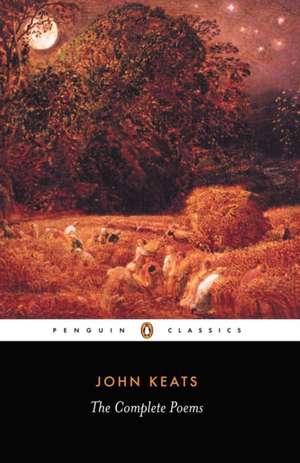
The Complete Poems
Autor John Keats Editat de John Barnarden Limba Engleză Paperback – 25 aug 1977
Prezentăm o ediție de referință a operei ketsiene, structurată sub forma unui volum cuprinzător care reunește întreaga moștenire poetică a unuia dintre cei mai importanți reprezentanți ai Romantismului englez. Observăm că această ediție, îngrijită de John Barnard, adoptă o abordare cronologică riguroasă, permițând cititorului să urmărească evoluția intelectuală și spirituală rapidă a autorului, de la primele exerciții lirice din 1817 până la marile ode care i-au definit geniul. Premisa acestui volum depășește simpla antologare; el oferă un aparat critic dens, incluzând note detaliate și o introducere academică necesară pentru înțelegerea contextului politic și filozofic al epocii. Structura cărții este concepută pentru a sprijini cercetarea aprofundată, integrând nu doar poemele celebre precum 'Ode to a Nightingale' sau 'La Belle Dame sans Merci', ci și fragmente din corespondența sa privată și adnotările marginale la opera lui Milton. Această bogăție de materiale auxiliare transformă lectura dintr-o experiență pur estetică într-un studiu documentar asupra procesului creativ. Recomandăm acest volum ca o alternativă academică la Selected Poems din Macmillan Collector's Library pentru cursurile de literatură engleză, cu avantajul unei cronologii complete și al includerii textelor care nu sunt disponibile pe scară largă. Față de volumul său final publicat în timpul vieții, Lamia, Isabella, The Eve of St Agnes and Other Poems, prezenta ediție oferă perspectiva de ansamblu necesară pentru a înțelege cum 'exaltarea imaginației' și descrierile senzoriale ale naturii s-au împletit cu întrebări filozofice profunde în scurta, dar intensa carieră a lui John Keats.
Preț: 81.34 lei
Preț vechi: 96.66 lei
-16%
Carte disponibilă
Livrare economică 20 noiembrie-01 decembrie
Specificații
ISBN-10: 0140422102
Pagini: 752
Dimensiuni: 196 x 126 x 40 mm
Greutate: 0.5 kg
Ediția:Revizuită
Editura: Penguin Publishing Group
Locul publicării:London, United Kingdom
V-ar putea interesa
-
 The Mind of the MakerDorothy L. SayersPreț: 112.45 lei
 -
 The Complete PoemsSamuel Taylor Coleridge-26%Preț: 91.59 lei123.50 lei
 -
 The Complete PoemsChristina RossettiPreț: 152.71 lei
 -
 Selected PoemsRobert Burns-31%Preț: 54.98 lei79.69 lei
 -
 William Wordsworth: Selected PoemsWilliam Wordsworth-31%Preț: 54.98 lei79.69 lei
 -
 Alfred Lord Tennyson: Selected PoemsAlfred TennysonPreț: 94.34 lei
 -
 Selected Poems of Lord George Gordon ByronLord George Gordon Byron-16%Preț: 105.81 lei125.46 lei
 -
 Selected PoemsJohn ClarePreț: 96.33 lei
 -
 Italian FolktalesItalo Calvino-17%Preț: 103.20 lei124.80 lei
 -
 New and Collected Poems 1931-2001Czeslaw Milosz-17%Preț: 122.51 lei147.13 lei
 -
 William Blake: Selected PoemsWilliam Blake-16%Preț: 67.84 lei80.79 lei
 -
 Selected Poems and ProsePercy Bysshe Shelley-33%Preț: 84.85 lei126.18 lei
 -
 Canvas: PoemsAdam ZagajewskiPreț: 72.90 lei
 -
 Mysticism for BeginnersAdam ZagajewskiPreț: 76.55 lei
 -
 Without EndZagajewski AdamPreț: 124.15 lei
 -
 The SabbathAbraham Joshua HeschelPreț: 90.04 lei
 -
 Eternal EnemiesAdam ZagajewskiPreț: 80.83 lei
 -
 AsymmetryAdam ZagajewskiPreț: 84.66 lei
 -
 The Meaning of AnxietyRollo MayPreț: 110.54 lei
 -
 William WordsworthWilliam WordsworthPreț: 66.91 lei
 -
 Visconti Tarot DeckLo ScarabeoPreț: 127.74 lei
 -
 -26%Preț: 41.99 lei57.02 lei
 -
 The Complete Poems of SapphoWillis BarnstonePreț: 143.32 lei
 -
 The Meaning of the Creative ActNikolai BerdyaevPreț: 154.66 lei
 -
 On WritingCharles BukowskiPreț: 71.50 lei
 -
 The BetrothedAlessandro Manzoni-25%Preț: 84.63 lei112.65 lei
De ce să citești această carte
Recomandăm această ediție oricărui cititor care dorește să exploreze profunzimea Romantismului englez printr-un instrument de studiu complet. Câștigați acces nu doar la poemele canonice, ci și la scrisorile și adnotările rare care dezvăluie omul din spatele versurilor. Este volumul ideal pentru studenții la Filologie și pentru pasionații de poezie care caută o ediție critică durabilă, cu un aparat de note ce clarifică referințele clasice complexe ale lui Keats.
Despre autor
John Keats (1795–1821) a fost o figură centrală a celei de-a doua generații de poeți romantici englezi, alături de Shelley și Byron. Rămas orfan la paisprezece ani și pregătit inițial pentru o carieră în medicină, a abandonat chirurgia pentru a se dedica poeziei. Deși opera sa timpurie a fost aspru criticată de contemporani, Keats a rămas încrezător în vocația sa, lăsând posterității capodopere scrise într-un interval creativ de doar patru ani. S-a stins din viață la Roma, la vârsta de 26 de ani, din cauza tuberculozei, lăsând în urmă o operă caracterizată printr-o senzorialitate remarcabilă și o explorare profundă a relației dintre frumusețe și adevăr.
Notă biografică
Descriere scurtă
Keats's first volume of poems, published in 1817, demonstrated both his belief in the consummate power of poetry and his liberal views. While he was criticized by many for his politics, his immediate circle of friends and family immediately recognized his genius. In his short life he proved to be one of the greatest and most original thinkers of the second generation of Romantic poets, with such poems as 'Ode to a Nightingale', 'Bright Star,' 'The Eve of St Agnes' and 'La Belle Dame sans Merci'. While his writing is illuminated by his exaltation of the imagination and abounds with sensuous descriptions of nature's beauty, it also explores profound philosophical questions.
John Barnard's acclaimed volume contains all the poems known to have been written by Keats, arranged by date of composition. The texts are lightly modernized and are complemented by extensive notes, a comprehensive introduction, an index of classical names, selected extracts from Keats's letters and a number of pieces not widely available, including his annotations to Milton's Paradise Lost.
John Keats (1795-1821) lost both his parents at an early age. His decision to commit himself to poetry, rather than follow a career in medicine, was a personal challenge, unfounded in any prior success. His first volume of poetry, published in 1817, was a critical and commercial failure. During his short life he received little recognition, and it was not until the latter part of the nineteenth century that his place in English Romanticism began to be understood, and not until this century that it became fully appreciated.
If you enjoyed Keats's Complete Poems you might enjoy John Clare's Selected Poems, also available in Penguin Classics.
Cuprins
Extracts from an Opera i. "O! were I one of the Olympian twelve" ii. Daisy's Song iii. Folly's Song iv. "O, I am frightened with most hateful thoughts" v. Song ("The stranger lighted from his steed") vi. "Asleep! O sleep a little while, white pearl!"
The Human Seasons "For there's Bishop's Teign" "Where be ye going, you Devon maid?" "Over the hill and over the dale" To J. H. Reynolds, Esq. To J[ames] R[ice] Isabella; or, The Pot of Basil To Homer Ode to May. Fragment Acrostic "Sweet, sweet is the greeting of eyes" On Visiting the Tomb of Burns "Old Meg she was a gipsy" A Song about Myself "Ah! ken ye what I met the day" To Ailsa Rock "This mortal body of a thousand days" "All gentle folks who owe a grudge" "Of late two dainties were before me placed" Lines Written in the Highlands after a Visit to Burns's Country On Visiting Staffa "Read me a lesson, Muse, and speak it loud" "Upon my life, Sir Nevis, I am piqued" Stanzas on some Skulls in Beauly Abbey, near Inverness Translated from Ronsard "'Tis 'the witching time of night'" "Welcome joy, and welcome sorrow" Song ("Spirit that here reignest") "Where's the Poet? Show him, show him" Fragment of the "Castle Builder" "And what is love? It is a doll dressed up" Hyperion. A Fragment Fancy Ode ("Bards of Passion and of Mirth") Song ("I had a dove and the sweet dove died") Song ("Hush, hush! tread softly! hush, hush my dear!") The Eve of St. Agnes The Eve of St. Mark "Gif ye wol stonden hardie wight" "Why did I laugh tonight?" Faery Bird's Song ("Shed no tear - O, shed no tear!") Faery Song ("Ah! woe is me! poor silver-wing!") "When they were come unto the Faery's Court" "The House of Mourning written by Mr. Scott" Character of Charles Brown A Dream, after reading Dante's Episode of Paolo and Francesca La Belle Dame Sans Merci. A Ballad Song of Four Faeries To Sleep "If by dull rhymes our English must be chained" Ode to Psyche On Fame (I) ("Fame, like a wayward girl, will still be coy") On Fame (II) ("How fevered is the man who cannot look") "Two or three posies" Ode on a Grecian Urn Ode to a Nightingale Ode on Melancholy Ode on Indolence Otho the Great. A Tragedy in Five Acts Lamia "Pensive they sit, and roll their languid eyes" To Autumn The Fall of Hyperion. A Dream "The day is gone, and all its sweets are gone" "What can I do to drive away" "I cry your mercy, pity, love - ay, love" "Bright star! would I were as steadfast as thou art" King Stephen. A Fragment of a Tragedy "This living hand, now warm and capable" The Cap and Bells; or, The Jealousies To Fanny "In after-time, a sage of mickle lore" Three Undated Fragments
Doubtful Attributions: "See, the ship in the bay is riding" The Poet Gripus
Appendix 1: Wordsworth and Hazlitt on the Origins of Greek Mythology Appendix 2: The Two Prefaces to Endymion Appendix 3: The Order of Poems in Poems (1817) and Lamia, Isabella, The Eve of St. Agnes, and Other Poems (1820) and The Publisher's Advertisement for 1820 Appendix 4: Keats's Notes on Milton's Paradise Lost Appendix 5: Keats on Kean's Shakespearean Acting Appendix 6: Selection of Keats's Letters
Notes Dictionary of Classical Names Index of Titles Index of First Lines
Descriere
Already with thee! tender is the night,
And haply the Queen-Moon is on her throne,
Cluster'd around by all her starry Fays;
But here there is no light,
Save what from heaven is with the breezes blown
Through verdurous glooms and winding mossy ways.
Despite his tragically short life, John Keats, a self-confessed "rebel Angel", endures for many as a personification of the Romantic age. While contemporary critics mocked him as a "Cockney poet" and an uneducated lower-class "apothecary" who aspired to poetry, subsequent generations began to see and appreciate both the rich and impassioned sensuousness and the love of beauty and liberty that pervade his work.
From Endymion and Hyperion to 'The Eve of St Agnes', 'La Belle Dame sans Merci' and the Odes, this collection, which presents Keats's oeuvre in chronological order, displays his rapid poetic growth, the development of his philosophical and spiritual beliefs and the voluptuous, silken nature of his verse.