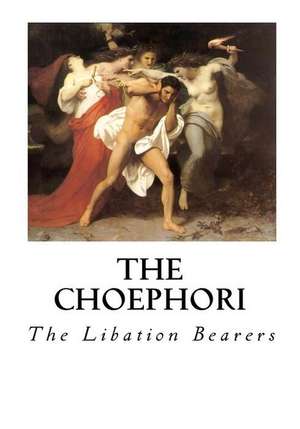
The Choephori
Autor Aeschylus Traducere de E. D. a. Morsheaden Limba Engleză Paperback
Preț: 55.34 lei
Puncte Express: 83
Carte disponibilă
Livrare economică 02-16 noiembrie
Livrare prin curier în România Termenul estimat este afișat lângă disponibilitate.
Transport gratuit de la 400.00 lei Plată online sau ramburs, în funcție de opțiunile comenzii.
Retur gratuit în 14 zile Comandă securizată și suport în română.
Specificații
ISBN-13: 9781534673533
ISBN-10: 1534673539
Pagini: 46
Dimensiuni: 178 x 254 x 3 mm
Greutate: 0.1 kg
ISBN-10: 1534673539
Pagini: 46
Dimensiuni: 178 x 254 x 3 mm
Greutate: 0.1 kg
V-ar putea interesa
-
 The New ArrivalSarah BeesonPreț: 72.48 lei
 -
 The OresteiaAeschylusPreț: 93.23 lei
 -
 The Persians and Other PlaysAeschylus-31%Preț: 64.31 lei93.00 lei
 -
 Armies of the Seven Years WarDigby SmithPreț: 315.12 lei
 -
 The Story of Colchester ZooS C KershawPreț: 165.38 lei
 -
 -22%Preț: 137.54 lei175.90 lei
 -
 The Spanish Second Republic Revisited: From Democratic Hopes to Civil War (1931-1936)Manuel Alvarez TardioPreț: 342.76 lei
Descriere
Descriere de la o altă ediție sau format:
Produced in 458 BC, Aeschylus' Choephori stands as the second play in the Oresteian trilogy. The bloodshed begun in the first play with the murder of Agamemnon by his wife Clytemnestra is here continued when Agamemnon's son Orestes avenges his father's death by killing Clytemnestra. It is not until the third and final play, Eumenides, that peace is restored to the family of the Atreiadae.This edition (first published in hardback in 1986) takes into account the large amount of recent research on the play and tackles the problems presented by an unusually corrupt text. The introduction discusses the pre-Aeschylean 'Orestes' tradition in literature (from Homer to Pindar) and art (representations on vases and reliefs), as well as the place of Choephori within the Oresteia, its imagery and dramatic structure, the questions of staging the play, and the manuscript tradition. Much of the commentary looks at problems of style, dramatic technique, and interpretation of the play, and before each scene is discussed an analysis of its contribution to the drama as a whole is supplied. The text and critical apparatus reproduced are those of D. L. Page (Oxford Classical Texts).
Produced in 458 BC, Aeschylus' Choephori stands as the second play in the Oresteian trilogy. The bloodshed begun in the first play with the murder of Agamemnon by his wife Clytemnestra is here continued when Agamemnon's son Orestes avenges his father's death by killing Clytemnestra. It is not until the third and final play, Eumenides, that peace is restored to the family of the Atreiadae.This edition (first published in hardback in 1986) takes into account the large amount of recent research on the play and tackles the problems presented by an unusually corrupt text. The introduction discusses the pre-Aeschylean 'Orestes' tradition in literature (from Homer to Pindar) and art (representations on vases and reliefs), as well as the place of Choephori within the Oresteia, its imagery and dramatic structure, the questions of staging the play, and the manuscript tradition. Much of the commentary looks at problems of style, dramatic technique, and interpretation of the play, and before each scene is discussed an analysis of its contribution to the drama as a whole is supplied. The text and critical apparatus reproduced are those of D. L. Page (Oxford Classical Texts).
Recenzii
'Meticulous and profound scholarship, wide familiarity with relevant work, painstaking attention to detail: all these are to be seen in profusion ... this work of genuine scholarship can only be welcomed as an outstanding, and outstandingly produced, long-needed edition from the Clarendon Press.' J. H. C. Leach, Times Literary Supplement
'[Garvie's] commentary is immensely thorough, open-minded and sober.' Greece and Rome
'Particularly valuable is the treatment of the myth before Aeschylus ... the combination of literary and archaeological evidence fills a serious gap left by previous commentators, and will be useful also to those reading or teaching the other plays of the trilogy.' R. A. S. Seaford, JACT Bulletin
'The need for a detailed, up-to-date commentary on the play was clear, and it is fully met by this solid and substantial work...a fine and valuable commentary.' Martin L. West Gnomon
'[Garvie's] commentary is immensely thorough, open-minded and sober.' Greece and Rome
'Particularly valuable is the treatment of the myth before Aeschylus ... the combination of literary and archaeological evidence fills a serious gap left by previous commentators, and will be useful also to those reading or teaching the other plays of the trilogy.' R. A. S. Seaford, JACT Bulletin
'The need for a detailed, up-to-date commentary on the play was clear, and it is fully met by this solid and substantial work...a fine and valuable commentary.' Martin L. West Gnomon