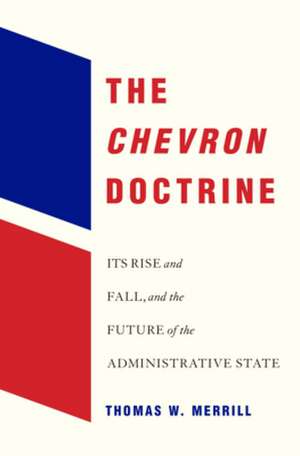
The Chevron Doctrine – Its Rise and Fall, and the Future of the Administrative State
Autor Thomas W. Merrillen Limba Engleză Hardback – 26 mai 2022
The Constitution makes Congress the principal federal lawmaker. But for a variety of reasons, including partisan gridlock, Congress increasingly fails to keep up with the challenges facing our society. Power has inevitably shifted to the executive branch agencies that interpret laws already on the books and to the courts that review the agencies' interpretations. Since the Supreme Court's 1984 decision in Chevron v. Natural Resources Defense Council, this judicial review has been highly deferential: courts must uphold agency interpretations of unclear laws as long as these interpretations are "reasonable." But the Chevron doctrine faces backlash from constitutional scholars and, now, from Supreme Court justices who insist that courts, not administrative agencies, have the authority to say what the law is. Critics of the administrative state also charge that Chevron deference enables unaccountable bureaucratic power. Thomas Merrill reviews the history and immense consequences of the Chevron doctrine and suggests a way forward. Recognizing that Congress cannot help relying on agencies to carry out laws, Merrill rejects the notion of discarding the administrative state. Instead, he focuses on what should be the proper relationship between agencies and courts in interpreting laws, given the strengths and weaknesses of these institutions. Courts are better at enforcing the rule of law and constitutional values; agencies have more policy expertise and receive more public input. And, unlike courts, agencies are subject to at least some political discipline. The best solution, Merrill suggests, is not of the either-or variety. Neither executive agencies nor courts alone should pick up the slack of our increasingly ineffectual legislature.
| Toate formatele și edițiile | Preț | Express |
|---|---|---|
| Paperback (1) | 159.47 lei 3-5 săpt. | +22.25 lei 6-10 zile |
| Harvard University Press – 29 aug 2024 | 159.47 lei 3-5 săpt. | +22.25 lei 6-10 zile |
| Hardback (1) | 248.34 lei 3-5 săpt. | +31.80 lei 6-10 zile |
| Harvard University Press – 26 mai 2022 | 248.34 lei 3-5 săpt. | +31.80 lei 6-10 zile |
Preț: 248.34 lei
Nou
Puncte Express: 373
Preț estimativ în valută:
43.96€ • 51.18$ • 38.39£
43.96€ • 51.18$ • 38.39£
Carte disponibilă
Livrare economică 31 decembrie 25 - 14 ianuarie 26
Livrare express 16-20 decembrie pentru 41.79 lei
Preluare comenzi: 021 569.72.76
Specificații
ISBN-13: 9780674260450
ISBN-10: 0674260457
Pagini: 368
Dimensiuni: 167 x 242 x 35 mm
Greutate: 0.64 kg
Editura: Harvard University Press
ISBN-10: 0674260457
Pagini: 368
Dimensiuni: 167 x 242 x 35 mm
Greutate: 0.64 kg
Editura: Harvard University Press
Notă biografică
Thomas W. Merrill is the Charles Evans Hughes Professor at Columbia Law School. A former Deputy Solicitor General in the Department of Justice, he is a member of the American Academy of Arts and Sciences and has twice been honored by the American Bar Association for his work on administrative law.
Descriere
Descriere de la o altă ediție sau format:
With Congress paralyzed, lawmaking falls to executive agencies and courts that interpret existing statutes. Due to the so-called Chevron doctrine, courts generally defer to agencies. Thomas Merrill examines the immense consequences of the doctrine and the intense backlash, offering a new way to conceptualize the authority of agencies and courts.
With Congress paralyzed, lawmaking falls to executive agencies and courts that interpret existing statutes. Due to the so-called Chevron doctrine, courts generally defer to agencies. Thomas Merrill examines the immense consequences of the doctrine and the intense backlash, offering a new way to conceptualize the authority of agencies and courts.