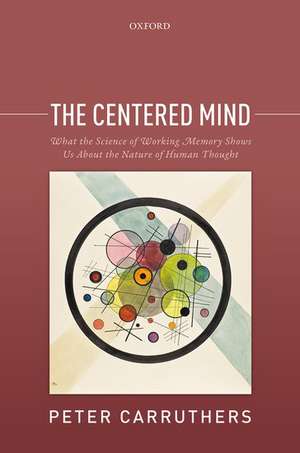
The Centered Mind: What the Science of Working Memory Shows Us About the Nature of Human Thought
Autor Peter Carruthersen Limba Engleză Hardback – 23 iul 2015
Preț: 540.63 lei
Preț vechi: 781.23 lei
-31%
Puncte Express: 811
Carte tipărită la comandă
Livrare economică 27 noiembrie-08 decembrie
Livrare prin curier în România Termenul estimat este afișat lângă disponibilitate.
Transport gratuit pentru acest produs Plată online sau ramburs, în funcție de opțiunile comenzii.
Retur gratuit în 14 zile Comandă securizată și suport în română.
Specificații
ISBN-13: 9780198738824
ISBN-10: 019873882X
Pagini: 304
Dimensiuni: 162 x 235 x 27 mm
Greutate: 0.6 kg
Editura: OUP OXFORD
Colecția OUP Oxford
Locul publicării:Oxford, United Kingdom
ISBN-10: 019873882X
Pagini: 304
Dimensiuni: 162 x 235 x 27 mm
Greutate: 0.6 kg
Editura: OUP OXFORD
Colecția OUP Oxford
Locul publicării:Oxford, United Kingdom
V-ar putea interesa
-
 -34%Preț: 584.07 lei888.00 lei
 -
 Preț: 278.27 lei
 -
 -24%Preț: 377.48 lei497.17 lei
 -
 -24%Preț: 571.05 lei755.13 lei
 -
 Consciousness and Moral ResponsibilityNeil Levy-29%Preț: 390.70 lei546.55 lei
 -
 Utilitarianism: A Very Short IntroductionKatarzyna de Lazari-Radek-20%Preț: 57.12 lei71.12 lei
 -
 -31%Preț: 590.64 lei855.00 lei
 -
 Virtue and Law in Plato and BeyondJulia Annas-29%Preț: 536.74 lei751.61 lei
 -
 Neuroethics: Anticipating the futureJudy Illes-30%Preț: 818.15 lei1174.82 lei
 -
 -31%Preț: 556.48 lei807.13 lei
 -
 -28%Preț: 374.87 lei522.91 lei
 -
 -22%Preț: 285.24 lei366.19 lei
 -
 Philosophical Progress: In Defence of a Reasonable OptimismDaniel Stoljar-30%Preț: 404.73 lei578.24 lei
 -
 Oxford Studies in Metaethics 12Russ Shafer-Landau-19%Preț: 300.26 lei368.76 lei
 -
 -31%Preț: 642.99 lei926.34 lei
 -
 Doing and Allowing HarmFiona Woollard-31%Preț: 608.80 lei882.31 lei
 -
 Ethical LifeWebb KeanePreț: 213.90 lei
 -
 Thinking about BriberyPhilip Nichols-27%Preț: 280.60 lei383.39 lei
 -
 Moral and Political Conceptions of Human RightsReidar Maliks-14%Preț: 746.46 lei867.98 lei
 -
 The Cambridge Handbook of Evolutionary EthicsMichael RusePreț: 252.58 lei
 -
 -15%Preț: 459.23 lei540.27 lei
 -
 The Blackwell Guide to Kant's EthicsThomas E. HillPreț: 359.51 lei
 -
 Preț: 249.03 lei
Recenzii
This impressive, if difficult, book of 'theoretical psychology' critically integrates results from across the cognitive sciences into a theory of 'reflection'. ... [Carruthers] systematizes and advances 'global workspace' theories in the most comprehensive philosophical study yet of the sciences of 'working memory' ... Even readers who disagree with Carruthers' central claims will enjoy his rich discussions along the way of attention, motor imagery, temporal discounting, mind-wandering and creativity, fluid intelligence, animal cognition, and extended minds.
a good example of the genre, meriting careful study from anyone interested in reflection and the stream of consciousness. Carruthers writes clearly and engagingly. He treats his traditional targets with respect. He presents an impressive array of empirical research while both getting into the details and fitting them all into an intelligible order. His aim throughout is to help us better understand the things themselves--reflection and the stream of consciousness -- not to grind some metaphilosophical axe ... I found reading his book and engaging with his reasoning to be instructive and illuminating.
Although the stream of consciousness seems intimately familiar to us, its underlying nature has been an enduring philosophical and psychological mystery. Carruthers presents a clear and deeply radical solution to this mystery, drawing together a massive array of empirical research in support of an attractively simple sensory-based account of conscious thought. He takes bold positions on a wide range of related issues, including the line between mental activity and passivity, the relationship between working memory and reflective thought, and the gap between our intuitive impressions of our conscious states and the real contents of those states themselves. For those who are curious about these questions, The Centered Mind is a terrific and accessible guide; for those who are already specialists in conscious thought, this book sets the agenda of future research.
Peter Carruthers has long been one of our foremost empirically informed philosophers of mind. In this book, he presents a persuasive account of the mechanisms underlying conscious thought and reasoning. Carruthers integrates a wealth of empirical work in the cognitive sciences to develop a novel conception of working memory as the heart of conscious thought and reasoning. Philosophically sophisticated and steeped in psychology and neuroscience, The Centered Mind is essential reading for philosophers and for cognitive scientists concerned with the nature of consciousness and the nature, powers and limits of conscious reasoning.
a good example of the genre, meriting careful study from anyone interested in reflection and the stream of consciousness. Carruthers writes clearly and engagingly. He treats his traditional targets with respect. He presents an impressive array of empirical research while both getting into the details and fitting them all into an intelligible order. His aim throughout is to help us better understand the things themselves--reflection and the stream of consciousness -- not to grind some metaphilosophical axe ... I found reading his book and engaging with his reasoning to be instructive and illuminating.
Although the stream of consciousness seems intimately familiar to us, its underlying nature has been an enduring philosophical and psychological mystery. Carruthers presents a clear and deeply radical solution to this mystery, drawing together a massive array of empirical research in support of an attractively simple sensory-based account of conscious thought. He takes bold positions on a wide range of related issues, including the line between mental activity and passivity, the relationship between working memory and reflective thought, and the gap between our intuitive impressions of our conscious states and the real contents of those states themselves. For those who are curious about these questions, The Centered Mind is a terrific and accessible guide; for those who are already specialists in conscious thought, this book sets the agenda of future research.
Peter Carruthers has long been one of our foremost empirically informed philosophers of mind. In this book, he presents a persuasive account of the mechanisms underlying conscious thought and reasoning. Carruthers integrates a wealth of empirical work in the cognitive sciences to develop a novel conception of working memory as the heart of conscious thought and reasoning. Philosophically sophisticated and steeped in psychology and neuroscience, The Centered Mind is essential reading for philosophers and for cognitive scientists concerned with the nature of consciousness and the nature, powers and limits of conscious reasoning.
Notă biografică
Peter Carruthers is Professor of Philosophy at the University of Maryland. He is the author of numerous articles and books in philosophy of mind and cognitive science, and has co-edited seven volumes of interdisciplinary essays in cognitive science.