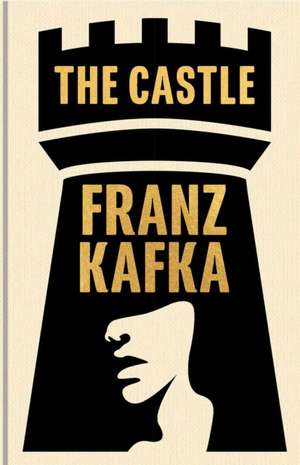
The Castle
Autor Franz Kafka Traducere de Debra De-Jongen Limba Engleză Hardback – 2 iun 2026
This elegant pocket-sized gift edition contains a new translation by Debra De-Jong and is presented with an embossed cover design, ivory pages, beautifully designed endpapers and gold gilded page edges. Part of the Arcturus Ornate Classics series, this book makes wonderful gift for any lover of classic literature.
ABOUT THE SERIES: Arcturus Ornate Classics are beautiful pocket editions of iconic literary works from across history. Presented with striking foil cover embossing, gilded page edges, and deluxe ivory paper, these editions make the perfect gift for lovers of classic literature.
Preț: 75.59 lei
Puncte Express: 113
Carte disponibilă
Livrare economică 13-27 noiembrie
Livrare prin curier în România Termenul estimat este afișat lângă disponibilitate.
Transport gratuit de la 400.00 lei Plată online sau ramburs, în funcție de opțiunile comenzii.
Retur gratuit în 14 zile Comandă securizată și suport în română.
Specificații
ISBN-13: 9781398866201
ISBN-10: 1398866202
Pagini: 256
Dimensiuni: 110 x 169 x 21 mm
Greutate: 0.25 kg
Editura: Arcturus Publishing
ISBN-10: 1398866202
Pagini: 256
Dimensiuni: 110 x 169 x 21 mm
Greutate: 0.25 kg
Editura: Arcturus Publishing
V-ar putea interesa
-
 The Complete NovelsFranz Kafka-25%Preț: 103.16 lei138.39 lei
 -
 Kafka: A Very Short IntroductionRitchie Robertson-20%Preț: 55.70 lei69.81 lei
 -
 The CastleFranz KafkaPreț: 59.46 lei
 -
 The Metamorphosis and Other StoriesFranz KafkaPreț: 51.77 lei
 -
 The Metamorphosis and Other StoriesFranz Kafka-19%Preț: 23.12 lei28.58 lei
 -
 Best Short StoriesFranz Kafka-19%Preț: 71.47 lei88.51 lei
 -
 Franz Kafka Metamorphosis & Castle Tote BagOut Of PrintPreț: 150.63 lei
 -
 -29%Preț: 67.64 lei94.91 lei
 -
 The Complete StoriesFranz KafkaPreț: 118.06 lei
 -
 In the Penal Colony and Other StoriesFranz KafkaPreț: 57.38 lei
 -
 A Country DoctorFranz KafkaPreț: 47.70 lei
 -
 The TrialFranz KafkaPreț: 43.19 lei
 -
 The MetamorphosisFranz KafkaPreț: 32.57 lei
 -
 The Castle: A NovelSeth RogoffPreț: 104.41 lei
 -
 Metamorphoses: In Search of Franz KafkaKarolina Watroba-19%Preț: 63.97 lei78.90 lei
 -
 The Unhappiness of Being a Single ManFranz KafkaPreț: 71.69 lei
 -
 Best of Kafka (Collector's Edition)Franz KafkaPreț: 78.69 lei
 -
 The CastleDavid Zane-11%Preț: 80.44 lei90.74 lei
 -
 Lovers of Franz K.Burhan Sonmez-20%Preț: 74.64 lei92.88 lei
Descriere
Descriere de la o altă ediție sau format:
A darkly comic novel from one of the greatest writers of the twentieth century, The Castle follows a man grappling with his inscrutable new master's authority, now freshly repackaged for the Union Square & Co. Signature Classics Line. Published posthumously in 1926, The Castle is Franz Kafka's final, unfinished novel, and a dark, surrealistic exploration of bureaucracy and alienation. Known or its absurdity and labrinthine plot, the novel follows a land surveyor known as "K" who, after moving for work, is drawn to a mysterious yet inaccessible castle that governs his new village. Irving Howe praised the book as projecting "a greater strength of will than we have encountered in Kafka’s earlier writings—an effort to overcome the muteness of existence.”
A darkly comic novel from one of the greatest writers of the twentieth century, The Castle follows a man grappling with his inscrutable new master's authority, now freshly repackaged for the Union Square & Co. Signature Classics Line. Published posthumously in 1926, The Castle is Franz Kafka's final, unfinished novel, and a dark, surrealistic exploration of bureaucracy and alienation. Known or its absurdity and labrinthine plot, the novel follows a land surveyor known as "K" who, after moving for work, is drawn to a mysterious yet inaccessible castle that governs his new village. Irving Howe praised the book as projecting "a greater strength of will than we have encountered in Kafka’s earlier writings—an effort to overcome the muteness of existence.”
Recenzii
“Of all Kafka’s fiction this is the most personal. K. is not of course a mouthpiece for Kafka–he lacks Kafka’s grave intelligence and humor–but his inner conflict between a taste for ordinary life and the demands imposed by his quest were in good part shared by Kafka . . . The Castle projects a greater strength of will than we have encountered in Kafka’s earlier writings–an effort to overcome the muteness of existence.” –from the Introduction by Irving Howe