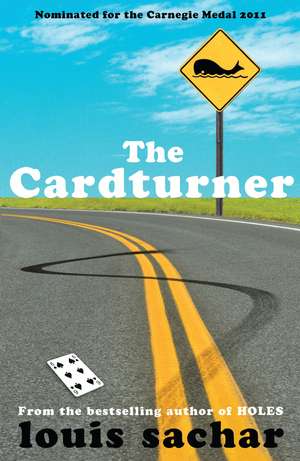
The Cardturner
Autor Louis Sacharen Limba Engleză Paperback – 9 aug 2011
Observăm că, deși bridge-ul poate părea la prima vedere un subiect arid pentru adolescenți, în mâinile unui narator precum Louis Sachar, acesta devine scena unei lecții de viață fascinante. Copiii care au iubit Pay Attention, Carter Jones de Gary D. Schmidt vor găsi aici aceeași dinamică subtilă între un tânăr aflat la răscruce și o figură autoritară excentrică, într-un context marcat de umor și descoperire de sine. Dacă în seria Wayside School autorul explora absurdul și suprarealismul mediului școlar, în The Cardturner el ancorează povestea într-o realitate mai matură, păstrând însă acea simplitate a prozei care l-a consacrat. Suntem de părere că forța acestui roman stă în modul în care Alton, un tânăr de 17 ani rămas fără perspective după o despărțire și presat de părinți să „vâneze” o moștenire, descoperă profunzimea în spatele unor cărți de joc și a unui unchi dificil. Louis Sachar demonstrează o măiestrie narativă discretă, construind o intrigă unde fiecare mână de bridge reflectă complexitatea relațiilor umane. Credem că este o lectură care reușește să transforme un joc de strategie într-o metaforă pentru deciziile pe care le luăm în viață, totul fiind presărat cu misterul legat de familia Castaneda și de trecutul unchiului Lester. Stilul este fluid, tonul este cald și sincer, oferind o perspectivă empatică asupra modului în care generațiile pot învăța una de la cealaltă atunci când sunt forțate de împrejurări să colaboreze.
Preț: 44.50 lei
Preț vechi: 65.69 lei
-32%
Carte disponibilă
Livrare economică 09-23 noiembrie
Livrare express 23-29 octombrie pentru 43.07 lei
Specificații
ISBN-10: 140880851X
Pagini: 352
Dimensiuni: 128 x 196 x 24 mm
Greutate: 0.25 kg
Editura: Bloomsbury Publishing
Locul publicării:London, United Kingdom
De ce să citești această carte
Recomandăm această carte adolescenților de peste 14 ani și părinților care caută o poveste despre maturizare ce depășește clișeele obișnuite. Cititorul va câștiga nu doar o introducere ingenioasă în universul bridge-ului, ci și o reflecție valoroasă despre integritate, loialitate și găsirea propriului drum. Este un roman despre cum să joci cel mai bine „cărțile” pe care ți le oferă destinul, scris de un autor premiat internațional.
Despre autor
Louis Sachar este un autor american de renume, specializat în literatură pentru copii și adolescenți, cunoscut la nivel mondial pentru stilul său care îmbină comedia cu misterul. Cariera sa este marcată de succese răsunătoare, fiind autorul celebrului roman „Holes”, care a câștigat National Book Award și Newbery Medal în 1999. Recunoscut pentru capacitatea de a crea universuri memorabile, de la școala bizară din seria Wayside School până la poveștile pline de profunzime emoțională din lucrări precum The Cardturner, Sachar este unul dintre cei mai apreciați scriitori contemporani, fiind nominalizat frecvent la distincții literare de prestigiu, precum Carnegie Medal.
Descriere
But, like all apparently casual choices in any of Louis Sachar's wonderful books, this choice soon turns out to be a lot more complex than Alton could ever have imagined. As his relationship with his uncle develops, and he meets the very attractive Toni, deeply buried secrets are uncovered and a romance that spans decades is finally brought to conclusion.
Alton's mother is in for a surprise!
Recenzii
This is Sachar, owner of the most distinctive, clever, funny, philosophical voice in children's fiction . . . a whale symbol on the page warns of forthcoming bridge analysis, which the readers can skip if they want. But they probably won't. Because this is Sachar
In Alton Richards, Sachar has created a credible and funny teenage lead . . . The human drama is gripping
The genius of Sachar's prose is that it's so plain and unshowy you don't notice the daredevil artistry of his storytelling until it's too late. You don't know you've been cut in half until you try to walk away . . . As Uncle Lester might say, nicely played, Louis
Notă biografică
Extras
My Favorite Uncle
Ever since I was a little kid, I've had it drilled into me that my uncle Lester was my favorite uncle. My mother would thrust the phone at me and say, "Uncle Lester wants to talk to you," her voice infused with the same forced enthusiasm she used to describe the deliciousness of canned peas. "Tell him you love him."
"I love you, Uncle Lester," I'd say.
"Tell him he's your favorite uncle."
"You're my favorite uncle."
It got worse as I got older. I never knew what to say to him, and he never seemed all that interested in talking to me. When I became a teenager I felt silly telling him he was my favorite uncle, although my mother still urged me to do so. I'd say things like "Hey, how's it goin'?" and he'd grunt some response. He might ask me a question about school. I imagine it was a great relief to both of us when my mother took back the phone. Our brief conversations always left me feeling embarrassed, and just a little bit creepy.
He was actually my great-uncle, having been my mother's favorite uncle long before he was mine.
I didn't know how much money he had, but he was rich enough that he never had to be nice to anyone. Our favorite uncle never visited us, and I think my mother initiated all the phone conversations with him. Later, after he got really sick, he wouldn't even talk to her. My mother would call almost daily, but she could never get past his housekeeper. I had only met Uncle Lester face to face one time, at his sixty-fifth birthday party. I was six years old, and to me, his house seemed like a castle on a mountaintop. I said the obligatory "Happy birthday" and "I love you" and "You're my favorite uncle" and then steered clear of him.
"His heart is as cold as a brick," my father said on the drive home.
That phrase has stuck with me, I think, because my father used the word cold instead of hard.
My elementary school was a brick building. Every day on the way home, I would drag my fingers over the hard, and yes, cold surface.
I'm in high school now, but still whenever I walk by a brick building, I feel compelled to touch it. Even now, as I write this, I can almost feel the hard coolness, the sharp edges, and the roughness of the cement between the bricks.
From the Hardcover edition.