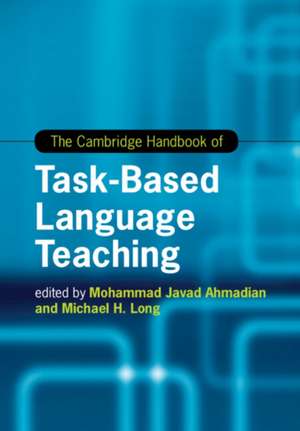
The Cambridge Handbook of Task-Based Language Teaching: Cambridge Handbooks in Language and Linguistics
Editat de Mohammad Javad Ahmadian, Michael H. Longen Limba Engleză Paperback – 13 iun 2024
| Toate formatele și edițiile | Preț | Express |
|---|---|---|
| Paperback (1) | 304.73 lei 3-5 săpt. | +55.60 lei 7-13 zile |
| Cambridge University Press – 13 iun 2024 | 304.73 lei 3-5 săpt. | +55.60 lei 7-13 zile |
| Hardback (1) | 970.04 lei 3-5 săpt. | +78.00 lei 7-13 zile |
| Cambridge University Press – 8 dec 2021 | 970.04 lei 3-5 săpt. | +78.00 lei 7-13 zile |
Din seria Cambridge Handbooks in Language and Linguistics
-
 Preț: 292.84 lei
 -
 Preț: 422.49 lei
 -
 Preț: 304.62 lei
 - 23%
 Preț: 1063.88 lei
 -
 Preț: 454.01 lei
 -
 Preț: 309.97 lei
 -
 Preț: 303.49 lei
 - 23%
 Preț: 1049.25 lei
 -
 Preț: 454.86 lei
 -
 Preț: 453.30 lei
 -
 Preț: 349.72 lei
 - 23%
 Preț: 1518.11 lei
 -
 Preț: 308.16 lei
 -
 Preț: 375.01 lei
 -
 Preț: 306.33 lei
 -
 Preț: 457.90 lei
 - 14%
 Preț: 952.75 lei
 - 23%
 Preț: 996.48 lei
 - 23%
 Preț: 1058.01 lei
 - 23%
 Preț: 1150.64 lei
 - 23%
 Preț: 1081.57 lei
 -
 Preț: 393.20 lei
 - 23%
 Preț: 1041.20 lei
 - 23%
 Preț: 765.44 lei
 -
 Preț: 475.91 lei
 - 11%
 Preț: 514.58 lei
 -
 Preț: 542.20 lei
 - 23%
 Preț: 1044.31 lei
 -
 Preț: 471.11 lei
 - 23%
 Preț: 1102.32 lei
 -
 Preț: 404.11 lei
 -
 Preț: 403.53 lei
 -
 Preț: 399.67 lei
 -
 Preț: 550.76 lei
 - 23%
 Preț: 1162.61 lei
 - 23%
 Preț: 1125.44 lei
 -
 Preț: 418.79 lei
 - 23%
 Preț: 905.83 lei
Preț: 304.73 lei
Nou
Puncte Express: 457
Preț estimativ în valută:
53.92€ • 62.89$ • 47.35£
53.92€ • 62.89$ • 47.35£
Carte disponibilă
Livrare economică 25 decembrie 25 - 08 ianuarie 26
Livrare express 11-17 decembrie pentru 65.59 lei
Preluare comenzi: 021 569.72.76
Specificații
ISBN-13: 9781108811934
ISBN-10: 1108811930
Pagini: 710
Dimensiuni: 170 x 244 x 38 mm
Greutate: 1.2 kg
Editura: Cambridge University Press
Seria Cambridge Handbooks in Language and Linguistics
ISBN-10: 1108811930
Pagini: 710
Dimensiuni: 170 x 244 x 38 mm
Greutate: 1.2 kg
Editura: Cambridge University Press
Seria Cambridge Handbooks in Language and Linguistics
Cuprins
Preface; Part I. The Rationale for TBLT: 1. The (unsatisfactory) status quo in language teaching: a psycholinguistic rationale for TBLT; 2. A pedagogic rationale for TBLT; Part II. Tasks and Needs Analysis: 3. Why tasks? Task as the unit of analysis in language education; 4. Adapting and advancing task-based needs analysis (NA) methodology across diverse language learning contexts; 4A. Developing a task-based approach: a case study of Australian Aboriginal VET students; 4B. A needs analysis for Syrian refugees in Turkey; 4C. TBLT in a Japanese university: from needs analysis to evaluation; 4D. The implementation of a task-based Spanish language program in Qingdao, China: a case study; 5. The L in TBLT: analyzing target discourse; 5A. Blustery with an occasional downpour: an analysis of target discourse in media weather forecasts; 5B. 'I have a question': A corpus-based analysis of target discourse in office hour interactions; Part III. The Task Syllabus and Materials: 6. The Cognition Hypothesis, the Triadic Componential Framework and the SSARC Model: an instructional design theory of pedagogic task sequencing; 7. From needs analysis to task selection, design, and sequencing; 7A. Task-based telecollaborative exchanges between US and Italian students: a case study in program design and implementation; 8. Exploring the nuts and bolts of task design; 8A. Designing pedagogic tasks for refugees learning English to enter universities in the Netherlands; Part IV. Methodology and Pedagogy: 9. A psycholinguistically motivated methodology for TBLT; 10. Technology-mediated TBLT; 10A. Task-based simulations for diplomatic security agents; 10B. Delivering TBLT at scale: a case study of a needs-based, technology-mediated workplace English program; 10C. TBLT and Indigenous Language Revitalisation; Part V. TBLT with School-age Children: 11. Children interacting in task-supported EFL/CLIL contexts; 11A. Tasks for children: using mainstream content to learn a language; 11B. A case study of a task-based approach for school-age learners in China; Part VI. The Teacher in TBLT: 12. Teacher preparation and support for TBLT; 12A. Connecting teacher training to TBLT implementation: a case study of pre-service teachers in Honduran bilingual schools; 12B. Training for tasks the cooperative way: an online tutored TBLT course for teachers, managers and course designers; Part VII. Task-Based Assessment and Program Evaluation: 13. Task-based, criterion-referenced performance testing; 14. TBLT program evaluation: why and how; 14A. Comparing the effectiveness of TBLT and PPP on L2 grammar learning: a pilot study with Chinese students of Italian L2; 14B. Evaluating the pilot year of a task-based Spanish immersion camp for high schoolers: examining learners' experience of task motivation and difficulty within and following tasks; 14C. Designing a classroom-based TBLA framework for primary schools: blurring the lines between teaching, learning and assessment; Part VIII. Research Needs and Future Prospects: 15. Methodological issues in (cognitively-oriented) TBLT research: advances and challenges; 16. Innovation in language education: a task-based perspective; 17. The adoption of TBLT in diverse contexts: challenges and opportunities; Conclusion.