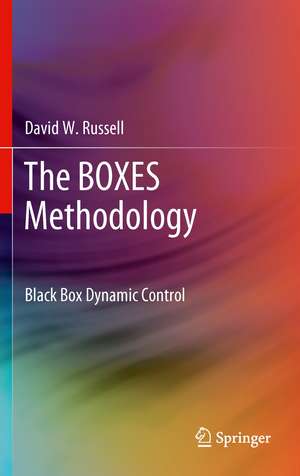
The BOXES Methodology: Black Box Dynamic Control
Autor David W. Russellen Limba Engleză Hardback – 14 mar 2012
Michie and Chambers’ BOXES methodology created a black box system that was designed to control a mechanically unstable system with very little a priori system knowledge, linearization or approximation. All the method needed was some notion of maximum and minimum values for the state variables and a set of boundaries that divided each variable into an integer state number. The BOXES Methodology applies the method to a variety of systems including continuous and chaotic dynamic systems, and discusses how it may be possible to create a generic control method that is self organizing and adaptive that learns with the assistance of near neighbouring states.
The BOXES Methodology introduces students at the undergraduate and master’s level to black box dynamic system control , and gives lecturers access to background materials that can be used in their courses in support of student research and classroom presentations in novel control systems and real-time applications of artificial intelligence. Designersare provided with a novel method of optimization and controller design when the equations of a system are difficult or unknown. Researchers interested in artificial intelligence (AI) research and models of the brain and practitioners from other areas of biology and technology are given an insight into how AI software can be written and adapted to operate in real-time.
Preț: 555.97 lei
Preț vechi: 797.67 lei
-30%
Puncte Express: 834
Carte indisponibilă temporar
Livrare prin curier în România Termenul estimat este afișat lângă disponibilitate.
Transport gratuit pentru acest produs Plată online sau ramburs, în funcție de opțiunile comenzii.
Retur gratuit în 14 zile Comandă securizată și suport în română.
Specificații
ISBN-13: 9781849965279
ISBN-10: 1849965277
Pagini: 224
Ilustrații: XXII, 226 p.
Dimensiuni: 155 x 235 x 18 mm
Greutate: 0.48 kg
Ediția:2012
Editura: SPRINGER LONDON
Colecția Springer
Locul publicării:London, United Kingdom
ISBN-10: 1849965277
Pagini: 224
Ilustrații: XXII, 226 p.
Dimensiuni: 155 x 235 x 18 mm
Greutate: 0.48 kg
Ediția:2012
Editura: SPRINGER LONDON
Colecția Springer
Locul publicării:London, United Kingdom
V-ar putea interesa
-
 -39%Preț: 359.16 lei590.66 lei
 -
 -38%Preț: 160.69 lei260.20 lei
 -
 Computational Principles of Mobile RoboticsGregory Dudek-20%Preț: 350.17 lei437.35 lei
 -
 Handbook of Hybrid Systems ControlJan Lunze-14%Preț: 956.13 lei1111.79 lei
 -
 Fundamentals of Object TrackingSubhash Challa-11%Preț: 694.29 lei780.11 lei
 -
 Nonlinear Dynamical Systems and ControlWassim M. Haddad-23%Preț: 1038.34 lei1348.49 lei
 -
 Beginning Arduino ProgrammingBrian EvansPreț: 367.74 lei
 -
 Biologically Inspired RoboticsYunhui Liu-18%Preț: 1124.23 lei1371.02 lei
 -
 Make: Arduino Bots and GadgetsTero KarvinenPreț: 210.49 lei
 -
 The Unofficial Lego Mindstorms Nxt 2.0 Inventor's GuideDavid J. PerduePreț: 156.37 lei
 -
 The LEGO Technic Idea Book: Simple MachinesYoshihito Isogawa-19%Preț: 133.26 lei163.69 lei
 -
 The LEGO Technic Idea Book: Wheeled WondersYoshihito Isogawa-19%Preț: 110.64 lei136.05 lei
Public țintă
ResearchCuprins
Chapter 1: Introduction.- Part I: Learning and Artificial Intelligence (AI).- Chapter 2: The Game Metaphor.- Chapter 3: Introduction to BOXES.- Chapter 4: Dynamic control as a game.- Part II: The Trolley and Pole.- Chapter 5: Control of a simulated inverted pendulum using the BOXES method.- Chapter 6: The Liverpool experiment.- Chapter 7: Solving the auto-start dilemma.- Part III: Other BOXES applications.- Chapter 8: Continuous system control.- Chapter 9: Other on/off control case studies.- Chapter 10: Two non-linear applications.- Part IV: Improving the Algorithm.- Chapter 11: Accelerated learning.- Chapter 12: Two advising paradigms.- Chapter 13: Evolutionary studies research.- Chapter 14: Conclusions
Notă biografică
David W. Russell, Ph.D, C.Eng, FBCS, FIET, FIMechE, is a Professor of Electrical Engineering at Penn State Great Valley, Pennsylvania, USA. His research interests include: applications of artificial intelligence (AI) to real-time, poorly defined control systems, systems engineering, factory information systems, philosophy of machine intelligence, and chaos theory and applications. He has lectured worldwide for many years and has over 30 papers based around the BOXES methodology.
Caracteristici
Suggests a generic BOXES coefficient that would make the system almost completely application-independent Highlights potential flaws in the system Describes how system flaws can be mitigated Includes supplementary material: sn.pub/extras
Descriere
Descriere de la o altă ediție sau format:
Robust control mechanisms customarily require knowledge of the system’s describing equations which may be of the high order differential type. In order to produce these equations, mathematical models can often be derived and correlated with measured dynamic behavior. There are two flaws in this approach one is the level of inexactness introduced by linearizations and the other when no model is apparent. Several years ago a new genre of control systems came to light that are much less dependent on differential models such as fuzzy logic and genetic algorithms. Both of these soft computing solutions require quite considerable a priori system knowledge to create a control scheme and sometimes complicated training program before they can be implemented in a real world dynamic system.
Michie and Chambers’ BOXES methodology created a black box system that was designed to control a mechanically unstable system with very little a priori system knowledge, linearization or approximation. All the method needed was some notion of maximum and minimum values for the state variables and a set of boundaries that divided each variable into an integer state number. The BOXES Methodologyapplies the method to a variety of systems including continuous and chaotic dynamic systems, and discusses how it may be possible to create a generic control method that is self organizing and adaptive that learns with the assistance of near neighbouring states.
The BOXES Methodologyintroduces students at the undergraduate and master’s level to black box dynamic system control , and gives lecturers access to background materials that can be used in their courses in support of student research and classroom presentations in novel control systems and real-time applications of artificial intelligence. Designers are provided with a novel method of optimization and controller design when the equations of a system are difficult or unknown. Researchers interested in artificial intelligence (AI) research and models of the brain and practitioners from other areas of biology and technology are given an insight into how AI software can be written and adapted to operate in real-time.
Robust control mechanisms customarily require knowledge of the system’s describing equations which may be of the high order differential type. In order to produce these equations, mathematical models can often be derived and correlated with measured dynamic behavior. There are two flaws in this approach one is the level of inexactness introduced by linearizations and the other when no model is apparent. Several years ago a new genre of control systems came to light that are much less dependent on differential models such as fuzzy logic and genetic algorithms. Both of these soft computing solutions require quite considerable a priori system knowledge to create a control scheme and sometimes complicated training program before they can be implemented in a real world dynamic system.
Michie and Chambers’ BOXES methodology created a black box system that was designed to control a mechanically unstable system with very little a priori system knowledge, linearization or approximation. All the method needed was some notion of maximum and minimum values for the state variables and a set of boundaries that divided each variable into an integer state number. The BOXES Methodologyapplies the method to a variety of systems including continuous and chaotic dynamic systems, and discusses how it may be possible to create a generic control method that is self organizing and adaptive that learns with the assistance of near neighbouring states.
The BOXES Methodologyintroduces students at the undergraduate and master’s level to black box dynamic system control , and gives lecturers access to background materials that can be used in their courses in support of student research and classroom presentations in novel control systems and real-time applications of artificial intelligence. Designers are provided with a novel method of optimization and controller design when the equations of a system are difficult or unknown. Researchers interested in artificial intelligence (AI) research and models of the brain and practitioners from other areas of biology and technology are given an insight into how AI software can be written and adapted to operate in real-time.