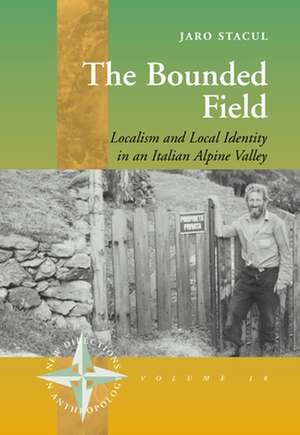
The Bounded Field
Autor Jaro Staculen Limba Engleză Hardback – noi 2003
Preț: 756.79 lei
Preț vechi: 982.84 lei
-23%
Puncte Express: 1135
Carte tipărită la comandă
Livrare economică 11-25 noiembrie
Livrare prin curier în România Termenul estimat este afișat lângă disponibilitate.
Transport gratuit pentru acest produs Plată online sau ramburs, în funcție de opțiunile comenzii.
Retur gratuit în 14 zile Comandă securizată și suport în română.
Specificații
ISBN-13: 9781571814630
ISBN-10: 1571814639
Pagini: 224
Dimensiuni: 157 x 235 x 17 mm
Greutate: 0.5 kg
Editura: BERGHAHN BOOKS
ISBN-10: 1571814639
Pagini: 224
Dimensiuni: 157 x 235 x 17 mm
Greutate: 0.5 kg
Editura: BERGHAHN BOOKS
V-ar putea interesa
-
 The Invention of the Jewish Gaucho: Villa Clara and the Construction of Argentine IdentityJudith Noemí FreidenbergPreț: 166.93 lei
 -
 Population Policy and Reproduction in Singapore: Making Future CitizensShirley Hsiao-Li Sun-18%Preț: 1252.01 lei1526.85 lei
 -
 Ethnography and the City: Readings on Doing Urban FieldworkRichard E. Ocejo-8%Preț: 560.31 lei609.02 lei
 -
 The Green LeapMark HostetlerPreț: 273.30 lei
 -
 The CityDeborah StevensonPreț: 185.39 lei
 -
 Land of StrangersAsh AminPreț: 185.66 lei
 -
 Urban ChinaXuefei RenPreț: 193.21 lei
 -
 Tuff CityNick Dines-23%Preț: 844.52 lei1096.78 lei
 -
 Why Cows Learn DutchJamesPreț: 138.74 lei
 -
 The New Blackwell Companion to the CityGary BridgePreț: 412.30 lei
 -
 BuzzLisa Jean MoorePreț: 265.96 lei
 -
 Rethinking the Informal CityFelipe Hernández-23%Preț: 758.11 lei984.56 lei
 -
 Preț: 274.23 lei
Notă biografică
Jaro Stacul obtained a Ph.D in Social Anthropology from the University of Cambridge. He has been a Lecturer in Anthropology at the University of Wales Swansea, and currently is Visiting Assistant Professor in the Department of Anthropology at Memorial University of Newfoundland, Canada.
Cuprins
List of Illustrations
Note on Language
Preface and Acknowledgements
Chapter 1. Introducing Localism
Chapter 2. The Setting and its Historical Background
Chapter 3. A Private Space: The Present-day Organisation of Village Life
Chapter 4. Knowing One's Land: Hunters and Poachers
Chapter 5. The View from Below: Constructions of Otherness
Chapter 6. Natural Time, Political Time: Representations of History
Chapter 7. Local Politics in Theory and Practice
Chapter 8. Conclusions: Localism Revisited
Appendices
References
Index
Note on Language
Preface and Acknowledgements
Chapter 1. Introducing Localism
Chapter 2. The Setting and its Historical Background
Chapter 3. A Private Space: The Present-day Organisation of Village Life
Chapter 4. Knowing One's Land: Hunters and Poachers
Chapter 5. The View from Below: Constructions of Otherness
Chapter 6. Natural Time, Political Time: Representations of History
Chapter 7. Local Politics in Theory and Practice
Chapter 8. Conclusions: Localism Revisited
Appendices
References
Index