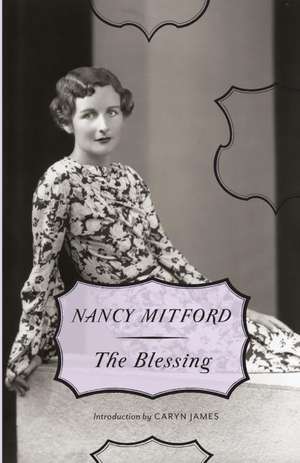
The Blessing
Autor Nancy Mitforden Limba Engleză Paperback – 10 aug 2010
Ce se întâmplă atunci când idealul romantic englezesc se lovește frontal de pragmatismul libertin al aristocrației franceze? În The Blessing, descoperim povestea lui Grace Allingham, o tânără englezoaică a cărei mutare în Franța alături de șarmantul Charles-Edouard devine o lecție brutală, dar hilară, despre diferențele culturale. Remarcăm rapid că miza nu este doar adaptarea la o bucătărie străină, ci acceptarea unei viziuni despre căsătorie care include, în mod firesc pentru soțul ei, o amantă permanentă și aventuri trecătoare. Atmosfera te trimite cu gândul la Le Mariage de Diane Johnson, deși perspectiva lui Nancy Mitford este mult mai ancorată în satira socială pură și în experiența personală a exilului său parizian. Apreciem în mod deosebit modul în care Mitford construiește dinamica familială prin ochii micului Sigismond. Spre deosebire de copiii din literatura clasică, „Sigi” nu este un liant pentru reconciliere, ci un mic strateg care își folosește viclenia pentru a-și menține părinții despărțiți, maximizându-și astfel propriile beneficii. Ritmul este alert, susținut de dialoguri tăioase și de o observație fină a moravurilor. Dacă în The Pursuit of Love autoarea explora entuziasmul căutării iubirii, aici ea analizează cu un cinism elegant ce rămâne după ce „fericirea până la adânci bătrâneți” este confruntată cu realitatea unei alte culturi. Este un roman despre neînțelegeri ridicate la rang de artă comică, scris cu acea strălucire specifică grupului „Bright Young Things” din care autoarea a făcut parte.
Preț: 113.61 lei
Carte disponibilă
Livrare economică 06-20 noiembrie
Specificații
ISBN-10: 0307740838
Pagini: 256
Dimensiuni: 133 x 202 x 23 mm
Greutate: 0.3 kg
Editura: PENGUIN RANDOM HOUSE LLC
V-ar putea interesa
-
 Madame de PompadourNancy Mitford-19%Preț: 58.33 lei71.82 lei
 -
 The Bonfire of the VanitiesTom Wolfe-15%Preț: 82.31 lei97.22 lei
 -
 Sound BitesAlex KapranosPreț: 90.85 lei
 -
 Preț: 109.04 lei
 -
 SpudJohn van de Ruit-25%Preț: 54.77 lei72.92 lei
 -
 -20%Preț: 39.92 lei49.73 lei
 -
 The Pursuit of LoveNancy MitfordPreț: 78.39 lei
 -
 Love In A Cold ClimateNancy Mitford-26%Preț: 58.16 lei78.67 lei
 -
 Don''t Tell AlfredNancy Mitford-26%Preț: 58.02 lei78.59 lei
 -
 Wigs on the GreenNancy Mitford-27%Preț: 57.02 lei77.99 lei
 -
 The Pursuit of LoveNancy MitfordPreț: 101.30 lei
 -
 Christmas Pudding & Pigeon PieNancy MitfordPreț: 125.35 lei
 -
 Marie AntoinetteLady Antonia Fraser-24%Preț: 94.45 lei124.80 lei
 -
 Love and Louis XIV: The Women in the Life of the Sun KingLady Antonia Fraser-26%Preț: 90.51 lei122.46 lei
 -
 Crazy Rich AsiansKevin KwanPreț: 74.54 lei
 -
 TamarMal PeetPreț: 68.62 lei
 -
 Mob DaughtersRicketta PrycePreț: 85.09 lei
 -
 Married, But Single Too!Carla BrownPreț: 77.67 lei
 -
 Sick ObsessionShawanda CarterPreț: 96.54 lei
 -
 A Toxic Love Affair Part 3Stacey FennerPreț: 69.70 lei
 -
 -26%Preț: 58.22 lei78.45 lei
 -
 -17%Preț: 103.27 lei124.30 lei
De ce să citești această carte
Recomandăm The Blessing cititorilor care savurează satira socială fină și poveștile despre ciocniri culturale. Este o lectură despre maturizare și despre complexitatea relațiilor moderne, unde umorul britanic întâlnește hedonismul francez. Cititorul câștigă o perspectivă amuzantă, dar onestă, asupra compromisurilor conjugale, totul într-un stil literar impecabil care a consacrat-o pe Nancy Mitford ca o voce critică a aristocrației.
Despre autor
Nancy Mitford (1904–1973) a fost o romancieră și biografă britanică, cea mai mare dintre celebrele surori Mitford și o figură centrală a scenei sociale londoneze interbelice. Deși a început să scrie fără o pregătire formală, reputația sa a fost consolidată de romanele semi-autobiografice The Pursuit of Love și Love in a Cold Climate. Stabilită în Franța după al Doilea Război Mondial, Mitford a transpus în opera sa propria experiență a relației cu ofițerul francez Gaston Palewski. A rămas celebră pentru spiritul său caustic și pentru teoretizarea distincției dintre limbajul „U” (upper class) și „non-U”, devenind o autoritate neoficială în materie de maniere și educație.
Notă biografică
Extras
‘The foreign gentleman seems to be in a terrible hurry, dear.’
And indeed the house, though quite large, what used to be called a family house, in Queen Anne’s Gate, was filled with sounds of impatience. Somebody was stamping about, moving furniture, throwing windows up and down, and clearing his throat exaggeratedly.
‘Ahem! Ahem!’
‘How long has he been here, Nanny?’
‘Nearly an hour I should think. He played the piano, very fast and loud, for a while, which seemed to keep him quiet. He’s only started this shindy since John went and told him you were in and would be down presently.’
‘You go, darling, and tell him he must wait while I change out of these trousers,’ said Grace, who was vigorously cleaning her neck with cotton wool. ‘Oh, the dirt. What I need is a bath.’
The drawing-room door was now flung open.
‘Do I see you or not?’ The voice was certainly foreign.
‘All right – very well. I’ll come down now, this minute.’
She looked at Nanny, laughing, and said, ‘He might go through the floor, like Rumpelstiltskin.’
But Nanny said, ‘Put on a dress dear, you can’t go down like that.’
‘Shall I come upstairs?’ said the voice.
‘No, don’t, here I am,’ and Grace ran down, still in her A.R.P.trousers.
The Frenchman, tall, dark and elegant, in French Air Force uniform, was on the drawing-room landing, both hands on the banister rail. He seemed about to uproot the delicate woodwork. When he saw Grace he said ‘Ah!’ as though her appearance caused him gratified surprise, then, ‘Is this a uniform? It’s not bad. Did you receive my note?’
‘Only now,’ said Grace. ‘I’ve been at the A.R.P. all day.’
They went into the drawing-room. ‘Your writing is very difficult. I was still puzzling over it when I heard all that noise – it was like the French Revolution. You must be a very impatient man.’
‘No. But I don’t like to be kept waiting, though this room has more compensations than most, I confess.’
‘I wouldn’t have kept you waiting if I’d known a little sooner – why didn’t you . . .’
He was no longer listening, he had turned to the pictures on the walls.
‘I do love this Olivier,’ he said. ‘You must give it to me.’
‘Except that it belongs to Papa.’
‘Ah yes, I suppose it does. Sir Conrad. He is very well known in the Middle East – I needn’t tell you, however. The Allingham Commission, ah! cunning Sir Conrad. He owes something to my country, after that.’ He turned from the picture to Grace looking at her rather as if she were a picture, and said, ‘Natoire, or Rosalba. You could be by either. Well, we shall see, and time will show.’
‘Papa loves France.’
‘I’m sure he does. The Englishmen who love France are always the worst.’
‘The worst?’
‘Each man kills the thing he loves, you know. Never mind.’
‘You’ve come from Cairo?’ she said. ‘I thought I read Cairo in your letter and something about Hughie? You saw him?’
‘The fiancé I saw.’
‘And you’ve come to give me news of him?’
‘Good news – that is to say no news. Why is this picture labeled Drouais?’
‘I suppose it is by Drouais,’ said Grace with perfect indifference.
Brought up among beautiful things, she took but small account of them.
‘Indeed? What makes you think so?’
‘Are you an art dealer?’
‘An art deal-ee.’
‘But you said you had news. Naturally I supposed it was the reason for your visit, to tell this news.’
‘Have you any milk chocolate?’
‘No, I’m sure we haven’t.’
‘Never mind.’
‘Would you like a cocktail – or a glass of sherry?’
‘Sherry, with delight.’
‘Did you enjoy Cairo? Hughie says it’s great fun.’
‘The museum is wonderful – but of course no pictures, while the millionaires, poor dears, have wonderful pictures, for which they’ve paid wonderful prices (from those ateliers where Renoirs and Van Goghs are painted on purpose for millionaires), but which hardly satisfy one’s cravings. Even their Corots are not always by Trouillebert. You see exactly how it is. So this afternoon I went to the National Gallery – shut. That is war. Now you will understand what an oasis I have found in Sir Conrad’s drawing-room, though I must have a word with him some time about this Drouais, so called.’
‘I’m afraid you won’t see many pictures in London now,’ said Grace. ‘Papa has sent all his best ones to the country, and most people have shut up their houses, you know.’
‘Never mind. I love London, even without pictures, and English women I love.’
‘Do you? Don’t we seem terribly dowdy?’
‘Of course. That’s what make you so amusing and mysterious. What can you possibly do, all day?’
‘Do?’
‘Yes. How do you fill those endless eons of time when Frenchwomen are having their hair washed, trying on hats, visiting the collections, discussing with the lingère – what is lingère in English?’
‘Underclothes-maker.’
‘Hours they spend with the underclothes-maker. What a funny word – are you sure? Anyhow, Frenchwomen always give one to understand that arranging themselves is full-time work. Now you English, like flowers in a basket, are not arranged, which is quite all right when the flowers are spring flowers.’ He gave her another long, approving look. ‘But how do you fill in the time? That is the great puzzle.’
‘I’m afraid,’ she said, laughing, ‘that we fill it in (not now, of course, but before the war) buying clothes and hats and having our hair washed. Perhaps the results were not quite the same, but I assure you that great efforts were made.’
‘Please don’t tell me. Do leave me in the dark, it makes you so much more interesting. Do let me go on believing that the hours drift by in a dream, that those blind blue eyes which see nothing, not even your father’s pictures, are turned inward upon some Anglo-Saxon fairyland of your own. Am I not right?’
He was quite right, though perhaps she hardly knew it herself.
Descriere scurtă
When Grace Allingham, a naïve young Englishwoman, goes to live in France with her dashingly aristocratic husband Charles-Edouard, she finds herself overwhelmed by the bewilderingly foreign cuisine and the shockingly decadent manners and mores of the French. But it is the discovery of her husband’s French notion of marriage—which includes a permanent mistress and a string of casual affairs—that sends Grace packing back to London with their “blessing,” young Sigismond, in tow. While others urge the couple to reconcile, little Sigi—convinced that it will improve his chances of being spoiled—applies all his juvenile cunning to keeping his parents apart. Drawing on her own years in Paris and her long affair with a Frenchman, Mitford elevates cultural and romantic misunderstandings to the heights of comedy.
Recenzii
“Mitford tells her story with much wit, intelligence, and polish.” —The Times (London)
“Deliciously funny.” —Evelyn Waugh