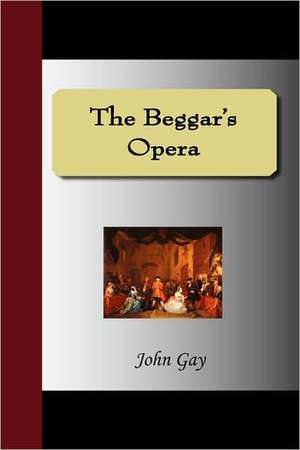
The Beggar's Opera
Autor John Gayen Limba Engleză Paperback – 22 oct 2007
Preț: 55.01 lei
Puncte Express: 83
Carte indisponibilă temporar
Livrare prin curier în România Termenul estimat este afișat lângă disponibilitate.
Transport gratuit de la 400.00 lei Plată online sau ramburs, în funcție de opțiunile comenzii.
Retur gratuit în 14 zile Comandă securizată și suport în română.
Specificații
ISBN-13: 9781595477941
ISBN-10: 1595477942
Pagini: 68
Dimensiuni: 152 x 229 x 4 mm
Greutate: 0.11 kg
Editura: NuVision Publications
Locul publicării:United States
ISBN-10: 1595477942
Pagini: 68
Dimensiuni: 152 x 229 x 4 mm
Greutate: 0.11 kg
Editura: NuVision Publications
Locul publicării:United States
V-ar putea interesa
-
 The Phantom of the OperaGaston LerouxPreț: 28.01 lei
 -
 Keep the Aspidistra FlyingGeorge Orwell-27%Preț: 52.63 lei71.65 lei
 -
 Jonathan WildHenry Fielding-17%Preț: 54.19 lei65.62 lei
 -
 She Stoops to Conquer and Other ComediesOliver Goldsmith-17%Preț: 67.00 lei80.66 lei
 -
 The Beggar's Opera and PollyJohn Gay-19%Preț: 52.70 lei64.76 lei
 -
 The Castrato and His WifeHelen BerryPreț: 184.13 lei
 -
 She Stoops to ConquerOliver Goldsmith-20%Preț: 22.68 lei28.26 lei
 -
 CandideVoltairePreț: 32.48 lei
 -
 The Changeling: Revised EditionThomas Middleton-18%Preț: 72.72 lei89.10 lei
 -
 The Way of the WorldWilliam CongrevePreț: 39.29 lei
 -
 The School for ScandalRichard Brinsley SheridanPreț: 40.07 lei
 -
 Rape of the LockAlexander PopePreț: 26.70 lei
 -
 The Country WifeWilliam Wycherley-35%Preț: 62.69 lei96.40 lei
 -
 The Ragged Trousered PhilanthropistsRobert TressellPreț: 28.01 lei
 -
 The Gilded StageDaniel Snowman-18%Preț: 189.61 lei230.48 lei
 -
 Oliver TwistCharles DickensPreț: 37.41 lei
 -
 The RoverAphra BehnPreț: 60.67 lei
 -
 Preț: 34.20 lei
 -
 Of Captain MissionDaniel DefoePreț: 62.35 lei
Notă biografică
Born in 1685, John Gay's first major success was THE SHEPHERD'S WEEK. It was followed by a number of other works, the most enduring of which is THE BEGGAR'S OPERA. Gay died in 1732, and is remembered as a popular and genial man whose self-penned epitaph reads 'Life is a jest, and all things show it, I thought it once, and now I know it'.
Descriere
Descriere de la o altă ediție sau format:
Mr. and Mrs. Peachum are horrified when they learn of their daughter Polly's secret marriage to the rebellious and notorious highwayman, Macheath. However, their fear is soon mitigated when they decide to kill him for his money. When Macheath is in the tavern, surrounded by women of 'ill repute', he discovers that he has been rumbled: two of these women are in cahoots with the Peachums and plan to kill him.
He finds himself in Newgate and, worse than that, in the company of the jailer's daughter, Lucy, to whom he is also betrothed. Although Macheath is captured and destined to be hanged, Gay's action-packed and entertaining play subverts audience expectations by letting Macheath off the hook and not punishing its villains.
John Gay's satirical opera, written in 1728, was revolutionary because it took poverty and corruption as its subject, and paupers and villains as its characters. The lyrics were set to famous songs of the day making it hugely popular with audiences and a radical departure from traditional opera.
The introduction puts the play in its historical and theatrical contexts and details its stage history in modern times too. David Lindley is an expert on theatrical music and the new dramatic form of ballad opera this play created. The music for the songs is included in the text, making this an edition to be used for performance as well as for study.
Mr. and Mrs. Peachum are horrified when they learn of their daughter Polly's secret marriage to the rebellious and notorious highwayman, Macheath. However, their fear is soon mitigated when they decide to kill him for his money. When Macheath is in the tavern, surrounded by women of 'ill repute', he discovers that he has been rumbled: two of these women are in cahoots with the Peachums and plan to kill him.
He finds himself in Newgate and, worse than that, in the company of the jailer's daughter, Lucy, to whom he is also betrothed. Although Macheath is captured and destined to be hanged, Gay's action-packed and entertaining play subverts audience expectations by letting Macheath off the hook and not punishing its villains.
John Gay's satirical opera, written in 1728, was revolutionary because it took poverty and corruption as its subject, and paupers and villains as its characters. The lyrics were set to famous songs of the day making it hugely popular with audiences and a radical departure from traditional opera.
The introduction puts the play in its historical and theatrical contexts and details its stage history in modern times too. David Lindley is an expert on theatrical music and the new dramatic form of ballad opera this play created. The music for the songs is included in the text, making this an edition to be used for performance as well as for study.