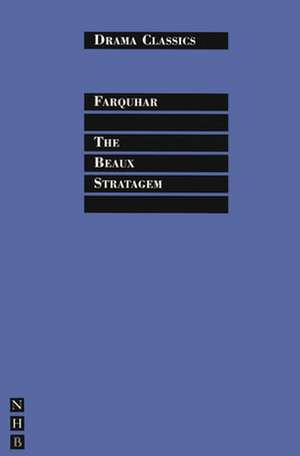
The Beaux' Stratagem: Drama Classics S.
Autor George Farquhar Editat de Simon Trussleren Limba Engleză Paperback – 29 feb 1996



Preț: 34.61 lei
Puncte Express: 52
Carte disponibilă
Livrare economică 09-23 noiembrie
Livrare prin curier în România Termenul estimat este afișat lângă disponibilitate.
Transport gratuit de la 400.00 lei Plată online sau ramburs, în funcție de opțiunile comenzii.
Retur gratuit în 14 zile Comandă securizată și suport în română.
Specificații
ISBN-13: 9781854591548
ISBN-10: 1854591541
Pagini: 128
Dimensiuni: 105 x 161 x 10 mm
Greutate: 0.1 kg
Ediția:Revised
Editura: NICK HERN BOOKS
Colecția Nick Hern Books
Seria Drama Classics S.
Locul publicării:United Kingdom
ISBN-10: 1854591541
Pagini: 128
Dimensiuni: 105 x 161 x 10 mm
Greutate: 0.1 kg
Ediția:Revised
Editura: NICK HERN BOOKS
Colecția Nick Hern Books
Seria Drama Classics S.
Locul publicării:United Kingdom
V-ar putea interesa
-
 The Works of George Farquhar: Volume IGeorge Farquhar-32%Preț: 1139.56 lei1679.91 lei
 -
 On MurderThomas De Quincey-18%Preț: 47.20 lei57.76 lei
 -
 -26%Preț: 176.69 lei237.83 lei
 -
 -23%Preț: 469.23 lei609.39 lei
 -
 Preț: 194.62 lei
 -
 Perspectives on Renaissance PoetryDr Robert C. Evans-25%Preț: 195.69 lei260.67 lei
 -
 August: Osage CountyTracy LettsPreț: 77.39 lei
 -
 When the Rain Stops FallingAndrew Bovell-13%Preț: 79.62 lei91.46 lei
 -
 Enda Walsh Plays: OneEnda WalshPreț: 133.40 lei
 -
 Be My BabyAmanda WhittingtonPreț: 79.18 lei
Descriere
Descriere de la o altă ediție sau format:
It attests to Farquhar's stature as a man that he composed this
warm-hearted and vibrant play while he was dying. Like The Recruiting
Officer, the play is set in a provincial town and its plot is slight:
Aimwell and Archer, two impecunious London gentlemen, arrive in
Lichfield looking for an heiress to marry. Aimwell, posing as his elder
brother, falls in love with his 'prey' Dorinda and confesses his
imposture to her; his 'man-servant' Archer arouses the wistful interest
of the unhappily married Mrs Sullen. The introduction to this edition
discusses the play for its theatrical merits and argues that it
dramatises the ills of marriage in early modern England, shown by
Farquhar to be more injurious to the wife than to the husband, and
calls for a reform of the divorce laws.
It attests to Farquhar's stature as a man that he composed this
warm-hearted and vibrant play while he was dying. Like The Recruiting
Officer, the play is set in a provincial town and its plot is slight:
Aimwell and Archer, two impecunious London gentlemen, arrive in
Lichfield looking for an heiress to marry. Aimwell, posing as his elder
brother, falls in love with his 'prey' Dorinda and confesses his
imposture to her; his 'man-servant' Archer arouses the wistful interest
of the unhappily married Mrs Sullen. The introduction to this edition
discusses the play for its theatrical merits and argues that it
dramatises the ills of marriage in early modern England, shown by
Farquhar to be more injurious to the wife than to the husband, and
calls for a reform of the divorce laws.