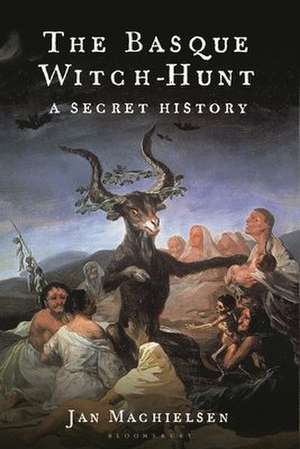
The Basque Witch-Hunt: A Secret History
Autor Dr Jan Machielsenen Limba Engleză Hardback – 3 oct 2024
In June 1609, two judges left Bordeaux for a territory at the very edge of their jurisdiction, a Basque-speaking province on the Atlantic coast called the Pays de Labourd. In four months, they executed up to 80 women and men for the crime of witchcraft, causing a wave of suspects to flee into Spain and sparking terror there. Witnesses, many of them children, described lurid tales of cannibalism, vampirism, and demonic sex. One of the judges, Pierre de Lancre, published a sensationalist account of this diabolical netherworld. With other accounts seemingly destroyed, this witch-hunt - France's largest - has always been seen through de Lancre's eyes. The narrative, re-told over the centuries, is that of a witch-hunt caused by a bigoted outsider.
Newly discovered evidence paints a very different, still darker picture, revealing a secret history underneath de Lancre's well-known tale. Far from an outside imposition, witchcraft was a home-grown problem. Panic had been building up over a number of years and the region was fractured by factionalism and a struggle over scarce resources. The Basque Witch-Hunt reveals that de Lancre was no outsider; he was a local partisan, married into the Basque nobility. Living at the Franco-Spanish border, the Basques were victims of geography. Geo-politics caused a local conflict which made the witch-hunt inevitable. The same forces eventually sent thousands of religious refugees from Spain to France where they, in turn, became new objects of popular fear and anger.
The Basque witch-hunt is justly infamous. This book shows that almost everything historians thought they knew about it is wrong.
Preț: 135.91 lei
Preț vechi: 215.95 lei
-37%
Puncte Express: 204
Carte disponibilă
Livrare economică 02-16 noiembrie
Livrare express 17-23 octombrie pentru 124.34 lei
Livrare prin curier în România Termenul estimat este afișat lângă disponibilitate.
Transport gratuit de la 400.00 lei Plată online sau ramburs, în funcție de opțiunile comenzii.
Retur gratuit în 14 zile Comandă securizată și suport în română.
Specificații
ISBN-13: 9781350441507
ISBN-10: 1350441503
Pagini: 344
Ilustrații: 33 bw illus
Dimensiuni: 160 x 240 x 34 mm
Greutate: 0.69 kg
Editura: Bloomsbury Publishing
Colecția Bloomsbury Academic
Locul publicării:London, United Kingdom
ISBN-10: 1350441503
Pagini: 344
Ilustrații: 33 bw illus
Dimensiuni: 160 x 240 x 34 mm
Greutate: 0.69 kg
Editura: Bloomsbury Publishing
Colecția Bloomsbury Academic
Locul publicării:London, United Kingdom
V-ar putea interesa
-
 The Devils of LoudunAldous Huxley-36%Preț: 60.38 lei93.87 lei
 -
 The Ruin of All WitchesMalcolm Gaskill-31%Preț: 64.52 lei93.27 lei
 -
 Ecstasies: Deciphering the Witches' SabbathCarlo GinzburgPreț: 242.61 lei
 -
 We Call Them WitchesIndia-Rose BowerPreț: 107.38 lei
 -
 Village Infernos and Witches' AdvocatesLu Ann HomzaPreț: 259.22 lei
 -
 Witch Craze: Terror and Fantasy in Baroque GermanyLyndal RoperPreț: 193.38 lei
 -
 Europe's Inner DemonsNorman Cohn-19%Preț: 86.16 lei106.70 lei
 -
 WitchfindersMalcolm Gaskill-27%Preț: 68.75 lei93.54 lei
 -
 Preț: 106.26 lei
 -
 Notorious: History’s Villains and Why They MatterOtto English-25%Preț: 81.65 lei108.54 lei
 -
 Accused!Tree Carr-21%Preț: 72.65 lei91.53 lei
 -
 -23%Preț: 62.57 lei81.75 lei
 -
 The BewitchingJill Dawson-27%Preț: 57.45 lei78.30 lei
 -
 Basques and Vicuñas at the Mouth of HellKris Lane-19%Preț: 554.41 lei684.46 lei
 -
 WitchesSteven VeerapenPreț: 142.59 lei
 -
 HOW TO KILL A WITCH: A Guide For The PatriarchyClaire Mitchell-26%Preț: 90.44 lei122.53 lei
 -
 Devon's Forgotten WitchesTracey NormanPreț: 99.32 lei
 -
 -18%Preț: 59.78 lei72.86 leiRecomandat
 -
 Witch HuntSyd MoorePreț: 65.39 lei
 -
 WitshMari Ellis Dunning-20%Preț: 68.53 lei85.49 lei
Cuprins
Figures
Maps
Naming Conventions
Dramatis Personae
Chronology
Introduction: The Summer of 1609
Part 1: A Perfect Storm
1. Living on the Edge
2. Beginnings (1603-1608)
Part 2: Outsiders
3. Judging the Judges
4. Throwing Roosters at Lions
5. Between a Rock and an Anchor
6. The Royal Will
Part 3: The Commission (1609)
7. Into the Devil's Snare
8. Of Village Musicians and Dancing Queens
9. Child Spies
10. Opposition
Part 4: Aftermath (1610-1619)
11. Too Many Witches
12. Spiritual Solutions
13. New Witch Bottles
Epilogue: Acts of Remembrance
Acknowledgements
Bibliography
Index
Maps
Naming Conventions
Dramatis Personae
Chronology
Introduction: The Summer of 1609
Part 1: A Perfect Storm
1. Living on the Edge
2. Beginnings (1603-1608)
Part 2: Outsiders
3. Judging the Judges
4. Throwing Roosters at Lions
5. Between a Rock and an Anchor
6. The Royal Will
Part 3: The Commission (1609)
7. Into the Devil's Snare
8. Of Village Musicians and Dancing Queens
9. Child Spies
10. Opposition
Part 4: Aftermath (1610-1619)
11. Too Many Witches
12. Spiritual Solutions
13. New Witch Bottles
Epilogue: Acts of Remembrance
Acknowledgements
Bibliography
Index
Recenzii
A rich study [which] . confronts the paradoxes and difficult questions head on.
Excellent and vividly written.
The Basque Witch-Hunt is a compelling read crammed full of witty asides and fascinating stories.
The multilingual archival work which underpins this book is breathtaking, as is Machielsen's ability to piece together a coherent picture from so many (often frustratingly incomplete) scraps of evidence . This is an author who knows how to bring a reader along with him, welcoming the uninitiated and eschewing jargon.
This wise and insightful book provides a radically new interpretation of a famous witch-hunt in the Basque country and of witch-finder Pierre de Lancre. In prose that is witty and arresting, Jan Machielsen explores the witch-hunt from the inside out and restores the agency of those caught up in it.
This is a story about a witch hunt in the mysterious Pays de Labourd, led by an obsessed witch-hunter driven by his own sexual fantasies. In its course, priests were accused, 'werewolves' mused on eating girls' flesh and children denounced their own mothers, accusing them of having taken them to Sabbaths. Machielsen tells this terrible tale in graphic detail, taking us into a nightmare world betwixt sea and mountain. This is a must-read.
The Basque Witch-Hunt is a tour de force of historical scholarship and imagination. It transports us to the borderlands of the Basque regions where in the early 1600s, rich and poor, men and women, adults and children, imagined their lives blighted by the devil, and acted against those family and friends they suspected of being in his service. From the memoir of the judge sent to investigate and punish, and many other sources, Jan Machielsen recreates the encounter between law and fear, judges and witches, accused and victims. A masterly work that will inform its readers, move them, and transform their thinking about the past.
Pierre de Lancre was convinced of women's inclination toward evil and of the reality of witchcraft, embracing the belief that witches, male or female, are real and that they fly to the sabbat, adore Satan, engage in unnatural sex, and plan the evil deeds (maleficia) that they will perpetrate when they return to their homes. This book explains vividly and in impressive detail what led up to the persecutions, how they were conducted, and what was their aftermath.
The great achievement of this book is that it moves beyond the shock and sensationalism of the infamous Basque witch-hunt to tell a more nuanced and, in many ways, more chilling story. Amid the grisly tales of demonic sex, cannibalism, and dark magic, Machielsen offers an important reevaluation of avid witch-hunter Pierre de Lancre, one that avoids simplistic moralizing. With its accessible and compelling prose, this book is a must read for anyone interested in why the witch-hunts happened-and how we can learn from them.
Excellent and vividly written.
The Basque Witch-Hunt is a compelling read crammed full of witty asides and fascinating stories.
The multilingual archival work which underpins this book is breathtaking, as is Machielsen's ability to piece together a coherent picture from so many (often frustratingly incomplete) scraps of evidence . This is an author who knows how to bring a reader along with him, welcoming the uninitiated and eschewing jargon.
This wise and insightful book provides a radically new interpretation of a famous witch-hunt in the Basque country and of witch-finder Pierre de Lancre. In prose that is witty and arresting, Jan Machielsen explores the witch-hunt from the inside out and restores the agency of those caught up in it.
This is a story about a witch hunt in the mysterious Pays de Labourd, led by an obsessed witch-hunter driven by his own sexual fantasies. In its course, priests were accused, 'werewolves' mused on eating girls' flesh and children denounced their own mothers, accusing them of having taken them to Sabbaths. Machielsen tells this terrible tale in graphic detail, taking us into a nightmare world betwixt sea and mountain. This is a must-read.
The Basque Witch-Hunt is a tour de force of historical scholarship and imagination. It transports us to the borderlands of the Basque regions where in the early 1600s, rich and poor, men and women, adults and children, imagined their lives blighted by the devil, and acted against those family and friends they suspected of being in his service. From the memoir of the judge sent to investigate and punish, and many other sources, Jan Machielsen recreates the encounter between law and fear, judges and witches, accused and victims. A masterly work that will inform its readers, move them, and transform their thinking about the past.
Pierre de Lancre was convinced of women's inclination toward evil and of the reality of witchcraft, embracing the belief that witches, male or female, are real and that they fly to the sabbat, adore Satan, engage in unnatural sex, and plan the evil deeds (maleficia) that they will perpetrate when they return to their homes. This book explains vividly and in impressive detail what led up to the persecutions, how they were conducted, and what was their aftermath.
The great achievement of this book is that it moves beyond the shock and sensationalism of the infamous Basque witch-hunt to tell a more nuanced and, in many ways, more chilling story. Amid the grisly tales of demonic sex, cannibalism, and dark magic, Machielsen offers an important reevaluation of avid witch-hunter Pierre de Lancre, one that avoids simplistic moralizing. With its accessible and compelling prose, this book is a must read for anyone interested in why the witch-hunts happened-and how we can learn from them.