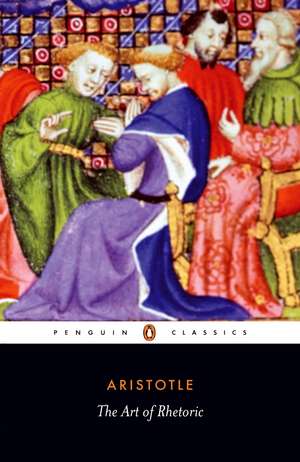
The Art of Rhetoric
Autor Aristotle Traducere de Hugh Lawson-Tancreden Limba Engleză Paperback – 3 mar 1992
For more than seventy years, Penguin has been the leading publisher of classic literature in the English-speaking world. With more than 1,700 titles, Penguin Classics represents a global bookshelf of the best works throughout history and across genres and disciplines. Readers trust the series to provide authoritative texts enhanced by introductions and notes by distinguished scholars and contemporary authors, as well as up-to-date translations by award-winning translators.
| Toate formatele și edițiile | Preț | Express |
|---|---|---|
| Paperback (2) | 59.48 lei 24-29 zile | +24.52 lei 4-10 zile |
| OUP OXFORD – 26 apr 2018 | 59.48 lei 24-29 zile | +24.52 lei 4-10 zile |
| Penguin Books – 3 mar 1992 | 75.48 lei 3-5 săpt. | +10.29 lei 4-10 zile |
| Hardback (1) | 62.28 lei Precomandă | |
| Arcturus Publishing – iun 2026 | 62.28 lei Precomandă |
Preț: 75.48 lei
Nou
Puncte Express: 113
Preț estimativ în valută:
13.36€ • 15.66$ • 11.73£
13.36€ • 15.66$ • 11.73£
Carte disponibilă
Livrare economică 12-26 ianuarie 26
Livrare express 26 decembrie 25 - 01 ianuarie 26 pentru 20.28 lei
Preluare comenzi: 021 569.72.76
Specificații
ISBN-13: 9780140445107
ISBN-10: 0140445102
Pagini: 304
Dimensiuni: 128 x 200 x 20 mm
Greutate: 0.23 kg
Editura: Penguin Books
Locul publicării:London, United Kingdom
ISBN-10: 0140445102
Pagini: 304
Dimensiuni: 128 x 200 x 20 mm
Greutate: 0.23 kg
Editura: Penguin Books
Locul publicării:London, United Kingdom
V-ar putea interesa
-
 When Nietzsche Wept: A Novel of ObsessionIrvin D YalomPreț: 98.68 lei
 -
 -27%Preț: 1130.10 lei1547.65 lei
 -
 -42%Preț: 506.08 lei879.18 lei
 -
 Ethics with AristotleSarah Broadie-14%Preț: 618.71 lei719.44 lei
 -
 Plato's EthicsTerence Irwin-31%Preț: 423.85 lei610.49 lei
 -
 First Democracy: The Challenge of an Ancient IdeaPaul Woodruff-13%Preț: 136.97 lei158.24 lei
 -
 De CaeloAristotle-21%Preț: 267.40 lei337.00 lei
 -
 Latin Forms of Address: From Plautus to ApuleiusEleanor Dickey-19%Preț: 463.74 lei574.62 lei
 -
 Seneca: De ClementiaSusanna Braund-30%Preț: 1028.58 lei1468.39 lei
 -
 Hierocles of AlexandriaHermann S. Schibli-34%Preț: 1445.06 lei2192.01 lei
 -
 -14%Preț: 366.44 lei427.87 lei
 -
 The PoliticsAristotle-19%Preț: 62.32 lei76.81 lei
 -
 -20%Preț: 60.95 lei75.98 lei
 -
 Preț: 341.24 lei
 -
 Socrates-Arg PhilosophersGerasimos Xenophon Santas-15%Preț: 417.98 lei491.74 lei
 -
 -29%Preț: 331.26 lei465.94 lei
 -
 Plato's Theory of ArtRupert C. Lodge-28%Preț: 336.62 lei469.14 lei
 -
 Plato's Theory of KnowledgeFrancis MacDonald Cornford-28%Preț: 337.57 lei469.72 lei
 -
 Preț: 341.55 lei
 -
 Preț: 111.48 lei
 -
 The Law Most Beautiful and BestRandall Baldwin ClarkPreț: 387.57 lei
 -
 Preț: 372.69 lei
 -
 The Works of ArchimedesArchimedesPreț: 97.19 lei
 -
 Aristotle's MetaphysicsAristotlePreț: 200.55 lei
 -
 The Heart of PlotinusAldis UzdavinysPreț: 142.55 lei
 -
 -27%Preț: 939.22 lei1286.59 lei
Notă biografică
Aristotle was born in 384BC. For twenty years he studied at Athens at the Academy of Plato, on whose death in 347 he left, and some time later became tutor to Alexander the Great. On Alexander's succession to the throne of Macedonia in 336, Aristotle returned to Athens and established his school and research institute, the Lyceum. After Alexander's death he was driven out of Athens and feld to Chalcis in Euboea where he died in 322. His writings profoundly affected the whole course of ancient and medieval philosophy.
HUGH LAWSON-TANCRED was born in 1955 and educated at Eton and Balliol College, Oxford. He is a Departmental Fellow in the Department of Philosophy at Birkbeck College in the University of London. He has published extensively on Aristotle and Plato and is currently engaged in research in computational linguistics. He translates widely from the Slavonic and Scandinavian languages. He is married with a daughter and two sons and lives in North London and Somerset.
HUGH LAWSON-TANCRED was born in 1955 and educated at Eton and Balliol College, Oxford. He is a Departmental Fellow in the Department of Philosophy at Birkbeck College in the University of London. He has published extensively on Aristotle and Plato and is currently engaged in research in computational linguistics. He translates widely from the Slavonic and Scandinavian languages. He is married with a daughter and two sons and lives in North London and Somerset.
Cuprins
The Art of Rhetoric - Aristotle Translated with an Introduction and Notes by Hugh Lawson-Tancred
Preface Introduction: 1. The Importance of Ancient Rhetoric 2. The Historical Background to the Rhetoric 3. Rhetoric as Techne 4. Psychology in the Rhetoric 5. Style and Composition 6. The Rhetorical Legacy of Aristotle 7. The Translation
THE ART OF RHETORICSection One: Introductory Chapter 1.1. The Nature of Rhetoric PART ONE: DEMONSTRATIONSection Two: The Genres of Oratory Chapter 1.2. The Definition of Rhetoric Chapter 1.3. The Genres Section Three: Deliberation Chapter 1.4. The Province of Deliberation Chapter 1.5. Happiness Chapter 1.6. The Good and the Expedient Chapter 1.7. Relative Expediency Chapter 1.8. Constitutions Section Four: Display Chapter 1.9. Display Oratory Section Five: Litigation Chapter 1.10. Injustice Chapter 1.11. Pleasure Chapter 1.12. The Criminal Mind Chapter 1.13. Crime and Punishment Chapter 1.14. Relatively Serious Crimes Chapter 1.15. Non-technical Proofs PART TWO: EMOTION AND CHARACTERSection Six: Emotion Chapter 2.1. The Role of Emotion and Character Chapter 2.2. Anger Chapter 2.3. Calm Chapter 2.4. Friendship and Enmity Chapter 2.5. Fear and Confidence Chapter 2.6. Shame Chapter 2.7. Favour Chapter 2.8. Pity Chapter 2.9. Indignation Chapter 2.10. Envy Chapter 2.11. Jealousy Section Seven: Character Chapter 2.12. Youth Chapter 2.13. Old Age Chapter 2.14. Prime Chapter 2.15. Birth Chapter 2.16. Wealth Chapter 2.17. Power PART THREE: UNIVERSAL ASPECTSSection Eight: Common Topics Chapter 2.18. The Role of Common Topics Chapter 2.19. The Topics of Possibility Chapter 2.20. Example Chapter 2.21. Maxim Chapter 2.22. Enthymeme Chapter 2.23. Demonstrative Common Topics Chapter 2.24. Illusory Topics Chapter 2.25. Refutation Chapter 2.26. Amplification Section Nine: Style Chapter 3.1. Historical Preliminary Chapter 3.2. Clarity Chapter 3.3. Frigidity Chapter 3.4. Simile Chapter 3.5. Purity Chapter 3.6. Amplitude Chapter 3.7. Propriety Chapter 3.8. Rhythm Chapter 3.9. Syntax Chapter 3.10. Wit and Metaphor Chapter 3.11. Vividness Chapter 3.12. Suitability to Genre Section Ten: Composition Chapter 3.13. Narration and Proof Chapter 3.14. The Introduction Chapter 3.15. Prejudice Chapter 3.16. Narration Chapter 3.17. Proof and Refutation Chapter 3.18. Altercation Chapter 3.19. The Epilogue Notes Bibliography
THE ART OF RHETORICSection One: Introductory Chapter 1.1. The Nature of Rhetoric PART ONE: DEMONSTRATIONSection Two: The Genres of Oratory Chapter 1.2. The Definition of Rhetoric Chapter 1.3. The Genres Section Three: Deliberation Chapter 1.4. The Province of Deliberation Chapter 1.5. Happiness Chapter 1.6. The Good and the Expedient Chapter 1.7. Relative Expediency Chapter 1.8. Constitutions Section Four: Display Chapter 1.9. Display Oratory Section Five: Litigation Chapter 1.10. Injustice Chapter 1.11. Pleasure Chapter 1.12. The Criminal Mind Chapter 1.13. Crime and Punishment Chapter 1.14. Relatively Serious Crimes Chapter 1.15. Non-technical Proofs PART TWO: EMOTION AND CHARACTERSection Six: Emotion Chapter 2.1. The Role of Emotion and Character Chapter 2.2. Anger Chapter 2.3. Calm Chapter 2.4. Friendship and Enmity Chapter 2.5. Fear and Confidence Chapter 2.6. Shame Chapter 2.7. Favour Chapter 2.8. Pity Chapter 2.9. Indignation Chapter 2.10. Envy Chapter 2.11. Jealousy Section Seven: Character Chapter 2.12. Youth Chapter 2.13. Old Age Chapter 2.14. Prime Chapter 2.15. Birth Chapter 2.16. Wealth Chapter 2.17. Power PART THREE: UNIVERSAL ASPECTSSection Eight: Common Topics Chapter 2.18. The Role of Common Topics Chapter 2.19. The Topics of Possibility Chapter 2.20. Example Chapter 2.21. Maxim Chapter 2.22. Enthymeme Chapter 2.23. Demonstrative Common Topics Chapter 2.24. Illusory Topics Chapter 2.25. Refutation Chapter 2.26. Amplification Section Nine: Style Chapter 3.1. Historical Preliminary Chapter 3.2. Clarity Chapter 3.3. Frigidity Chapter 3.4. Simile Chapter 3.5. Purity Chapter 3.6. Amplitude Chapter 3.7. Propriety Chapter 3.8. Rhythm Chapter 3.9. Syntax Chapter 3.10. Wit and Metaphor Chapter 3.11. Vividness Chapter 3.12. Suitability to Genre Section Ten: Composition Chapter 3.13. Narration and Proof Chapter 3.14. The Introduction Chapter 3.15. Prejudice Chapter 3.16. Narration Chapter 3.17. Proof and Refutation Chapter 3.18. Altercation Chapter 3.19. The Epilogue Notes Bibliography
Descriere
This text examines Aristotle's "Rhetoric" as a classic treatise on the arts of public speaking and persuasion which played a role in the civic life of Greece. These arts, which evolved a highly formalized tradition of technique, were connected with the study of political and moral theory.
Recenzii
In short, this translation from Waterfield builds on a series of readable and affordable translations from Oxford World's Classics and will no doubt prove valuable to both students and academics. Waterfield has given Aristotle his own colourful voice, if not an even more doddery one, which will prove both entertaining as well as informative to Oxford World's Classics' intended audience.