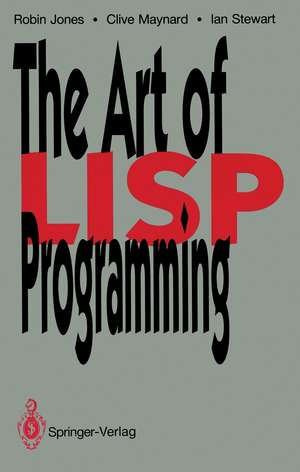
The Art of Lisp Programming
Autor Robin Jones, Clive Maynard, Ian Stewarten Limba Engleză Paperback – 20 dec 1989
Preț: 330.23 lei
Preț vechi: 412.78 lei
-20%
Puncte Express: 495
Carte tipărită la comandă
Livrare economică 05-19 decembrie
Livrare prin curier în România Termenul estimat este afișat lângă disponibilitate.
Transport gratuit de la 400.00 lei Plată online sau ramburs, în funcție de opțiunile comenzii.
Retur gratuit în 14 zile Comandă securizată și suport în română.
Specificații
ISBN-13: 9783540195689
ISBN-10: 3540195688
Pagini: 184
Ilustrații: XIV, 169 p. 20 illus.
Dimensiuni: 170 x 242 x 11 mm
Greutate: 0.33 kg
Ediția:Softcover reprint of the original 1st ed. 1990
Editura: Springer
Locul publicării:London, United Kingdom
ISBN-10: 3540195688
Pagini: 184
Ilustrații: XIV, 169 p. 20 illus.
Dimensiuni: 170 x 242 x 11 mm
Greutate: 0.33 kg
Ediția:Softcover reprint of the original 1st ed. 1990
Editura: Springer
Locul publicării:London, United Kingdom
V-ar putea interesa
-
 -17%Preț: 90.52 lei109.04 lei
 -
 The Art of C ProgrammingRobin Jones-20%Preț: 586.78 lei733.48 lei
 -
 Sport and Physical Education in ChinaRobin Jones-15%Preț: 473.86 lei557.49 lei
 -
 Sport and Physical Education in ChinaRobin Jones-18%Preț: 1635.19 lei1994.13 lei
 -
 Unthology No.1Robin JonesPreț: 134.72 lei
 -
 Unthology No.3Robin JonesPreț: 144.43 lei
 -
 Spring Persistence with HibernatePaul Fisher-20%Preț: 220.20 lei275.25 lei
 -
 Beginning HibernateJeff Linwood-20%Preț: 220.47 lei275.59 lei
 -
 Beginning Java EE 6 with GlassFish 3Antonio Goncalves-20%Preț: 251.12 lei313.90 lei
 -
 Design Driven TestingMatt Stephens-20%Preț: 324.81 lei406.00 lei
 -
 -20%Preț: 264.60 lei330.75 lei
 -
 Beginning JavafxLawrence Premkumar-20%Preț: 198.35 lei247.93 lei
 -
 Practical ClojureLuke Vanderhart-20%Preț: 229.08 lei286.36 lei
 -
 Programming LanguagesKent D. Lee-20%Preț: 757.24 lei946.55 lei
 -
 Great Western Railway Pannier TanksRobin JonesPreț: 210.97 lei
 -
 Value-Range Analysis of C ProgramsAxel Simon-20%Preț: 982.37 lei1227.96 lei
 -
 An Introduction to PHP for Scientists and EngineersDavid R. Brooks-20%Preț: 298.82 lei373.53 lei
 -
 -20%Preț: 338.47 lei423.09 lei
 -
 -20%Preț: 476.94 lei596.18 lei
 -
 Fortran 90 Language GuideWilhelm Gehrke-20%Preț: 327.15 lei408.94 lei
 -
 Practical Usage of ISPF Dialog ManagerAnthony S. Rudd-20%Preț: 340.35 lei425.44 lei
 -
 Fortran 95 Language GuideWilhelm Gehrke-20%Preț: 575.21 lei719.01 lei
 -
 The F Language GuideWilhelm Gehrke-20%Preț: 324.99 lei406.23 lei
 -
 Logic, Language, Information and ComputationAnuj Dawar-20%Preț: 320.72 lei400.90 lei
 -
 Java will nur spielenSven Eric Panitz-20%Preț: 225.90 lei282.37 lei
Public țintă
ResearchCuprins
1 Some Basic Ideas.- Lists.- Representing Lists.- The Interpreter.- Functions.- Two More Primitives.- Constants and Variables.- S-Expressions.- Postscript.- Exercises 1.- Answers.- 2 List Functions.- Splitting Lists.- car and cdr.- Setting Up Lists.- setq.- A Piece of Pedantry.- Head and Tail Revisited.- cons.- Postscript.- Exercises 2.- Answers.- 3 Predicates.- cond.- Boolean Functions.- Exercises 3.- Answers.- 4 Recursion.- Powers.- Boolean Functions Revisited.- eq.- Meanwhile Back at the Problem....- null.- AND and OR.- flat.- first.- rest.- The Fly in the Ointment.- append and list.- Postscript.- Exercises 4.- Answers.- 5 A Look Back (and Forward).- Variables: a Sense of Place.- Variable Scope.- Variable Binding.- Free Variables.- Lexical Scoping.- A Software Engineering Problem.- setq.- System Variables.- Exercises 5.- Answers.- 6 Sets and Lists.- Sets of Numbers.- The Set Functions.- Intersection.- disjoint-p.- Subsets.- Complement.- Union.- Exercises 6.- Answers.- 7 Input.- read.- read-line.- Single Characters.- More About #.- Yes or No Responses.- Using the read Primitives.- Exercises 7.- Answers.- 8 Output.- format.- The Control String.- Printing Values.- Format Directives.- Using Arguments as Parameters.- Tabs.- Other Output Functions.- The Telephone Index Again.- The read-eval-print Loop.- The Program-Data Distinction.- Exercises 8.- Answers.- 9 Iterative Constructs.- loop.- return.- do.- The Size of a List.- Iteration v. Recursion.- dotimes.- dolist.- Mapping.- mapcar.- Exercises 9.- Answers.- 10 More About Program Control.- if.- when.- unless.- case.- Synonyms.- Defaults.- Some New Control Constructs.- let.- flet.- progl to progrc.- The Lambda Notation.- Exercises 10.- Answers.- 11 File Handling.- Pathnames.- merge-pathnames.- Streams.- Opening and ClosingFiles.- Keyword Arguments.- The Body.- Other Keyword Arguments.- Getting the File Back.- EOF-ERROR-P and EOF-VALUE.- Exercises 11.- Answers.- 12 Data Structures.- Association Lists.- pairlis.- The Dot Notation.- assoc.- rassoc.- aeons.- setf.- Database Manipulation.- Trees.- Binary Trees.- The Searching Problem.- Implementing a Binary Tree.- Growing a Tree.- Searching the Tree.- Stacks.- push.- pop.- Exercises 12.- Answers.- 13 Arrays, Strings and Structures.- Arrays.- Changing an Array Element.- Multidimensional Arrays.- Strings.- char.- string=.- string