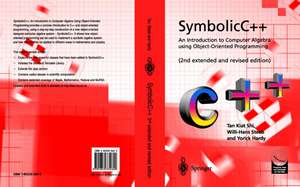
SymbolicC++:An Introduction to Computer Algebra using Object-Oriented Programming: An Introduction to Computer Algebra using Object-Oriented Programming
Autor Kiat Shi Tan, Willi-Hans Steeb, Yorick Hardyen Limba Engleză Paperback – 2 feb 2000
Preț: 338.47 lei
Preț vechi: 423.09 lei
-20%
Puncte Express: 508
Carte tipărită la comandă
Livrare economică 01-15 decembrie
Livrare prin curier în România Termenul estimat este afișat lângă disponibilitate.
Transport gratuit de la 400.00 lei Plată online sau ramburs, în funcție de opțiunile comenzii.
Retur gratuit în 14 zile Comandă securizată și suport în română.
Specificații
ISBN-13: 9781852332600
ISBN-10: 1852332603
Pagini: 688
Ilustrații: XVI, 692 p.
Dimensiuni: 155 x 235 x 36 mm
Greutate: 0.95 kg
Ediția:2nd extended and rev. ed. 2000
Editura: SPRINGER LONDON
Colecția Springer
Locul publicării:London, United Kingdom
ISBN-10: 1852332603
Pagini: 688
Ilustrații: XVI, 692 p.
Dimensiuni: 155 x 235 x 36 mm
Greutate: 0.95 kg
Ediția:2nd extended and rev. ed. 2000
Editura: SPRINGER LONDON
Colecția Springer
Locul publicării:London, United Kingdom
V-ar putea interesa
-
 C Programming - An Advanced CourseNoel Kalicharan-20%Preț: 138.35 lei172.94 lei
 -
 Raspberry Pi Camera Controls Using Python 3.2.3Herb Norbom-20%Preț: 62.81 lei78.52 lei
 -
 -20%Preț: 64.98 lei81.22 lei
 -
 Basic V for the Acorn ArchimedesMR Mike Williams-20%Preț: 78.12 lei97.66 lei
 -
 PythonSteve Gold-20%Preț: 82.14 lei102.68 lei
 -
 Django CookbookLogan Barton-20%Preț: 55.30 lei69.13 lei
 -
 Magento PHP Developer's Guide - Second EditionAllan Macgregor-20%Preț: 260.78 lei325.97 lei
 -
 Kivy CookbookHugo Solis-20%Preț: 289.19 lei361.48 lei
 -
 Arduino Electronics BlueprintsDon Wilcher-20%Preț: 260.30 lei325.36 lei
 -
 Multiparadigm Programming in Mozart/OzPeter Van Roy-20%Preț: 324.82 lei406.03 lei
 -
 Compiler ConstructionRastislav Bodik-20%Preț: 348.96 lei436.20 lei
 -
 -20%Preț: 336.31 lei420.38 lei
 -
 Term Rewriting and ApplicationsFrank Pfenning-20%Preț: 329.14 lei411.42 lei
 -
 Computer Science LogicZoltán Ésik-20%Preț: 667.30 lei834.12 lei
 -
 -20%Preț: 326.55 lei408.19 lei
 -
 -20%Preț: 318.67 lei398.33 lei
 -
 Declarative Programming for Knowledge ManagementMasanobu Umeda-20%Preț: 319.28 lei399.10 lei
 -
 Languages and Compilers for Parallel ComputingEduard Ayguadé-20%Preț: 345.45 lei431.82 lei
 -
 -20%Preț: 644.31 lei805.39 lei
 -
 Classical and Quantum ComputingYorick Hardy-20%Preț: 356.50 lei445.62 lei
 -
 PROB & SOL IN DIFF GEOM, LIE SERIES, DIFFER FORMS, RELATIVSteeb Willi-HansPreț: 343.71 lei
 -
 NONLINEAR WORKBOOK, THE (5TH ED)Steeb Willi-HansPreț: 500.41 lei
 -
 Bose, Spin and Fermi SystemsWilli-Hans SteebPreț: 352.81 lei
Public țintă
Lower undergraduateCuprins
1 Introduction.- 1.1 What is Computer Algebra ?.- 1.2 Properties of Computer Algebra Systems.- 1.3 Pitfalls in Computer Algebra Systems.- 1.4 Design of a Computer Algebra System.- 2 Mathematics for Computer Algebra.- 2.1 Rings and Fields.- 2.2 Integers.- 2.3 Rational Numbers.- 2.4 Real Numbers.- 2.5 Complex Numbers.- 2.6 Vectors and Matrices.- 2.7 Quaternions.- 2.8 Polynomials.- 2.9 Differentiation.- 2.10 Integration.- 2.11 Commutativity and Noncommutativity.- 2.12 Tensor and Kronecker Product.- 2.13 Exterior Product.- 3 Computer Algebra Systems.- 3.1 Introduction.- 3.2 Reduce.- 3.3 Maple.- 3.4 Axiom.- 3.5 Mathematica.- 3.6 MuPAD.- 4 Object-Oriented Programming.- 4.1 Objects, Classes and Abstract Data Types.- 4.2 Message Passing.- 4.3 Inheritance.- 4.4 Polymorphism.- 4.5 Object-Oriented Languages.- 4.6 Summary.- 5 Basic Tools in C++.- 5.1 Pointers and References.- 5.2 Classes.- 5.3 Constructors and Destructor.- 5.4 Copy Constructor and Assignment Operator.- 5.5 Type Conversion.- 5.6 Operator Overloading.- 5.7 Class Templates.- 5.8 Function Templates.- 5.9 Friendship.- 5.10 Inheritance.- 5.11 Virtual Functions.- 5.12 Wrapper Class.- 5.13 Standard Template Library.- 5.14 Recursion.- 5.15 Summary.- 6 Classes for Computer Algebra.- 6.1 The Verylong Integer Class.- 6.2 The Rational Number Class.- 6.3 The Complex Number Class.- 6.4 The Quaternion Class.- 6.5 The Derive Class.- 6.6 The Vector Class.- 6.7 The Matrix Class.- 6.8 Array Classes.- 6.9 The String Class.- 6.10 Bit Vectors.- 6.11 The Linked List Class.- 6.12 The Polynomial Class.- 6.13 The Set Class.- 6.14 Summary.- 7 The Symbolic Class.- 7.1 Object-Oriented Design.- 7.2 Data Fields and Types of Symbol.- 7.3 Constructors.- 7.4 Operators.- 7.5 Functions.- 7.6 Simplification.- 7.7 Commutativity.- 7.8 Symbolic and Numeric Interface.- 7.9 Summary.- 8 Applications.- 8.1 Bit Vector Class.- 8.2 Verylong Class.- 8.3 Verylong and Rational Classes.- 8.4 Verylong, Rational and Derive Classes.- 8.5 Verylong, Rational and Complex Classes.- 8.6 Symbolic Class.- 8.7 Symbolic Class and Symbolic Differentiation.- 8.8 Matrix Class.- 8.9 Array and Symbolic Classes.- 8.10 Polynomial and Symbolic Classes.- 8.11 Lie Series Techniques.- 8.12 Spectra of Small Spin Clusters.- 8.13 Nonlinear Maps and Chaotic Behaviour.- 8.14 Numerical-Symbolic Application.- 8.15 Summary.- 9 Lisp and Computer Algebra.- 9.1 Introduction.- 9.2 Basic Functions of Lisp.- 9.3 Examples from Symbolic Computation.- 9.4 Lisp System based on C++.- 10 Program Listing.- 10.1 Verylong Class.- 10.2 Rational Class.- 10.3 Complex Class.- 10.4 Quaternion Class.- 10.5 Derive Class.- 10.6 Vector Class.- 10.7 Matrix Class.- 10.8 Array Class.- 10.9 String Class.- 10.10Bit Vector Class.- 10.11Linked List Class.- 10.12Polynomial Class.- 10.13Set Class.- 10.14Symbolic Class.- 11 PVM and Abstract Data Types.- 12 Error Handling Techniques.- 12.1 Error State.- 12.2 Exception Handling.- 13 Gnuplot and PostScript.
Caracteristici
DEMONSTRATES HOW THE FEATURES OF OBJECT-ORIENTED PROGRAMMING MAY BE APPLIED TO THE DEVELOPMENT OF A COMPUTER ALGEBRA SYSTEM *DESIGN BASED ON BOTH ACKNOWLEDGED PRINCIPLES AND SOLID EXPERIENCE OF ACTUAL USE *SUITED FOR USE IN THE HEADER FILES OF THE CLASSES ARE PROVIDED ON THE ACCOMPANYING DISK *REFERENCE LISTS TEXTBOOKS USEFUL IN THE STUDY OF C++