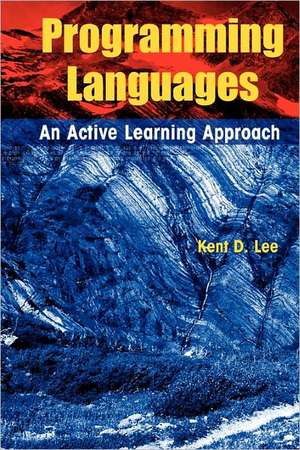
Programming Languages
Autor Kent D. Leeen Limba Engleză Paperback – 5 noi 2010
Key Features: (1) Accessible structure guides the student through various programming languages. (2) Seamlessly integrated practice exercises. (3) Classroom-tested. (4) Online support materials.
Advance praise:
“The Programming Languages book market is overflowing with books, but none like this. In many ways, it is precisely the book I have been searching for to use in my own programming languages course. One of the main challenges I perpetually face is how to teach students to program in functional and logical languages, but also how to teach them about compilers. This book melds the two approaches very well.” -- David Musicant, Carleton College
Preț: 757.24 lei
Preț vechi: 946.55 lei
-20%
Puncte Express: 1136
Carte tipărită la comandă
Livrare economică 27 noiembrie-11 decembrie
Livrare prin curier în România Termenul estimat este afișat lângă disponibilitate.
Transport gratuit pentru acest produs Plată online sau ramburs, în funcție de opțiunile comenzii.
Retur gratuit în 14 zile Comandă securizată și suport în română.
Specificații
ISBN-13: 9781441946362
ISBN-10: 1441946365
Pagini: 296
Ilustrații: XIV, 282 p.
Dimensiuni: 155 x 235 x 17 mm
Greutate: 0.45 kg
Ediția:2008
Editura: Springer
Locul publicării:New York, NY, United States
ISBN-10: 1441946365
Pagini: 296
Ilustrații: XIV, 282 p.
Dimensiuni: 155 x 235 x 17 mm
Greutate: 0.45 kg
Ediția:2008
Editura: Springer
Locul publicării:New York, NY, United States
V-ar putea interesa
-
 -42%Preț: 409.53 lei707.28 lei
 -
 The C++ Programming LanguageBjarne Stroustrup-20%Preț: 507.21 lei634.02 lei
 -
 Introduction to C++ Programming and GraphicsConstantine Pozrikidis-20%Preț: 355.18 lei443.97 lei
 -
 Prolog and its ApplicationsF U M I O Mizoguchi-20%Preț: 321.81 lei402.26 lei
 -
 Python Programming for BiologyTim J. Stevens-20%Preț: 460.01 lei575.01 lei
 -
 Beginning Programming with C++ For DummiesStephen R. Davis-20%Preț: 173.62 lei217.02 lei
 -
 System on Chip Design LanguagesAnne Mignotte-20%Preț: 1023.92 lei1279.90 lei
 -
 System Specification & Design LanguagesJean Mermet-20%Preț: 1026.99 lei1283.74 lei
 -
 -20%Preț: 668.61 lei835.76 lei
 -
 Pro ASP.NET Web API SecurityBadrinarayanan Lakshmiraghavan-20%Preț: 525.86 lei657.33 lei
 -
 -20%Preț: 230.97 lei288.71 lei
 -
 Visual Languages and ApplicationsKang Zhang-20%Preț: 676.05 lei845.05 lei
 -
 Python Programming FundamentalsKent D. Lee-20%Preț: 305.61 lei382.01 lei
 -
 -20%Preț: 156.43 lei195.54 lei
 -
 Workload Characterization for Computer System DesignLizy Kurian John-20%Preț: 617.38 lei771.73 lei
 -
 Open Source Software for Digital ForensicsEwa Huebner-20%Preț: 952.32 lei1190.41 lei
 -
 Functional Programming in ScalaRunar Bjarnason-20%Preț: 340.60 lei425.75 lei
 -
 Python Programming for BeginnersJoseph Joyner-20%Preț: 53.61 lei67.02 lei
 -
 Murachs C# 2012Joel Murach-28%Preț: 359.74 lei496.79 lei
Public țintă
Lower undergraduateCuprins
Introduction.- Specifying Syntax.- Object-Oriented Programming with C++.- Object-Oriented Programming with Ruby.- Functional Programming in Standard ML.- Language Implementation in Standard ML.- Logic Programming.- Formal Semantics.- Appendix A: The C++ Scanner Class Implementation.- Appendix B: The Ruby Scanner Class Implementation.- Appendix C: Standard ML Basis Library.- Appendix D: SML Calculator Compiler.- Appendix E: The Factorial Program's Code.- Appendix F: Small Action Semantic Description.
Recenzii
From the reviews:
"This is a very nice textbook. … ‘An active learning approach’ gives a true picture of the style of presentation of the material. Each chapter ends with a list of problems to be solved … and with references to further reading. There is a web page of the book … offering supplementary material for students and teachers. The book is beneficial for self-study, too. It starts with an interesting concise survey of computers and computation history, mentioning the influence of mathematics on programming … ." (Antonín Ríha, Zentrablatt MATH, Vol. 1153, 2009)
"This is an excellent undergraduate-level textbook for courses devoted to understanding programming language concepts … . exercises with solutions allow the student work either individually or in a collaborative group. … the text will permit instructors to use any class time for problem solution, discussion, and collaborative learning, including writing codes. … highly recommended to those teaching undergraduate programming language courses, and as a self directed study guide for professionals who wish to enhance their understanding of some of the newer languages … ." (E. A. Unger, ACM Computing Reviews, March, 2009)
"This is a very nice textbook. … ‘An active learning approach’ gives a true picture of the style of presentation of the material. Each chapter ends with a list of problems to be solved … and with references to further reading. There is a web page of the book … offering supplementary material for students and teachers. The book is beneficial for self-study, too. It starts with an interesting concise survey of computers and computation history, mentioning the influence of mathematics on programming … ." (Antonín Ríha, Zentrablatt MATH, Vol. 1153, 2009)
"This is an excellent undergraduate-level textbook for courses devoted to understanding programming language concepts … . exercises with solutions allow the student work either individually or in a collaborative group. … the text will permit instructors to use any class time for problem solution, discussion, and collaborative learning, including writing codes. … highly recommended to those teaching undergraduate programming language courses, and as a self directed study guide for professionals who wish to enhance their understanding of some of the newer languages … ." (E. A. Unger, ACM Computing Reviews, March, 2009)
Textul de pe ultima copertă
Programming Languages: An Active Learning Approach introduces students to three programming paradigms: object-oriented/imperative languages using C++ and Ruby, functional languages using Standard ML, and logic programming using Prolog. This interactive textbook is intended to be used in and outside of class. Each chapter follows a pattern of presenting a topic followed by a practice exercise or exercises that encourage students to try what they have just read. This textbook is best-suited for students with a 2-3 course introduction to imperative programming.
Key Features:
Advance Praise for Lee’s Programming Languages: An Active Learning Approach
"The Programming Languages book market is overflowing with books, but none like this. In many ways, it is precisely the book I have been searching for to use in my own programming languages course. One of the main challenges I perpetually face is how to teach students to program in functional and logical languages, but also how to teach them about compilers. This book melds the two approaches very well."
-- David Musicant, Carleton College
Key Features:
- Accessible structure guides the student through various programming languages
- Seamlessly integrated practice exercises
- Classroom-tested
- Online support materials
Advance Praise for Lee’s Programming Languages: An Active Learning Approach
"The Programming Languages book market is overflowing with books, but none like this. In many ways, it is precisely the book I have been searching for to use in my own programming languages course. One of the main challenges I perpetually face is how to teach students to program in functional and logical languages, but also how to teach them about compilers. This book melds the two approaches very well."
-- David Musicant, Carleton College
Caracteristici
Interactive text with projects for students to do outside of the classroom Book incorporates compiler and logical programming approaches Promotes active learning techniques Classroom-tested material Includes supplementary material: sn.pub/extras
Notă biografică
Dr. Kent D. Lee is a Professor Emeritus of Computer Science at Luther College, Decorah, Iowa, USA. He now works for Hewlett Packard Enterprise as an Engineer and Architect on the DragonHPC project within the High Performance Computing division (formerly Cray, Inc.). He is the author of the successful introductory companion textbook from Springer, Python Programming Fundamentals, and the Foundations of Programming Languages - an excellent textbook on compiler and interpreter implementation.
Dr. Steve Hubbard is a Professor Emeritus of Mathematics and Computer Science at Luther College.