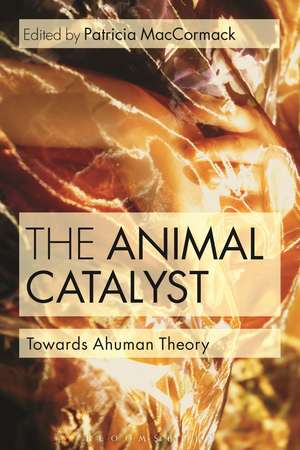
The Animal Catalyst: Towards Ahuman Theory
Editat de Professor Patricia MacCormacken Limba Engleză Paperback – 19 iun 2014
- How "compassion" for animals reinforces ideas of what distinguishes human beings from other animals.
- How speciesism and human centricity are built into the legal system.
- How individualist subjectivity works in relation to animals who may not think of themselves in the same way.
- How any consideration of animal others must involve a radical deconstruction of our very notion of the "human."
- How art, philosophy and literature can both avoid speciesism and deliver the human from subjectivity.
This volume is a unique project which stands at the cutting edge of both animal rights philosophies and posthuman/artistic/abstract philosophies of identity. It will be of great interest to undergraduates and researchers in philosophy, ethics, particularly continental philosophy, critical theory and cultural studies.
Preț: 226.26 lei
Preț vechi: 279.95 lei
-19%
Puncte Express: 339
Carte disponibilă
Livrare economică 11-25 noiembrie
Livrare prin curier în România Termenul estimat este afișat lângă disponibilitate.
Transport gratuit de la 400.00 lei Plată online sau ramburs, în funcție de opțiunile comenzii.
Retur gratuit în 14 zile Comandă securizată și suport în română.
Specificații
ISBN-13: 9781472534446
ISBN-10: 1472534441
Pagini: 224
Dimensiuni: 156 x 232 x 16 mm
Greutate: 0.4 kg
Editura: Bloomsbury Publishing
Colecția Bloomsbury Academic
Locul publicării:London, United Kingdom
ISBN-10: 1472534441
Pagini: 224
Dimensiuni: 156 x 232 x 16 mm
Greutate: 0.4 kg
Editura: Bloomsbury Publishing
Colecția Bloomsbury Academic
Locul publicării:London, United Kingdom
V-ar putea interesa
-
 Experiences: An Inquiry into Some AmbiguitiesJ. M. Hinton-28%Preț: 372.05 lei519.35 lei
 -
 -31%Preț: 820.31 lei1192.52 lei
 -
 On ReflectionHilary Kornblith-21%Preț: 247.30 lei313.70 lei
 -
 A Naturalistic Epistemology: Selected PapersHilary Kornblith-28%Preț: 525.14 lei733.94 lei
 -
 Replacing TruthKevin Scharp-31%Preț: 680.92 lei985.77 lei
 -
 Epistemic Norms: New Essays on Action, Belief, and AssertionClayton Littlejohn-31%Preț: 577.67 lei836.27 lei
 -
 The Aim of BeliefTimothy Chan-31%Preț: 727.11 lei1048.64 lei
 -
 -31%Preț: 695.66 lei1008.31 lei
 -
 Know HowJason Stanley-13%Preț: 264.15 lei303.88 lei
 -
 -13%Preț: 304.68 lei349.23 lei
 -
 -13%Preț: 303.53 lei347.35 lei
 -
 Hermeneutics: A Very Short IntroductionJens Zimmermann-20%Preț: 57.15 lei71.12 lei
 -
 Knowledge and PresuppositionsMichael Blome-Tillmann-29%Preț: 522.72 lei732.53 lei
 -
 Ignorance and Moral ObligationMichael J. Zimmerman-29%Preț: 481.95 lei676.05 lei
 -
 The A Priori in PhilosophyAlbert Casullo-31%Preț: 636.02 lei920.53 lei
 -
 Unruly Words: A Study of Vague LanguageDiana Raffman-28%Preț: 432.35 lei603.12 lei
 -
 Dialogues IIGilles Deleuze-43%Preț: 126.82 lei220.85 lei
 -
 Critical Thinking 2EHunter-8%Preț: 442.48 lei480.95 lei
 -
 -32%Preț: 78.12 lei114.73 lei
Cuprins
Notes on Contributors
Acknowledgements
Introduction, Patricia MacCormack
Part I: New Abolitionist Approaches
1. The War on Compassion, Carol J. Adams
2. Legal Technology Confronts Speciesism or We Have Met the Enemy and He is Us, John T. Maher
3. 'Beyond' the Singular? Ecology, Subjectivity, Politics, Danielle Sands
Part II: Animal Mediators: Philosophy, Film, Literature
4. 'Etre aux aguets': Deleuze, Creation and Territorialization, Charles J. Stivale
5. 'Out of the Labyrinth, into the Métro: Becoming-animal, the Waking Dream and Movements of World in Raymond Queneau and Louis Malle's Zazie dans le métro.', Colin Gardner
6. The Animal That Therefore I Am Not: Inhuman Mediations on the Ultimate Degeneration of Bios and Zoe via the Inevitable Process of Phenomenophagism, Charlie Blake
7. The Taste of Living, Chrysanthi Nigianni
Part III: Ahumanity: A Liberation of Life
8. Suicide for Animals, Claire Colebrook
9. Dark Pedagogy, Jason Wallin
10. Self-Harm, Human Harm?, Ruth McPhee
11. After Life, Patricia MacCormack
Bibliography
Index
Acknowledgements
Introduction, Patricia MacCormack
Part I: New Abolitionist Approaches
1. The War on Compassion, Carol J. Adams
2. Legal Technology Confronts Speciesism or We Have Met the Enemy and He is Us, John T. Maher
3. 'Beyond' the Singular? Ecology, Subjectivity, Politics, Danielle Sands
Part II: Animal Mediators: Philosophy, Film, Literature
4. 'Etre aux aguets': Deleuze, Creation and Territorialization, Charles J. Stivale
5. 'Out of the Labyrinth, into the Métro: Becoming-animal, the Waking Dream and Movements of World in Raymond Queneau and Louis Malle's Zazie dans le métro.', Colin Gardner
6. The Animal That Therefore I Am Not: Inhuman Mediations on the Ultimate Degeneration of Bios and Zoe via the Inevitable Process of Phenomenophagism, Charlie Blake
7. The Taste of Living, Chrysanthi Nigianni
Part III: Ahumanity: A Liberation of Life
8. Suicide for Animals, Claire Colebrook
9. Dark Pedagogy, Jason Wallin
10. Self-Harm, Human Harm?, Ruth McPhee
11. After Life, Patricia MacCormack
Bibliography
Index
Recenzii
How do "we" relate to animals? Treating "them" with respect and granting "them" legal rights just isn't enough. The chapters in this book propose more radical approaches- starting with the rejection of the whole "we vs. them" framework. The Animal Catalyst is an urgent and necessary book, because it tells us that we cannot love and care for others without questioning and undoing ourselves.
The so called "Animal Turn" in the arts and humanities is neither the 'next big thing' nor a flash in the pan: it is here to stay with us and its confluences with posthuman, transhuman, and nonhuman theory will reshape these fields permanently. MacCormack has collected a brilliant selection of essays at the exact point of this conjunction, with original contributions in animal studies, philosophy, film and media theory, cultural studies and queer theory. As MacCormack says, though, The Animal Catalyst belongs to no one discourse, creating a new standard and class of "ahuman" theory that is all its own.
The so called "Animal Turn" in the arts and humanities is neither the 'next big thing' nor a flash in the pan: it is here to stay with us and its confluences with posthuman, transhuman, and nonhuman theory will reshape these fields permanently. MacCormack has collected a brilliant selection of essays at the exact point of this conjunction, with original contributions in animal studies, philosophy, film and media theory, cultural studies and queer theory. As MacCormack says, though, The Animal Catalyst belongs to no one discourse, creating a new standard and class of "ahuman" theory that is all its own.