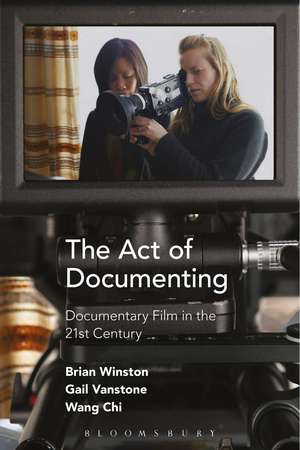
The Act of Documenting: Documentary Film in the 21st Century
Autor Brian Winston, Dr Gail Vanstone, Wang Chien Limba Engleză Paperback – 26 ian 2017
Preț: 258.09 lei
Preț vechi: 314.44 lei
-18%
Puncte Express: 387
Carte tipărită la comandă
Livrare economică 30 noiembrie-14 decembrie
Livrare express 23-29 octombrie pentru 92.51 lei
Livrare prin curier în România Termenul estimat este afișat lângă disponibilitate.
Transport gratuit de la 400.00 lei Plată online sau ramburs, în funcție de opțiunile comenzii.
Retur gratuit în 14 zile Comandă securizată și suport în română.
Specificații
ISBN-13: 9781501309175
ISBN-10: 150130917X
Pagini: 288
Dimensiuni: 148 x 226 x 18 mm
Greutate: 0.42 kg
Editura: Bloomsbury Publishing
Colecția Bloomsbury Academic
Locul publicării:New York, United States
ISBN-10: 150130917X
Pagini: 288
Dimensiuni: 148 x 226 x 18 mm
Greutate: 0.42 kg
Editura: Bloomsbury Publishing
Colecția Bloomsbury Academic
Locul publicării:New York, United States
V-ar putea interesa
-
 The English Patient: ScreenplayAnthony Minghella-7%Preț: 109.21 lei117.29 lei
 -
 Painting with Light 2eJohn AltonPreț: 258.61 lei
 -
 -25%Preț: 92.88 lei123.86 lei
 -
 -26%Preț: 89.87 lei121.42 lei
 -
 ZonaGeoff DyerPreț: 78.43 lei
 -
 Preț: 137.31 lei
 -
 Claiming the Real: Documentary: Grierson and BeyondBrian Winston-24%Preț: 241.15 lei318.15 lei
 -
 A Right to OffendBrian Winston-14%Preț: 292.73 lei342.06 lei
Cuprins
AN AGENDA
1. "A Much Hailed Triumph"
2. "The Shakiest of Foundations"
3. The Act of Documenting
PART ONE: DIGITAL POTENTIALS
1. "A Walk in the Woods"
Image:
AUTHENTICITY: Indexing -- Evidence
TRUST: Manipulation -- Judgment
SAVVY: Inferences -- Probability
2. "A breath of fresh air for documentary"
Kit:
CONTRADICTION: Digitization -- Standards
GLOBALIZATIONi: Proliferation-- Resistance
3. "Life as narrativized"
Story:
INTERPASSIVITY: Navigation -- Feedback -- Intervention
HOMO NARRANS: Texts -- Stories
SCRIPTRIX NARRANS: Challenge --Paths
PART TWO: ACTUAL EFFECTS..
.. on THE FILMED
4. "To thine own self be true"
Performing:
APPEARING: Distrust -- Presentational Acting -- Representational Being
BEHAVING: Performativity -- Casting
5. "Giving Voice"
Co-creating:
CONTROL: Engagement -- Empowerment
CHANGE: Facilitating -- Embedding
.. on THE FILMER
6. "To Make Space For The Un-Thought"
Subjectivities:
GENDER: Narcissism -- Auto/Biography
EMANCIPATION: Exclusions -- "Facts"
7. "Nous somme dans le bain"/"We are implicated"
Care:
HARM: Involvement -- Consequences
RIGHTS: Protocols -- Control
.. on THE SPECTATOR
8. "You have to make up your own mind"
Perception:
EXPECTATIONS: Truth -- Omission
ASSUMPTONS: Wow! -- Ostranenie
9. "When the lights go up" -- Reception
OUTCOMES: Impact -- Engagement -- Research
CONDITIONS: Autonomy -- Hazards
MINUTES: THE ACT OF DOCUMENTING
Considerations
1. "A Much Hailed Triumph"
2. "The Shakiest of Foundations"
3. The Act of Documenting
PART ONE: DIGITAL POTENTIALS
1. "A Walk in the Woods"
Image:
AUTHENTICITY: Indexing -- Evidence
TRUST: Manipulation -- Judgment
SAVVY: Inferences -- Probability
2. "A breath of fresh air for documentary"
Kit:
CONTRADICTION: Digitization -- Standards
GLOBALIZATIONi: Proliferation-- Resistance
3. "Life as narrativized"
Story:
INTERPASSIVITY: Navigation -- Feedback -- Intervention
HOMO NARRANS: Texts -- Stories
SCRIPTRIX NARRANS: Challenge --Paths
PART TWO: ACTUAL EFFECTS..
.. on THE FILMED
4. "To thine own self be true"
Performing:
APPEARING: Distrust -- Presentational Acting -- Representational Being
BEHAVING: Performativity -- Casting
5. "Giving Voice"
Co-creating:
CONTROL: Engagement -- Empowerment
CHANGE: Facilitating -- Embedding
.. on THE FILMER
6. "To Make Space For The Un-Thought"
Subjectivities:
GENDER: Narcissism -- Auto/Biography
EMANCIPATION: Exclusions -- "Facts"
7. "Nous somme dans le bain"/"We are implicated"
Care:
HARM: Involvement -- Consequences
RIGHTS: Protocols -- Control
.. on THE SPECTATOR
8. "You have to make up your own mind"
Perception:
EXPECTATIONS: Truth -- Omission
ASSUMPTONS: Wow! -- Ostranenie
9. "When the lights go up" -- Reception
OUTCOMES: Impact -- Engagement -- Research
CONDITIONS: Autonomy -- Hazards
MINUTES: THE ACT OF DOCUMENTING
Considerations
Recenzii
The Act of Documenting is a first work of its kind (barring anthologies) that I have come across in the last five years that eclectically distills scholarship in . [multiple] areas to effectively map and analyze the field of contemporary documentary studies.
Fiercely argued, urgently rendered, and rigorously researched, The Act of Documenting whacks through the ethical, political, moral, evidentiary, and argumentative acts undergirding documentary production and reception. This gutsy, vital book cuts to the core of documentary: it interrogates the place of documentary in the world and how it engages people and ideas in ways that truly matter. Moving adroitly between the histories of analog documentary and the promising landscapes of digital forms, this substantial, sage book irrefutably shows that ethics, politics, and philosophical inquiry override formats, interfaces, and technologies. Polemical yet lyrical, forceful yet inviting, this book leaves the reader exhilarated with new ways of thinking about and through documentary. The opening chapter précis could be assembled as an intellectual toolkit for all us in the act of documentary-theorists, historians, practitioners, programmers, or offered as a manifesto cracking open the most salient issues demanding our attention and action.
By shifting emphasis from the category of documentary to the diverse practices of documenting, Winston and his co-authors exchange the generic preoccupations of many past approaches for a more open exploration of what is going on audio-visually around 'the real'. Their provocative appraisal takes our understanding of international media culture to new places.
Recognising that documentary, or 'documedia' as the authors' prefer, is on new terrain in the digital 21st Century, this book offers up fresh ideas that we will be debating in classrooms, in conferences, and in films and online for decades to come. Taking seriously, and at times, seriously debunking, the claims of documentary's new challenges and affordances in the 21st Century, The Act of Documenting offers a fresh perspective on this dynamic and ever-changing thing we still call (for better or worse) documentary.
The Act of Documenting, by Brian Winston, Gail Vanstone, and Wang Chi, is an elegantly argued, complex investigation of the ethics of each phase of documentary media making. It is in this context that they take on the ethics of The Act of Killing. Once I found that they would implicitly challenge even the ethics of my relation to my subjects (not villains but people I admire) in my own media making, the whole book became totally engrossing.
The text is thorough and does a fine job of clearly defining terms and laying out, and supporting, arguments. The work represents high-quality scholarship that most likely will appeal to advanced students and professionals, though it is definitely accessible to beginners, who will find here a tool that will help them expand their intellectual horizons.
A volume from which film students can explore informative, clearly structured, and detailed content, while practitioners and scholars can appreciate its thought-provoking and challenging nature.
Fiercely argued, urgently rendered, and rigorously researched, The Act of Documenting whacks through the ethical, political, moral, evidentiary, and argumentative acts undergirding documentary production and reception. This gutsy, vital book cuts to the core of documentary: it interrogates the place of documentary in the world and how it engages people and ideas in ways that truly matter. Moving adroitly between the histories of analog documentary and the promising landscapes of digital forms, this substantial, sage book irrefutably shows that ethics, politics, and philosophical inquiry override formats, interfaces, and technologies. Polemical yet lyrical, forceful yet inviting, this book leaves the reader exhilarated with new ways of thinking about and through documentary. The opening chapter précis could be assembled as an intellectual toolkit for all us in the act of documentary-theorists, historians, practitioners, programmers, or offered as a manifesto cracking open the most salient issues demanding our attention and action.
By shifting emphasis from the category of documentary to the diverse practices of documenting, Winston and his co-authors exchange the generic preoccupations of many past approaches for a more open exploration of what is going on audio-visually around 'the real'. Their provocative appraisal takes our understanding of international media culture to new places.
Recognising that documentary, or 'documedia' as the authors' prefer, is on new terrain in the digital 21st Century, this book offers up fresh ideas that we will be debating in classrooms, in conferences, and in films and online for decades to come. Taking seriously, and at times, seriously debunking, the claims of documentary's new challenges and affordances in the 21st Century, The Act of Documenting offers a fresh perspective on this dynamic and ever-changing thing we still call (for better or worse) documentary.
The Act of Documenting, by Brian Winston, Gail Vanstone, and Wang Chi, is an elegantly argued, complex investigation of the ethics of each phase of documentary media making. It is in this context that they take on the ethics of The Act of Killing. Once I found that they would implicitly challenge even the ethics of my relation to my subjects (not villains but people I admire) in my own media making, the whole book became totally engrossing.
The text is thorough and does a fine job of clearly defining terms and laying out, and supporting, arguments. The work represents high-quality scholarship that most likely will appeal to advanced students and professionals, though it is definitely accessible to beginners, who will find here a tool that will help them expand their intellectual horizons.
A volume from which film students can explore informative, clearly structured, and detailed content, while practitioners and scholars can appreciate its thought-provoking and challenging nature.