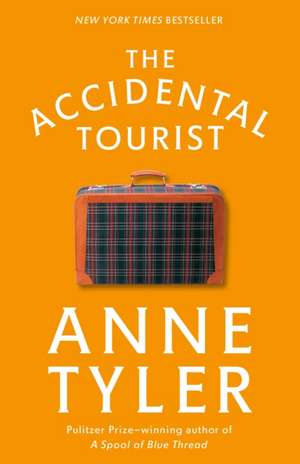
The Accidental Tourist
Autor Anne Tyleren Limba Engleză Paperback – apr 2002
Lectura acestui roman oferă o senzație stranie de familiaritate, ca un murmur cald de conversație auzit prin ferestrele deschise ale unei case vecine. Remarcăm, încă de la primele pagini, atmosfera melancolică și totodată comică în care Anne Tyler își plasează personajele, transformând banalul cotidian într-un spectacol de o profunzime emoțională rară. Macon Leary, protagonistul, este un bărbat captiv în propria rigoare, un scriitor de ghiduri de călătorie care încearcă paradoxal să minimizeze orice contact cu necunoscutul. Observăm cum Tyler construiește o punte între izolarea autoimpusă a lui Macon și vitalitatea haotică reprezentată de Muriel, dresoarea de câini care îi forțează intrarea înapoi în fluxul vieții. Tonul este unul de o compasiune lucidă, explorând cum tragedia personală — pierderea fiului său — a pietrificat rutina unui om până la absurd. Cartea amintește de Redhead by the Side of the Road prin portretul unui bărbat atașat obsesiv de tabieturile sale și de o existență calibrată matematic, dar The Accidental Tourist se diferențiază printr-o încărcătură tragică mai pronunțată și o rezolvare narativă mai amplă. În contextul operei sale, romanul se situează între explorările familiale din French Braid și dinamica domestică din Breathing Lessons, păstrând acea precizie a detaliului care a consacrat-o pe autoare. Nu este doar o poveste despre doliu, ci o cronică despre curajul de a fi „improvisat” într-o lume care cere ordine. Tyler nu judecă slăbiciunile personajelor sale, ci le expune cu o blândețe care face ca fiecare mic eșec domestic să pară o victorie a spiritului uman.
Preț: 102.23 lei
Carte disponibilă
Livrare economică 09-23 noiembrie
Livrare express 23-29 octombrie pentru 42.81 lei
Specificații
ISBN-10: 0345452003
Pagini: 352
Dimensiuni: 128 x 200 x 22 mm
Greutate: 0.26 kg
Ediția:Ballantine Book.
Editura: Random House LLC US
Colecția Ballantine Books
V-ar putea interesa
-
 Great WorldDavid Malouf-51%Preț: 59.46 lei121.09 lei
 -
 The Tin Can TreeAnne Tyler-27%Preț: 56.09 lei76.89 lei
 -
 Very Long EngagementSebastien Japrisot-52%Preț: 56.79 lei118.88 lei
 -
 Earthly PossessionsAnne Tyler-19%Preț: 57.02 lei70.62 lei
 -
 The Amateur MarriageAnne Tyler-26%Preț: 57.59 lei77.93 lei
 -
 Clock WinderAnne Tyler-25%Preț: 59.33 lei79.33 lei
 -
 FanglandJohn MarksPreț: 116.98 lei
 -
 A Slipping Down LifeAnne Tyler-20%Preț: 55.71 lei69.84 lei
 -
 Morgan''s PassingAnne Tyler-26%Preț: 58.62 lei78.93 lei
 -
 If Morning Ever ComesAnne Tyler-28%Preț: 55.19 lei76.91 lei
 -
 -19%Preț: 52.53 lei64.66 lei
 -
 KarooSteve Tesich-23%Preț: 61.86 lei80.83 lei
 -
 MemoirsTennessee Williams-19%Preț: 76.26 lei93.84 lei
 -
 The Woman Who WaitedAndreï Makine-27%Preț: 57.14 lei78.35 lei
 -
 Human LoveAndreï Makine-27%Preț: 56.29 lei77.31 lei
 -
 Alias GraceMargaret Atwood-23%Preț: 63.18 lei81.95 lei
 -
 Morgan's PassingAnne TylerPreț: 85.19 lei
 -
 SummerEdith WhartonPreț: 34.93 lei
 -
 No Longer HumanOsamu DazaiPreț: 85.29 lei
 -
 Clinical Studies in Neuropsychoanalysis RevisitedChristian Salas-5%Preț: 338.46 lei356.28 lei
 -
 Beyond Evolutionary PsychologyGeorge EllisPreț: 248.60 lei
 -
 CODE NAME VERITY PBElizabeth WeinPreț: 72.17 lei
 -
 More Than ThisPatrick NessPreț: 66.59 lei
 -
 The Only Woman in the RoomMarie Benedict-26%Preț: 52.76 lei71.72 lei
 -
 The Inseparable Nature of Love and AggressionOtto F. Kernberg-5%Preț: 467.65 lei492.26 lei
 -
 SexualityMeg-John BarkerPreț: 124.95 lei
 -
 -23%Preț: 110.67 lei143.32 lei
De ce să citești această carte
Recomandăm această carte celor care caută o proză de o finețe psihologică excepțională, unde umorul și tristețea coexistă firesc. Cititorul va câștiga o perspectivă nouă asupra modului în care micile rutine ne protejează sau ne izolează de lume. Este o lectură esențială pentru fanii realismului domestic, oferind o lecție discretă despre cum poți învăța să călătorești prin propria viață fără a mai fi un simplu turist accidental.
Despre autor
Anne Tyler, născută în 1941, este una dintre cele mai respectate voci ale literaturii americane contemporane, fiind membră a Academiei Americane de Arte și Litere. De-a lungul carierei sale prolifice, a publicat peste douăzeci de romane, fiind recunoscută pentru abilitatea de a surprinde nuanțele vieții de familie din Baltimore. The Accidental Tourist a marcat un punct de cotitură în cariera sa, câștigând National Book Critics Circle Award, succes urmat de Premiul Pulitzer pentru Breathing Lessons. Stilul său este adesea comparat cu cel al lui Jane Austen sau John Updike, datorită observației sociale ascuțite și limbajului precis.
Extras
Macon wore a formal summer suit, his traveling suit—much more logical for traveling than jeans, he always said. Jeans had those stiff, hard seams and those rivets. Sarah wore a strapless terry beach dress. They might have been returning from two entirely different trips. Sarah had a tan but Macon didn’t. He was a tall, pale, gray-eyed man, with straight fair hair cut close to his head, and his skin was that thin kind that easily burns. He’d kept away from the sun during the middle part of every day.
Just past the start of the divided highway, the sky grew almost black and several enormous drops spattered the windshield. Sarah sat up straight. “Let’s hope it doesn’t rain,” she said.
“I don’t mind a little rain,” Macon said.
Sarah sat back again, but she kept her eyes on the road.
It was a Thursday morning. There wasn’t much traffic. They passed a pickup truck, then a van all covered with stickers from a hundred scenic attractions. The drops on the windshield grew closer together. Macon switched his wipers on. Tick-swoosh, they went—a lulling sound; and there was a gentle patter on the roof. Every now and then a gust of wind blew up. Rain flattened the long, pale grass at the sides of the road. It slanted across the boat lots, lumberyards, and discount furniture outlets, which already had a darkened look as if here it might have been raining for some time.
“Can you see all right?” Sarah asked.
“Of course,” Macon said. “This is nothing.”
They arrived behind a trailer truck whose rear wheels sent out arcs of spray. Macon swung to the left and passed. There was a moment of watery blindness till the truck had dropped behind. Sarah gripped the dashboard with one hand.
“I don’t know how you can see to drive,” she said.
“Maybe you should put on your glasses.”
“Putting on my glasses would help you to see?”
“Not me; you,” Macon said. “You’re focused on the windshield instead of the road.”
Sarah continued to grip the dashboard. She had a broad, smooth face that gave an impression of calm, but if you looked closely you’d notice the tension at the corners of her eyes.
The car drew in around them like a room. Their breaths fogged the windows. Earlier the air conditioner had been running and now some artificial chill remained, quickly turning dank, carrying with it the smell of mildew. They shot through an underpass. The rain stopped completely for one blank, startling second. Sarah gave a little gasp of relief, but even before it was uttered, the hammering on the roof resumed. She turned and gazed back longingly at the underpass. Macon sped ahead, with his hands relaxed on the wheel.
“Did you notice that boy with the motorcycle?” Sarah asked. She had to raise her voice; a steady, insistent roaring sound engulfed them.
“What boy?”
“He was parked beneath the underpass.”
“It’s crazy to ride a motorcycle on a day like today,” Macon said. “Crazy to ride one any day. You’re so exposed to the elements.”
“We could do that,” Sarah said. “Stop and wait it out.”
“Sarah, if I felt we were in the slightest danger I’d have pulled over long ago.”
“Well, I don’t know that you would have,” Sarah said.
They passed a field where the rain seemed to fall in sheets, layers and layers of rain beating down the cornstalks, flooding the rutted soil. Great lashings of water flung themselves at the windshield. Macon switched his wiper blades to high.
“I don’t know that you really care that much,” Sarah said. “Do you?”
Macon said, “Care?”
“I said to you the other day, I said, ‘Macon, now that Ethan’s dead I sometimes wonder if there’s any point to life.’ Do you remember what you answered?”
“Well, not offhand,” Macon said.
“You said, ‘Honey, to tell the truth, it never seemed to me there was all that much point to begin with.’ Those were your exact words.”
“Um . . .”
“And you don’t even know what was wrong with that.”
“No, I guess I don’t,” Macon said.
He passed a line of cars that had parked at the side of the road, their windows opaque, their gleaming surfaces bouncing back the rain in shallow explosions. One car was slightly tipped, as if about to fall into the muddy torrent that churned and raced in the gully. Macon kept a steady speed.
“You’re not a comfort, Macon,” Sarah said.
“Honey, I’m trying to be.”
“You just go on your same old way like before. Your little routines and rituals, depressing habits, day after day. No comfort at all.”
“Shouldn’t I need comfort too?” Macon asked. “You’re not the only one, Sarah. I don’t know why you feel it’s your loss alone.”
“Well, I just do, sometimes,” Sarah said.
They were quiet a moment. A wide lake, it seemed, in the center of the highway crashed against the underside of the car and slammed it to the right. Macon pumped his brakes and drove on.
“This rain, for instance,” Sarah said. “You know it makes me nervous. What harm would it do to wait it out? You’d be showing some concern. You’d be telling me we’re in this together.”
Macon peered through the windshield, which was streaming so that it seemed marbled. He said, “I’ve got a system, Sarah. You know I drive according to a system.”
“You and your systems!”
“Also,” he said, “if you don’t see any point to life, I can’t figure why a rainstorm would make you nervous.”
Sarah slumped in her seat.
“Will you look at that!” he said. “A mobile home’s washed clear across that trailer park.”
“Macon, I want a divorce,” Sarah told him.
Macon braked and glanced over at her. “What?” he said. The car swerved. He had to face forward again. “What did I say?” he asked. “What did it mean?”
“I just can’t live with you anymore,” Sarah said.
Macon went on watching the road, but his nose seemed sharper and whiter, as if the skin of his face had been pulled tight. He cleared his throat. He said, “Honey. Listen. It’s been a hard year. We’ve had a hard time. People who lose a child often feel this way; everybody says so; everybody says it’s a terrible strain on a marriage—”
“I’d like to find a place of my own as soon as we get back,” Sarah told him.
“Place of your own,” Macon echoed, but he spoke so softly, and the rain beat so loudly on the roof, it looked as if he were only moving his lips. “Well,” he said. “All right. If that’s what you really want.”
“You can keep the house,” Sarah said. “You never did like moving.”
For some reason, it was this that made her finally break down. She turned away sharply. Macon switched his right blinker on. He pulled into a Texaco station, parked beneath the overhang, and cut off the engine. Then he started rubbing his knees with his palms. Sarah huddled in her corner. The only sound was the drumming of rain on the overhang far above them.
Descriere scurtă
–The New York Times
Macon Leary is a travel writer who hates both travel and anything out of the ordinary. He is grounded by loneliness and an unwillingness to compromise his creature comforts when he meets Muriel, a deliciously peculiar dog-obedience trainer who up-ends Macon’s insular world–and thrusts him headlong into a remarkable engagement with life.
“BITTERSWEET . . . EVOCATIVE . . . It’s easy to forget this is the warm lull of fiction; you half-expect to run into her characters at the dry cleaners . . . Tyler [is] a writer of great compassion.”
–The Boston Globe
“Tyler has given us an endlessly diverting book whose strength gathers gradually to become a genuinely thrilling one.”
–Los Angeles Times
“A DELIGHT . . . A GRACEFUL COMIC NOVEL ABOUT GETTING THROUGH LIFE.”
–The Wall Street Journal
Recenzii
It leaves one aching with pleasure and pain.”
–The Washington Post
“Hilarious . . . and touching . . . Anne Tyler is a wise and perceptive writer with a warm understanding of human foibles.”
–St. Louis Post-Dispatch
“Comic . . . Sweetly perverse . . . A novel animated by witty invention and lively personalities.”
–Time
“Anne Tyler [is] covering common ground with uncommon insight. . . . Convincingly real.”
–People