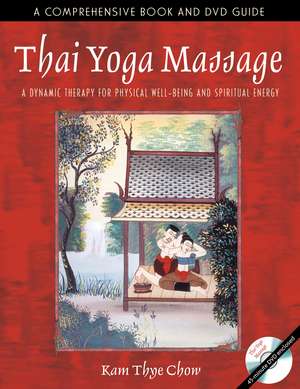
Thai Yoga Massage: A Dynamic Therapy for Physical Well-Being and Spiritual Energy
Autor Kam Thye Chowen Limba Engleză Paperback – 9 mar 2004
Preț: 121.13 lei
Preț vechi: 159.82 lei
-24%
Puncte Express: 182
Carte disponibilă
Livrare economică 13-25 noiembrie
Livrare prin curier în România Termenul estimat este afișat lângă disponibilitate.
Transport gratuit de la 400.00 lei Plată online sau ramburs, în funcție de opțiunile comenzii.
Retur gratuit în 14 zile Comandă securizată și suport în română.
Specificații
ISBN-13: 9780892811465
ISBN-10: 0892811463
Pagini: 160
Ilustrații: 144 b&w photographs and 49 b&w illustrations
Dimensiuni: 216 x 279 x 13 mm
Greutate: 0.47 kg
Ediția:Paperback Edition with DVD
Editura: Inner Traditions/Bear & Company
Colecția Healing Arts Press
Locul publicării:United States
ISBN-10: 0892811463
Pagini: 160
Ilustrații: 144 b&w photographs and 49 b&w illustrations
Dimensiuni: 216 x 279 x 13 mm
Greutate: 0.47 kg
Ediția:Paperback Edition with DVD
Editura: Inner Traditions/Bear & Company
Colecția Healing Arts Press
Locul publicării:United States
V-ar putea interesa
-
 JuicingDaniel D'ApollonioPreț: 158.56 lei
 -
 Preț: 134.41 lei
 -
 Preț: 95.47 lei
 -
 Pray. Eat. Lift.Meagan PinkneyPreț: 68.72 lei
 -
 The Yin Yoga Kit: The Practice of Quiet PowerBiff Mithoefer-30%Preț: 113.26 lei162.63 lei
 -
 -23%Preț: 95.08 lei124.23 lei
 -
 -23%Preț: 95.03 lei124.16 lei
 -
 -24%Preț: 100.53 lei131.85 lei
 -
 -18%Preț: 113.95 lei138.31 lei
 -
 Preț: 137.74 lei
 -
 Hot Stone and Gem MassageDagmar Fleck-24%Preț: 86.00 lei113.81 lei
 -
 -37%Preț: 133.57 lei212.66 lei
 -
 -34%Preț: 142.32 lei216.76 lei
 -
 My Life as a DietMaurice HorwitzPreț: 80.90 lei
 -
 Preț: 74.25 lei
 -
 Preț: 73.64 lei
 -
 Preț: 73.07 lei
 -
 Weight Loss Winners & Dieting DownfallsBurns-Hill Phd, AlyssaPreț: 64.81 lei
 -
 Till the Fat Lady Slims 2.0 - The 'When' DietFlint, MS DebbiePreț: 71.34 lei
 -
 Preț: 96.47 lei
 -
 Preț: 105.51 lei
 -
 Preț: 103.27 lei
 -
 The World's Greatest Weight Loss SecretJeremy HendonPreț: 82.50 lei
 -
 Preț: 66.88 lei
 -
 Green SmoothiesBern, Mrs SaraPreț: 59.31 lei
Notă biografică
Kam Thye Chow (1958–2018), was one of the world’s foremost practitioners and taught massage in Thailand and throughout Europe and North America. Author of Tai Chi Chuan: Mindfulness in Motion, his writings were featured in Massage Magazine, Bodywork, and other healing arts journals. He was the founder and director of the Lotus Palm School in Montreal.
Extras
The Working Stances
Thai Yoga Massage is a beautiful dance that requires continuous movement by the practitioner to provide a relaxed and flowing session for the recipient. It is therefore extremely important that the practitioner uses his body well, moving with effortless, graceful transitions. Ancient lessons of fluid movement and proper body mechanics are extracted from the traditions of tai chi and yoga as a foundation for the working stances described below.
When holding a working stance within Thai Yoga Massage, consider the tree as inspiration for your position. Imagine your arms and hands are the branches, strong yet yielding. They are connected to your spine, which is the trunk of a tree, sturdy and erect. The spine transfers your body’s weight to your feet, which are the roots, firmly planted in the earth. By keeping your spine straight and your head up, you are aligning the seven energy centers (the chakras) along the spine. Combining the energy of earth and heaven, like the tree, with the energy of your body, you maintain a strong yet resilient posture that is fluid in every aspect of its movement.
A common mistake for bodywork practitioners is hunching through the back and losing strong spinal alignment through the course of a session. When the body is hunched over in this way, the practitioner is using her shoulders instead of connecting her body to the earth. This position can result in a sore back and fatigue for the practitioner, and a less-than-effective massage for the recipient. Always keep the image of the tree present in your body as you practice these stances.
Warrior Stance
From the Kneeling Diamond stance (see page 35), rise up on one knee. Keep your arms and back straight. Move from the second chakra as you work on the recipient. Be careful that the raised knee does not extend beyond the toes; the front heel is grounded. This is the most frequently used stance in a Thai Yoga Massage session.
Archer Stance
In a squatting stance, the toes of both feet are tucked under. Place one knee on the ground. Keep your back straight. This is a tricky pose, requiring strength and balance. Practice, practice, practice.
Tai Chi Stance
Stand with feet shoulder-width apart; legs are straight but knees are soft. Step forward a comfortable distance, straightening your back leg and bending your front knee slightly. Do not let your bent knee extend past your toes. The front foot is pointing directly ahead and the back foot is naturally turned outward. Maintain a stable center, with 70 percent of your weight on the front leg and 30 percent on the back leg.
Rowboat
From Warrior stance move into Kneeling Diamond stance. Grasp the recipient’s elbows and allow the hands to fall beside the hips. Support the recipient’s shoulders with your hands.
Cross your legs behind you, roll back, and sit down in a cross-legged position.
Place your feet on the recipient’s upper back, with your toes on the scapula. Grasp the recipient’s wrists and gently lift and spread the arms outward, as if you are conducting an orchestra. Bend your legs at the knees, allowing the recipient to fall into an upper-back backbend.
Straighten your legs to gently push the recipient upright.
Repeat twice, moving your feet down the back about one inch at a time.
Benefits: Helps relax the back after sitting; strengthens the back by supporting the recipient in a properly upright posture.
Precaution: Be careful not to pull the arms too much, as this can cause discomfort to the shoulder and pectoral muscles.
Recommended for: Kapha, and for vata if performed gently
AG Pose (Anti-Gravitational Spinal Relaxation Pose)
Bend the recipient’s legs, knees together. Place the recipient’s insteps on your knees. Keep your knees together and your feet spread shoulder-width apart. Reach around and interlace your fingers just above the recipient’s knees. Hold tight!
Pull the recipient’s legs firmly toward your body. With a confident lift and squat, bring the recipient up into the AG pose.
To release, roll up and return the recipient to the original position. Slowly walk back while holding the feet. Gently shake out the legs and rock them from side to side.
Adaptation: If you have sharp, pointy kneecaps, use a folded towel between your knees and the recipient’s insteps. For a more secure grip, use a scarf or a yoga strap.
Benefits: This inversion exercise relaxes the lower back, increases space between the vertebrae, and provides traction to the spine; this is one of the most surprising and well-loved poses.
Common mistake: The practitioner does not stand with his knees together, and/or stands too far away from the recipient to do the posture effectively. It is easier to execute this pose when you are closer to the recipient, but it’s a fine balance. Don’t be intimidated by this posture; it’s easier than it looks. Just keep your knees together, gauge your distance from the recipient, remember to breathe, and--whatever you do--don’t let go!
Precaution: Do not lift the recipient’s neck off the mat. To be safe, advise the recipient to tuck her chin to her chest when releasing the pose.
Recommended for: Pitta and kapha
Thai Yoga Massage is a beautiful dance that requires continuous movement by the practitioner to provide a relaxed and flowing session for the recipient. It is therefore extremely important that the practitioner uses his body well, moving with effortless, graceful transitions. Ancient lessons of fluid movement and proper body mechanics are extracted from the traditions of tai chi and yoga as a foundation for the working stances described below.
When holding a working stance within Thai Yoga Massage, consider the tree as inspiration for your position. Imagine your arms and hands are the branches, strong yet yielding. They are connected to your spine, which is the trunk of a tree, sturdy and erect. The spine transfers your body’s weight to your feet, which are the roots, firmly planted in the earth. By keeping your spine straight and your head up, you are aligning the seven energy centers (the chakras) along the spine. Combining the energy of earth and heaven, like the tree, with the energy of your body, you maintain a strong yet resilient posture that is fluid in every aspect of its movement.
A common mistake for bodywork practitioners is hunching through the back and losing strong spinal alignment through the course of a session. When the body is hunched over in this way, the practitioner is using her shoulders instead of connecting her body to the earth. This position can result in a sore back and fatigue for the practitioner, and a less-than-effective massage for the recipient. Always keep the image of the tree present in your body as you practice these stances.
Warrior Stance
From the Kneeling Diamond stance (see page 35), rise up on one knee. Keep your arms and back straight. Move from the second chakra as you work on the recipient. Be careful that the raised knee does not extend beyond the toes; the front heel is grounded. This is the most frequently used stance in a Thai Yoga Massage session.
Archer Stance
In a squatting stance, the toes of both feet are tucked under. Place one knee on the ground. Keep your back straight. This is a tricky pose, requiring strength and balance. Practice, practice, practice.
Tai Chi Stance
Stand with feet shoulder-width apart; legs are straight but knees are soft. Step forward a comfortable distance, straightening your back leg and bending your front knee slightly. Do not let your bent knee extend past your toes. The front foot is pointing directly ahead and the back foot is naturally turned outward. Maintain a stable center, with 70 percent of your weight on the front leg and 30 percent on the back leg.
Rowboat
From Warrior stance move into Kneeling Diamond stance. Grasp the recipient’s elbows and allow the hands to fall beside the hips. Support the recipient’s shoulders with your hands.
Cross your legs behind you, roll back, and sit down in a cross-legged position.
Place your feet on the recipient’s upper back, with your toes on the scapula. Grasp the recipient’s wrists and gently lift and spread the arms outward, as if you are conducting an orchestra. Bend your legs at the knees, allowing the recipient to fall into an upper-back backbend.
Straighten your legs to gently push the recipient upright.
Repeat twice, moving your feet down the back about one inch at a time.
Benefits: Helps relax the back after sitting; strengthens the back by supporting the recipient in a properly upright posture.
Precaution: Be careful not to pull the arms too much, as this can cause discomfort to the shoulder and pectoral muscles.
Recommended for: Kapha, and for vata if performed gently
AG Pose (Anti-Gravitational Spinal Relaxation Pose)
Bend the recipient’s legs, knees together. Place the recipient’s insteps on your knees. Keep your knees together and your feet spread shoulder-width apart. Reach around and interlace your fingers just above the recipient’s knees. Hold tight!
Pull the recipient’s legs firmly toward your body. With a confident lift and squat, bring the recipient up into the AG pose.
To release, roll up and return the recipient to the original position. Slowly walk back while holding the feet. Gently shake out the legs and rock them from side to side.
Adaptation: If you have sharp, pointy kneecaps, use a folded towel between your knees and the recipient’s insteps. For a more secure grip, use a scarf or a yoga strap.
Benefits: This inversion exercise relaxes the lower back, increases space between the vertebrae, and provides traction to the spine; this is one of the most surprising and well-loved poses.
Common mistake: The practitioner does not stand with his knees together, and/or stands too far away from the recipient to do the posture effectively. It is easier to execute this pose when you are closer to the recipient, but it’s a fine balance. Don’t be intimidated by this posture; it’s easier than it looks. Just keep your knees together, gauge your distance from the recipient, remember to breathe, and--whatever you do--don’t let go!
Precaution: Do not lift the recipient’s neck off the mat. To be safe, advise the recipient to tuck her chin to her chest when releasing the pose.
Recommended for: Pitta and kapha
Cuprins
Acknowledgments
Foreword by Sudhir Jonathan Foust
Part One: The Philosophy
1. From Temple Art to Healing Art
2. Theoretical Foundations: The Sen Lines, the Doshas, and Western Medical Principles
3. The Dancing Meditation of Thai Yoga Massage
4. The Practitioner/Client Relationship
Part Two: The Practice
5. Introduction
6. Sitting Postures
7. Double- and Single-Foot Postures
8. Sen Work on Legs
9. Single-Leg Postures
10. Side-Lying Postures
11. Back-Position Postures
12. Double-Leg Postures
13. Abdomen, Chest, Arm, and Hand Postures
14. Session Closure
Appendix 1: Personal Health Questionnaire
Appendix 2: Ayurvedic Constitution Questionnaire
Resources
Suggested Reading
Foreword by Sudhir Jonathan Foust
Part One: The Philosophy
1. From Temple Art to Healing Art
2. Theoretical Foundations: The Sen Lines, the Doshas, and Western Medical Principles
3. The Dancing Meditation of Thai Yoga Massage
4. The Practitioner/Client Relationship
Part Two: The Practice
5. Introduction
6. Sitting Postures
7. Double- and Single-Foot Postures
8. Sen Work on Legs
9. Single-Leg Postures
10. Side-Lying Postures
11. Back-Position Postures
12. Double-Leg Postures
13. Abdomen, Chest, Arm, and Hand Postures
14. Session Closure
Appendix 1: Personal Health Questionnaire
Appendix 2: Ayurvedic Constitution Questionnaire
Resources
Suggested Reading
Recenzii
“Only a true master of Thai massage could present this profound healing art with such clarity and precision, and make it so accessible.”
“Necessary reading for anyone interested in this indigenous healing art and its contemporary practice. Kam Thye Chow is a sensei of the art and spirit of his work.”
"A supremely accessible teacher, Kam Thye is masterful with detail and nuance in the develpment and transmission of this ancient practice."
"I highly recommend this text for practicioners who are flexible and love floor work."
"This is a must-have for anyone interested in a dynamic therapy for physical well being."
"A dynamic guide, therapists should add Thai Yoga Massage to their home instructional reference libraries."
“Necessary reading for anyone interested in this indigenous healing art and its contemporary practice. Kam Thye Chow is a sensei of the art and spirit of his work.”
"A supremely accessible teacher, Kam Thye is masterful with detail and nuance in the develpment and transmission of this ancient practice."
"I highly recommend this text for practicioners who are flexible and love floor work."
"This is a must-have for anyone interested in a dynamic therapy for physical well being."
"A dynamic guide, therapists should add Thai Yoga Massage to their home instructional reference libraries."
Descriere
A paperback edition with DVD featuring a unique massage therapy that combines stretching, breath work, assisted yoga postures, and pressure point therapy.