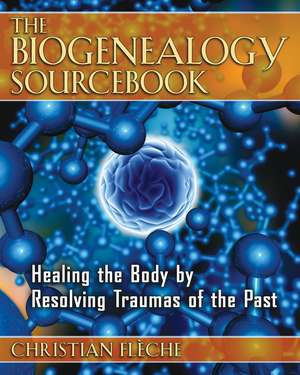
The Biogenealogy Sourcebook: Healing the Body by Resolving Traumas of the Past
Autor Christian Flècheen Limba Engleză Paperback – 18 iun 2008
Preț: 100.53 lei
Preț vechi: 131.85 lei
-24%
Puncte Express: 151
Carte disponibilă
Livrare economică 13-25 noiembrie
Livrare prin curier în România Termenul estimat este afișat lângă disponibilitate.
Transport gratuit de la 400.00 lei Plată online sau ramburs, în funcție de opțiunile comenzii.
Retur gratuit în 14 zile Comandă securizată și suport în română.
Specificații
ISBN-13: 9781594772061
ISBN-10: 1594772061
Pagini: 224
Ilustrații: 28 b&w illustrations
Dimensiuni: 203 x 254 x 15 mm
Greutate: 0.41 kg
Ediția:Us.
Editura: Inner Traditions/Bear & Company
Colecția Healing Arts Press
ISBN-10: 1594772061
Pagini: 224
Ilustrații: 28 b&w illustrations
Dimensiuni: 203 x 254 x 15 mm
Greutate: 0.41 kg
Ediția:Us.
Editura: Inner Traditions/Bear & Company
Colecția Healing Arts Press
Notă biografică
Christian Flèche is a psychotherapist and a master practitioner of Neuro-Linguistic Programming and the leader in the field of the biological decoding of the psycho-cerebro-physical effects of diseases that manifest in the body. He also is a practitioner of metaphor and symbolic modeling and uses Ericksonian hypnosis, psychogenealogy, and memorized biological cycles in his work. His workshops and seminars have influenced therapists throughout his homeland of France.
Extras
From the Introduction
Jung said that we aren’t here to heal our illnesses, but our illnesses are here to heal us.
A woman came to consult with me one day because she had a tumor in her left breast. The breast is the only organ that has no use for its owner--it is for someone else. A problem in the breast is therefore a problem in relation to someone else. The breast is there to make milk, to nourish someone else, to give of oneself.
So I explained to this woman that with this illness there was someone else, a child or someone in maternal relation to her, with whom there was a problem. We moved back in time, and suddenly she collapsed in tears. She found the event, the emotional experience, and she related this story. She was at a fair with her grandson. Wanting to ride on the ghost train, he rushed forward and fell with his hands on the rail just as the train arrived. . . . Within a second, she saw the child’s hands cut off, and all the problems that this handicap would cause. She immediately saw a thousand and one things and felt guilty for each one. It was unthinkable. She wanted to do something, give something of herself, but there was nothing that could be done. There she was,
caught in a maternal impossibility. What she told me in the course of half an hour took place in her head within one or two seconds.
In fact, the child was unharmed except for a few scratches on his knee. He had long sleeves and his hands were not on the rail, but she didn’t see that. At that moment in time, a sharp emotion had entered her. After the incident, using her reason, she convinced herself that all was well and the child was safe. But the important element is not what she knew in her head but what she felt in her body--what happened in her “gut.” In her gut she felt this accident could well happen again, and this time for real. She began to have nightmares about it. In her head, she was settled; there was no problem. In her gut, that moment in time was fixed, frozen.
When scientists drill into an ice floe, they discover dust and gas that dates from prehistory. The same is true with people. It’s all there in the history, in the deep layers. Everything remains. And for this woman, if a few years later she happened to see something on television, a child in trouble who falls or is knocked over, anything like that, that’s all that’s needed for there to be an effect, for the emotional experience to be awakened and unleash a physical symptom of adaptation.
Someone else who has not experienced the same ordeal does not experience the events in the same way. This woman, on the other hand, has been programmed for this reaction. She carries within herself: it could happen. She has this program in her mind, in her memory, in her cells, in the nucleus of her cells, in the genetic code of the nuclei of her cells--which eventually manifests as a tumor in her breast.
From Chapter 12
Reproductive System
GYNECOLOGY
BREASTS
Four types of conflict can arise in the four types of tissue present in the breast:
1. Mammary gland: Conflicts related to the glands of the breast are conflicts of the human ordeal and can manifest physically as mastosis and adenocarcinoma.
2. Galactophore ducts: These ducts are linked to conflicts of separation and can manifest physically as intraduct epithelioma.
3. Derma: The derma is related to conflicts involving defilement and the physical condition of melanoma.
4. Nerve endings: The nerve endings are related to the desire for separation and neurinoma.
1. Mammary Gland Conflicts
Left Breast: In a right-handed woman, physical problems with the left breast are related to mother/child conflicts. This concerns the territory of the nest and everything for which we feel responsible, where people absolutely need us.
Conflicts of this nature can manifest in a number of ways:
• Through identification, by taking the child’s side against someone or something.
• In a conflict in relation to the child: what happens to the child or what he or she has done.
The same kind of impact can be produced with a virtual child (someone who occupies this role), an ill family member (someone who is a dependant due to old age, illness, or injury), and anyone or anything that you feel driven to mother and protect.
Right Breast: For a right-handed woman, problems with the right breast relate to conflicts with a partner--someone she mothers but in secondary way. These partnership relationships are ranked as follows: first are the parents, second are siblings and grown-up children, the third is the husband, and in fourth place are neighbors, colleagues, cousins, and friends.
Note: For a left-handed woman, this is reversed. The right breast is related to conflicts of the nest, and the left breast to conflicts with a partner.
Examples:
• Mrs. X had several children. She and her husband decided to build a house. The husband wanted her to make plans with him, very quickly. However, she was overloaded with work and could not manage to do any more. She argued with her husband about this house, this nest where they wanted to raise their children. A tumor was later found in her left breast.
• Mrs. Y’s right breast was red and burning. The emotional conflict she was struggling with was a fear that when she died, her depressed adult child would be unable to cope and have no one to look after her.
Cerebral Connections of Mammary Gland Conflicts:
• Primordial mesoderm
• Lateral position of the cerebellum on the side opposite the breast
Cuprins
Acknowledgments
Preface
Introduction: The General Principles of Biogenealogy
1. Cardiology
2. Dermatology
3. Digestive System
4. Endocrinology
5. Hematology
6. Neurology
7. Ophthalmology
8. Osteology and the Musculoskeletal System
9. Otolaryngology: Ear, Nose, and Throat
10. Pulmonology
11. Reproductive System: Andrology
12. Reproductive System: Gynecology
13. Urology
Conclusion
Glossary
Index
Recenzii
"The Biogenealogy Sourcebook is as thought provoking as it is practical in showing us one of the true conduits between creation and nature. It opens up some of the secrets by which we were meant to live our lives and presents us with a template to align our physical and emotional needs. Reading it could well change your life and who knows one day it might even save it."
Descriere
A practical guide to the correspondence between emotion, organ systems, and disease.