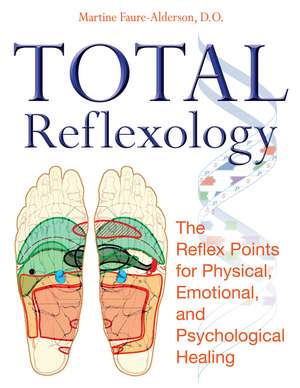
Total Reflexology: The Reflex Points for Physical, Emotional, and Psychological Healing
Autor Martine Faure-Alderson D.O.en Limba Engleză Paperback – 26 noi 2008
Preț: 154.76 lei
Preț vechi: 258.22 lei
-40%
Carte disponibilă
Livrare economică 13-25 noiembrie
Specificații
ISBN-10: 1594772479
Pagini: 176
Ilustrații: Full-color throughout
Dimensiuni: 216 x 279 x 13 mm
Greutate: 0.64 kg
Editura: Inner Traditions/Bear & Company
Colecția Healing Arts Press
V-ar putea interesa
-
 Total Reflexology of the Hand: An Advanced Guide to the Integration of Craniosacral Therapy and ReflexologyMartine Faure-Alderson D.O.-22%Preț: 92.65 lei118.53 lei
 -
 Preț: 146.20 lei
Notă biografică
Martine Faure-Alderson, D.O., had integrated naturopathy, acupuncture, and homeopathy into her medical practice for 25 years before she began her training in reflexology in the 1960s. She combines all these complementary holistic disciplines in her treatment and diagnoses of patients and in her research and teaching at her Total Reflexology Therapy school in Paris. She also gives seminars throughout the United States, Canada, Australia, New Zealand, England, and Europe. She lives in England.
Extras
From Reflex to Consciousness
The Total Reflexology Therapy method presented in this book is distinguished from other methods by the following essential facts:
-The holistic principle “All is in all and all is the cause of all” is fundamental: it is based on the dynamic unity of the body in its self-regulating and self-healing abilities.
-The craniosacral principle dear to osteopaths resides in the study of the fluctuations of the cerebrospinal fluid, which acts on the nervous system by means of the primary respiratory mechanism (PRM). Total Reflexology Therapy is the first to have applied these principles to foot reflexology and integrated their consequences into this practice.
-Perfectly mirroring the afflicted regions when their reflex point is painful to the touch, the occipital zones confirm which zones on the foot need to be worked on--whether the problem is structural in nature or originates in the sympathetic or parasympathetic nervous systems.
The human being is an emotional, mental, and structural whole (bones, muscles, nerves, organs, fluids). Therefore, a simple physical treatment applied to a reflex point or a zone of the foot can affect a particular organ or region of the body beyond the physical plane, on the psychic or even the mental plane, triggering a healing emotional release. A pain in the stomach, for example, could reveal a difficulty in digesting not a food but a traumatizing event, even one that occurred in the remote past.
As all these principles come out of a strict discipline, appropriate treatments will require a precise diagnostic choice followed by a precise working of the corresponding points and zones on the foot. This precision can exist only if infallible and invariable anatomical benchmarks are used as points of reference. Only the human skeleton can provide these elements.
Let it be emphasized here that the plates presented in this book are not simplistic textbook diagrams of organs; they represent the precise zones correlated with each unique organ and its particular systems following years of research and experimentation.
The Different Systems of the Body
After asking the patient the preliminary questions, palpating the occipital zones, determining his or her bio-type, and in some cases charting the effects of stress, the practitioner should take great care in considering the different treatments that might be applied to treat the pathological conditions of the particular systems involved.
It is necessary to distinguish the following and take an exact measurement of each of them:
-The symptom, or the sign, perceived by the patient or established by a clinical examination
-The syndrome (or set of symptoms) that best sums up the pathological process
-The illness (or description of the associated syndromes)
The practitioner should always keep in mind that he or she is treating not a disease but a patient.
The practitioner should also pay special heed to Hering’s law, which provides the basis for meticulously following the evolution or involution of an illness, when overseeing the treatment’s progress.
The symptoms should move in the following way:
-From the top to the bottom of the body (descending)
-From the inside toward the outside (exiting)
-From the present toward the past (moving back through the previous stages of the illness or disorder)
In what follows we shall review the principles of the following systems in succession, from both an anatomical standpoint and a consideration of overall health:
1. The skeletal system
2. The digestive system
3. The urinary system
4. The respiratory system
5. The cardiovascular system
6. The lymphatic system
1. The Skeletal System
Standing posture reveals the vitality of the subject.
The skeleton experiences profound transformations over the course of an individual’s life. It becomes more fragile during times of hormonal change (growth, puberty, and menopause).
The skeleton supports the body and contains minerals that in some ways constitute the bricks of the body.The parathyroid glands, controlled by the liver, regulate their fixation, and the pituitary gland acts on growth.
The skeleton requires a balanced diet that includes vitamins C, D, and B; proper intestinal absorption; a hormonal system in good function; and regular physical activity, which stimulates the formation of bone cells. A deficient and acidic diet (sugars, tomatoes, citrus fruits, tea, coffee) is harmful. Stress blocks the stomach. Acids will then irritate the mucous membranes, hindering their ability to absorb minerals. Should this problem reach a crisis point, eliminate meats, processed lunch meats, fish, and dairy products from the diet as well.
Cuprins
Part One
An Introduction to Reflexology
History
Why Reflexology?
The Distinctive Features of Total Reflexology Therapy
Basics of Reflexology
Part Two
The Therapeutic Experience
Total Reflexology Treatment
The Therapeutic Experience of Reflexology
Part Three
Overview of Human Anatomy and Physiology
The Cell
The Embryological Basis of Reflexology
The Reflex Arc
Biotypes or Somatotypes
The Nervous System
The Three Brains
The Plexuses
The Endocrine Glands and the Hormones
Sleep
The Systems of the Body
The Lymphatic System
Part Four
A Healthy Lifestyle
The Vital Force
The Forces of Life
The Phenomenon of Aging
Advice for Living Well
The Brain of the Heart
Life’s Simple Pleasures Are the Best Therapy
Diet and Health
The Healing Power of Water
Part Five
Total Reflexology Therapy
The Occipital Zones and the Ten Reflex Zones
The Craniosacral System
Stress Syndrome
The Three Levels of Being
From Reflex to Consciousness
About the Author
Total Reflexology Training Seminars
Acknowledgments
Bibliography
List of Plate
Index
Recenzii
"Total Reflexology is the first complete book of reflexology to incorporate osteopathy, craniosacral therapy, and the chakra system. . . . Easily read and understood, this is a great guide for anyone to use and enjoy reflexology at home or in a professional setting."
Descriere
In this groundbreaking work, Dr. Martine Faure-Alderson takes reflexology to a new level by integrating acupuncture, naturopathy, homeopathy, and other holistic healing modalities into the practice. From her background as a physician, she brings a scientific precision to using the foot as a map of the body and all of its systems. She then uses her training in alternative therapies to integrate the mental and psychological issues that may accompany physical conditions, providing the first complete holistic approach to using reflexology for physical, emotional, and mental health. Total Reflexologypresents each of the major body systems in turn--from the digestive system to the human energetic system--using 25 full-color newly mapped foot diagrams that provide precise indications of pressure points and their correspondences to all areas of the body. The author also includes her latest work using craniosacral therapy and the role of the cerebrospinal fluid in reflexology as well as how to integrate use of the chakra system. She shows how finely tuned reflexology stimulates the body’s self-healing abilities, making this an indispensable resource for the layman and professional alike.