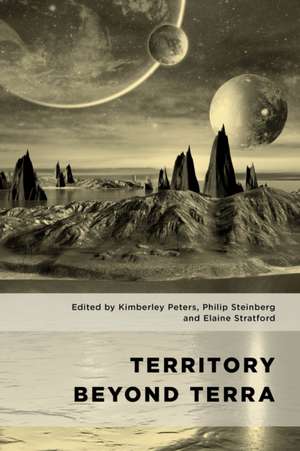
Territory Beyond Terra: Geopolitical Bodies, Material Worlds
Editat de Kimberley Peters, Philip Steinberg, Elaine Stratforden Limba Engleză Paperback – 8 mar 2018
This book examines the politics of these spaces to shed light on the challenges of our increasingly dynamic world. Through a focus on the planet's elements, environments, and edges, the contributors to Territory beyond Terra extend our understanding of territory to the dynamic, contentious spaces of contemporary politics.



Preț: 315.83 lei
Preț vechi: 408.02 lei
-23%
Puncte Express: 474
Carte tipărită la comandă
Livrare economică 07-21 decembrie
Livrare prin curier în România Termenul estimat este afișat lângă disponibilitate.
Transport gratuit de la 400.00 lei Plată online sau ramburs, în funcție de opțiunile comenzii.
Retur gratuit în 14 zile Comandă securizată și suport în română.
Specificații
ISBN-13: 9781786600127
ISBN-10: 1786600129
Pagini: 302
Ilustrații: 1 b/w illustrations;6 b/w photos;
Dimensiuni: 146 x 226 x 20 mm
Greutate: 0.41 kg
Editura: Bloomsbury Publishing
Colecția Rowman & Littlefield
Seria Geopolitical Bodies, Material Worlds
Locul publicării:New York, United States
ISBN-10: 1786600129
Pagini: 302
Ilustrații: 1 b/w illustrations;6 b/w photos;
Dimensiuni: 146 x 226 x 20 mm
Greutate: 0.41 kg
Editura: Bloomsbury Publishing
Colecția Rowman & Littlefield
Seria Geopolitical Bodies, Material Worlds
Locul publicării:New York, United States
Cuprins
Foreword, Stuart Elden / 1. Introduction, Kimberley Peters, Philip Steinberg, Elaine Stratford / PART I: Elements / 2. Earth: A grain of sand against a world of territory: experiences of sand and sandscapes in China, Marijn Nieuwenhuis / 3. Air: Spacing the atmosphere: the politics of territorialising air, Weiqiang Lin / 4. Water: Order and the offshore: the territories of deep-water oil production, Jon Phillips / 5. Fire: Pyropolitics for a world of fire, Nigel Clark / PART II: Environments / 6. Mudflats: Fluid terrain: climate contestations in the mudflats of the Bolivian highlands, Clayton Whitt / 7. Floodplains: Where sheets of water intersect: infrastructural culture from flooding to hydropower in Winnipeg, Manitoba, Stephanie C. Kane / 8. Cities: Mare-Magnum: urbanisation of land and sea, Ross Exo Adams / 9. Ice: Placing territory on ice: militarisation, measurement and murder in the High Arctic, Johanne Bruun, Philip Steinberg / PART III: Edges / 10. Bodies: The body of the drowned: convicts and shipwr
Recenzii
In a time and space marked indelibly by anthropogenic impact, Territory Beyond Terra offers new maps to comprehend our changing worlds. This fine book shows the intimate links between natural elements, geo-physical manifestations, and geopolitical power. It offers ways to understand the politics of the geo, but also shows how new politics can be shaped through and with the geo.
How do air, water, fire, and earth interact with each other and with contemporary human political imagination around parcelling of space? Various scholars in this interesting collection engage with this question using radical and eclectic theoretical, philosophical and empirical resources and make an important contribution in challenging the land-centrism of dominant academic approaches to territory. Territory will never feel the same after reading this book.
This thought-provoking book interlaces the competition for primacy of how the place where humans live is defined and its continuous process of becoming, juxtaposed against a well fitted, defined "horizon of separation." The power of the planet Earth, its surfaces and its elements to render unsovereign or sovereign a nation is magnificently displayed in this book. Framed in this way, Earth, its surface and elements are both the creator and created. The elements are sovereign and travel where they will, putting into perspective ".the limits of human agency, individual or collective" to produce a "political-social-geophysical transformation," while not limiting human agency in climate change. In developing a "political theory of terrain" Territory Beyond Terra advocates for the need to engage in a unified inquiry of ". air, water, soil, rock, ice, and biota" and the political implications of this integration.
From sand, airspace, ice-islands, to the city and back, Territory beyond Terra is a direct call to move with and beyond territory as both solid or landed, but fast or slow moving, fluidic, chaotic, stubborn, hot, cold, immersive (sometimes dangerously so) but also icy, slippery, fleshy, decomposing and dead. Peters, Steinberg, Stratford and their contributors have made an incredible volume and let loose a new territory of thinking to disturb and inspire us.
This is an original, fascinating book that focuses upon the extraordinary diversity of the meanings of 'Terra' and its Symbols', its words and meanings according to different lands. Here etymology brings about a unique original approach and invites us to reflect upon the novel meanings of geopolitics at a time marked by turbulence and instability, by combining philosophy and geography.
The authors and editors of this volume are careful to attend to what is not 'captured' in territories beyond terra, be they of the sea, air, ice or mud. In Phillips' chapter, we read of Ghanaian canoe-fishers who do not navigate with maps or radios warning of offshore exclusion zones; in Nieuwenhuis' chapter, we read of sand and dust particles too nebulous for governance; and in Gibb's chapter, assumptions around shark territoriality, and associated policies of net-based enclosure, are thoroughly complicated. We are left therefore with multiple accounts that are sensitive to the novel questions and issues posed by grasping territory beyond terra. This volume is essential reading for scholars working at the intersection of political philosophy, geography and anthropology and is, at the same time, a generous invitation for further investments in thinking about elemental and fluid territories.
Territory beyond Terra undoubtedly succeeds in destabilising inherited ontologies of territory and provides myriad alternative or extended theorisations and practices ... in decoupling territory from terrain, Territory beyond Terrashould inspire yet further exciting scholarship from both its contributors and
readers alike.
Recent years have seen the growth of a thought-provoking literature on the interconnections between geopolitics, environmental governance, and the Anthropocene. . Territory beyond Terra contributes to this new literature with a collection of thoughtful essays on how indeterminate elements, environments, and bodies can flow against expectations of an abstract and fixed political spatiality.
How do air, water, fire, and earth interact with each other and with contemporary human political imagination around parcelling of space? Various scholars in this interesting collection engage with this question using radical and eclectic theoretical, philosophical and empirical resources and make an important contribution in challenging the land-centrism of dominant academic approaches to territory. Territory will never feel the same after reading this book.
This thought-provoking book interlaces the competition for primacy of how the place where humans live is defined and its continuous process of becoming, juxtaposed against a well fitted, defined "horizon of separation." The power of the planet Earth, its surfaces and its elements to render unsovereign or sovereign a nation is magnificently displayed in this book. Framed in this way, Earth, its surface and elements are both the creator and created. The elements are sovereign and travel where they will, putting into perspective ".the limits of human agency, individual or collective" to produce a "political-social-geophysical transformation," while not limiting human agency in climate change. In developing a "political theory of terrain" Territory Beyond Terra advocates for the need to engage in a unified inquiry of ". air, water, soil, rock, ice, and biota" and the political implications of this integration.
From sand, airspace, ice-islands, to the city and back, Territory beyond Terra is a direct call to move with and beyond territory as both solid or landed, but fast or slow moving, fluidic, chaotic, stubborn, hot, cold, immersive (sometimes dangerously so) but also icy, slippery, fleshy, decomposing and dead. Peters, Steinberg, Stratford and their contributors have made an incredible volume and let loose a new territory of thinking to disturb and inspire us.
This is an original, fascinating book that focuses upon the extraordinary diversity of the meanings of 'Terra' and its Symbols', its words and meanings according to different lands. Here etymology brings about a unique original approach and invites us to reflect upon the novel meanings of geopolitics at a time marked by turbulence and instability, by combining philosophy and geography.
The authors and editors of this volume are careful to attend to what is not 'captured' in territories beyond terra, be they of the sea, air, ice or mud. In Phillips' chapter, we read of Ghanaian canoe-fishers who do not navigate with maps or radios warning of offshore exclusion zones; in Nieuwenhuis' chapter, we read of sand and dust particles too nebulous for governance; and in Gibb's chapter, assumptions around shark territoriality, and associated policies of net-based enclosure, are thoroughly complicated. We are left therefore with multiple accounts that are sensitive to the novel questions and issues posed by grasping territory beyond terra. This volume is essential reading for scholars working at the intersection of political philosophy, geography and anthropology and is, at the same time, a generous invitation for further investments in thinking about elemental and fluid territories.
Territory beyond Terra undoubtedly succeeds in destabilising inherited ontologies of territory and provides myriad alternative or extended theorisations and practices ... in decoupling territory from terrain, Territory beyond Terrashould inspire yet further exciting scholarship from both its contributors and
readers alike.
Recent years have seen the growth of a thought-provoking literature on the interconnections between geopolitics, environmental governance, and the Anthropocene. . Territory beyond Terra contributes to this new literature with a collection of thoughtful essays on how indeterminate elements, environments, and bodies can flow against expectations of an abstract and fixed political spatiality.