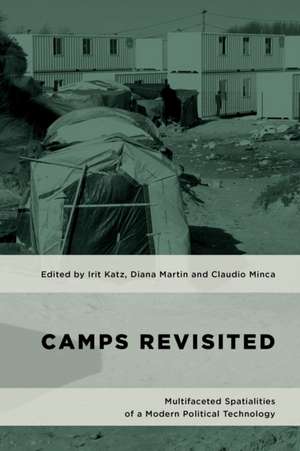
Camps Revisited: Multifaceted Spatialities of a Modern Political Technology: Geopolitical Bodies, Material Worlds
Editat de Irit Katz, Diana Martin, Claudio Mincaen Limba Engleză Paperback – 23 noi 2018
This book focuses on past and present camp geographies and on the dispositifs that make them an ever-present spatial formation in the management of unwanted populations characterizing many authoritarian regimes as well as many contemporary democracies. It also offers and investigates possible ways to resist the present-day proliferating manifestations of camps and 'camp thinking', by calling for the incorporation of 'camp studies' into the broader field of political geography and to consider the geographies of the camp as constitutive of much broader modern geo-political economies.
By linking spatial theory to the geopolitical and biopolitical workings and practices of contemporary camps, the contributions in this collection argue that the camps seem to be here-to-stay, like a permanent/temporary presence giving shape to improvised, semi-structured and hyper-orderly structured spatialities in our cities and our countryside. Camps are also a specific response, for example, to the changing conditions of European borders due to the 'refugee crisis' and the rise of nationalism in many countries affected by such crisis.






Preț: 303.52 lei
Preț vechi: 396.83 lei
-24%
Puncte Express: 455
Carte tipărită la comandă
Livrare economică 08-22 iunie
Specificații
ISBN-13: 9781786605818
ISBN-10: 1786605813
Pagini: 340
Ilustrații: 34 b/w photos; 1 maps; 1 tables;
Dimensiuni: 148 x 228 x 20 mm
Greutate: 0.52 kg
Editura: Bloomsbury Publishing
Colecția Rowman & Littlefield
Seria Geopolitical Bodies, Material Worlds
Locul publicării:New York, United States
ISBN-10: 1786605813
Pagini: 340
Ilustrații: 34 b/w photos; 1 maps; 1 tables;
Dimensiuni: 148 x 228 x 20 mm
Greutate: 0.52 kg
Editura: Bloomsbury Publishing
Colecția Rowman & Littlefield
Seria Geopolitical Bodies, Material Worlds
Locul publicării:New York, United States
Cuprins
1. The Camp Reconsidered, Irit Katz, Diana Martin & Claudio Minca / Part 1: Institutional and Makeshift Camps / 2. Networks of Encampments and "Travelling" Emergencies: The Bologna Hub between Carceral Geographies and Spaces of Transition, Loris Bacchetta and Diana Martin / 3. Walking the Balkan Route: The Archipelago of Refugee Camps in Serbia, Claudio Minca, Danica Santic and Dragan Umek / 4. The Bubble, the Airport, and the Jungle: Europe's Urban Migrant Camps, Irit Katz, Toby Parsloe, Zoey Poll and Akil Scafe-Smith / 5. On the Meaning of Shelter: Living in Calais' Camps de la Lande, Cannelle Gueguen-Teil and Irit Katz / Part 2: Camp identities / 6. Indefinite Imprisonment, Infinite Punishment: Materializing Australia's Pacific Black Sites, Suvendrini Perera / 7. Protracted Encampment and its Consequences: Gender Identities and Historical Memory, Kirsten McConnachie / 8. De-Camping through Development: The Palestinian Refugee Camps in the Gaza Strip under the Israeli Occupation, Fatina Abreek-Zubiedat and
Recenzii
This is a must-read collection that will stand as a pivotal reference point in the field. Camps Revisited is innovative in its theorisations of the camp as a key political technology and comprehensive in its geopolitical mapping of the globe's camp archipelagos. This book reveals the camp's entangled complexities, multidimensional uses and its contested relations of power.
This book is an urgent intervention into the spatial, political and juridical spaces of camps. It analyses camps as historical and contemporary structures, as a space that is contingent and ubiquitous, urban and makeshift. Above all, it makes us recognize how camps are now a central feature of our political and geographical lives.
Reflecting on the development of camps the world over, Camps Revisited offers an important and extremely timely analysis of how to understand the formation, mutation, potentiality, and limits of the camp as a political and spatial technology. Addressing questions of governance, activism, informality, and insurgency, this collection offers a rich source for developing a critical politics of the camp.
For containment, control, protest, or protection, camps have become an ubiquitous presence in contemporary world. This must-read collection offers a theoretically astute and empirically rich exploration of camps, their functions and purposes across continents and time.
This book is an urgent intervention into the spatial, political and juridical spaces of camps. It analyses camps as historical and contemporary structures, as a space that is contingent and ubiquitous, urban and makeshift. Above all, it makes us recognize how camps are now a central feature of our political and geographical lives.
Reflecting on the development of camps the world over, Camps Revisited offers an important and extremely timely analysis of how to understand the formation, mutation, potentiality, and limits of the camp as a political and spatial technology. Addressing questions of governance, activism, informality, and insurgency, this collection offers a rich source for developing a critical politics of the camp.
For containment, control, protest, or protection, camps have become an ubiquitous presence in contemporary world. This must-read collection offers a theoretically astute and empirically rich exploration of camps, their functions and purposes across continents and time.