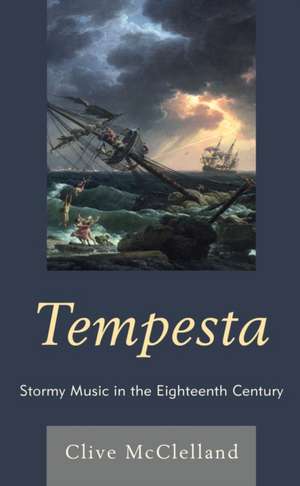
Tempesta
Autor Clive McClellanden Limba Engleză Hardback – 13 oct 2017
This 'stormy' music formed the ingredients of a particular style in the later 18th century that scholars in recent decades have referred to as Sturm und Drang, implying a relationship to German literature which I believe is unhelpful and misleading. Haydn's so-called Sturm und Drang symphonies exhibit characteristics that are no different to his depictions of storms in his operas and sacred music, and there is no evidence of Haydn suffering some kind of personal crisis, or even of him responding to the 'spirit of the age'. He was simply exploring the expressive possibilities of the style for dramatic/rhetorical effect. Scholars have been dissatisfied with the term for some time, but no-one has previously suggested an alternative. The term tempesta therefore applies to all manifestations of this kind of music, a label that acknowledges the 'stormy' origins of the style, but which also recognizes that it functions as a counterpart to ombra.
Tempesta contributed enormously to the continued popularity of operas on supernatural subjects, and quickly migrated towards sacred music and even instrumental music, where it became part of the topical discourse. The music does not merely represent the supernatural, it instills an emotional response in the listener. Awe and terror had already been identified as sources of the sublime, notably by Edmund Burke (predating the German literary Sturm und Drang), and the latter half of the century saw the rise of Gothic literature. The supernatural remained popular in theaters and opera houses, and special music that could produce an emotional response of such magnitude was a powerful tool in the composer's expressive armory.
Preț: 672.56 lei
Preț vechi: 820.19 lei
-18%
Puncte Express: 1009
Carte tipărită la comandă
Livrare economică 23 iunie-07 iulie
Specificații
ISBN-13: 9781498519922
ISBN-10: 149851992X
Pagini: 256
Ilustrații: 106 b/w photos; 23 tables;
Dimensiuni: 157 x 235 x 19 mm
Greutate: 0.53 kg
Editura: Bloomsbury Publishing
Locul publicării:New York, United States
ISBN-10: 149851992X
Pagini: 256
Ilustrații: 106 b/w photos; 23 tables;
Dimensiuni: 157 x 235 x 19 mm
Greutate: 0.53 kg
Editura: Bloomsbury Publishing
Locul publicării:New York, United States
V-ar putea interesa
-
 Encyclopedia of American Gospel MusicW. K. McNeil-18%Preț: 1576.95 lei1923.12 lei
 -
 Preț: 298.29 lei
 -
 Ombra: Supernatural Music in the Eighteenth CenturyClive McClelland-30%Preț: 328.89 lei468.85 lei
 -
 The Heritage of Musical StyleDonald H. Van Ess-28%Preț: 265.37 lei367.15 lei
 -
 Head First: The Language of the Head VoiceDenes Striny-21%Preț: 304.98 lei384.70 lei
 -
 -23%Preț: 443.87 lei576.45 lei
 -
 -25%Preț: 255.34 lei339.79 lei
 -
 -27%Preț: 328.16 lei446.48 lei
 -
 Singing: The First ArtDan H. Marek-36%Preț: 571.45 lei888.87 lei
 -
 Choral Masterworks from Bach to Britten: Reflections of a ConductorRobert J. Summer-33%Preț: 436.05 lei652.49 lei
 -
 Hymns for Unaccompanied TrumpetWilliam BayPreț: 109.82 lei
 -
 Preț: 90.33 lei
 -
 -15%Preț: 422.53 lei497.10 lei
 -
 -15%Preț: 450.78 lei530.34 lei
 -
 Opera in the British Isles, 1875-1918Paul Rodmell-15%Preț: 431.89 lei508.10 lei
 -
 -15%Preț: 423.40 lei498.11 lei
 -
 -15%Preț: 449.52 lei528.85 lei
 -
 -15%Preț: 421.71 lei496.13 lei
 -
 -15%Preț: 418.25 lei492.05 lei
 -
 Light Music in Britain since 1870: A SurveyGeoffrey Self-15%Preț: 422.98 lei497.62 lei
 -
 Benjamin Britten Complete Folksong ArrangementsBenjamin BrittenPreț: 217.03 lei
 -
 Tecnica La EstrellaJose Eduardo Matute EstradaPreț: 243.94 lei
 -
 Caruso and Tetrazzini on the Art of SingingEnrico Jr. CarusoPreț: 100.94 lei
 -
 Traditional Folk Song in Modern JapanDavid W Hughes-23%Preț: 926.83 lei1203.67 lei
 -
 Franny and the FireballsKnut HartmannPreț: 158.05 lei
Cuprins
Chapter 1 Tempesta Music in Context
Chapter 2 Tonality (Opera)
Chapter 3 Harmony and Line (Opera)
Chapter 4 Tempo and Rhythm (Opera)
Chapter 5 Texture, Dynamics and Instrumentation (Opera)
Chapter 6 Case Studies in Opera
Chapter 7 Tempesta in Sacred Music
Chapter 8 Tempesta in Instrumental Music
Chapter 9 Towards Romanticism
Chapter 2 Tonality (Opera)
Chapter 3 Harmony and Line (Opera)
Chapter 4 Tempo and Rhythm (Opera)
Chapter 5 Texture, Dynamics and Instrumentation (Opera)
Chapter 6 Case Studies in Opera
Chapter 7 Tempesta in Sacred Music
Chapter 8 Tempesta in Instrumental Music
Chapter 9 Towards Romanticism
Recenzii
This is an interesting survey of 18th-century musical topoi that fall under the rubrics of Sturm und Drang, ombra, and Empfindsamer Stil, among others. These topoi are characterized by the use of minor keys, rapid rhythmic pulsations, rapid changes in dynamics, and the attempted musical depiction of heightened emotional states and storms in instrumental, vocal, and musicodramatic forms. McClelland (Univ. of Leeds, UK) does a very good job of summarizing the work that has been done previously by American and Continental scholars. His main contribution to the expanding literature on this topic is to propose the term tempesta to replace Sturm und Drang and the other terms that have come to signify "stormy" music. . . the book has much to recommend it, in particular the careful analyses of little-known symphonies and operas from the 18th century.
Summing Up: Recommended. Lower-division undergraduates and above.
Clive McClelland's study of 'tempesta' complements his analysis of 'ombra' scenes in dramatic music and the way in which they penetrate instrumental music. He effectively supersedes the theory of 'Sturm und Drang' with a more nuanced and far-reaching study of storms, literal and metaphorical, in music ranging from Lully to Beethoven; the range of examples is particularly impressive.
Drawing upon innumerable examples of storms, floods, earthquakes and other cataclysms in operas as well as church and programmatic instrumental music, Clive McClelland establishes tempesta as a stylistic category of eighteenth-century music and paints a fascinating picture of its development in the light of the aesthetic categories of the time. Along with his earlier monograph on ombra, this book provides scholars, performers and listeners alike with an indispensable survey of musical representations of the supernatural in the eighteenth century and beyond. -Danuta Mirka, University of Southampton
Summing Up: Recommended. Lower-division undergraduates and above.
Clive McClelland's study of 'tempesta' complements his analysis of 'ombra' scenes in dramatic music and the way in which they penetrate instrumental music. He effectively supersedes the theory of 'Sturm und Drang' with a more nuanced and far-reaching study of storms, literal and metaphorical, in music ranging from Lully to Beethoven; the range of examples is particularly impressive.
Drawing upon innumerable examples of storms, floods, earthquakes and other cataclysms in operas as well as church and programmatic instrumental music, Clive McClelland establishes tempesta as a stylistic category of eighteenth-century music and paints a fascinating picture of its development in the light of the aesthetic categories of the time. Along with his earlier monograph on ombra, this book provides scholars, performers and listeners alike with an indispensable survey of musical representations of the supernatural in the eighteenth century and beyond. -Danuta Mirka, University of Southampton