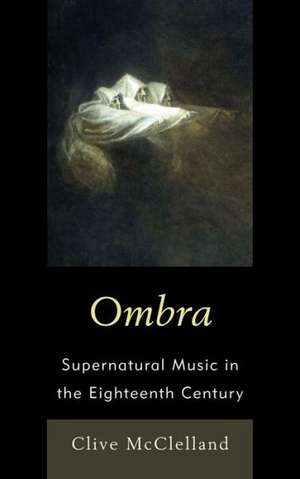
Ombra: Supernatural Music in the Eighteenth Century
Autor Clive McClellanden Limba Engleză Paperback – 9 oct 2013
Clive McClelland's Ombra: Supernatural Music in the Eighteenth Century is an in-depth examination of ombra and is many influences on classical music performance. McClelland reveals that ombra scenes proved popular with audiences not only because of the special stage effects employed, but also due to increasing use of awe-inspiring musical effects. By the end of the eighteenth century the scenes had come to be associated with an elaborate set of musical features including slow, sustained writing, the use of flat keys, angular melodic lines, chromaticism and dissonance, dotted rhythms and syncopation, tremolando effects, unexpected harmonic progressions, and unusual instrumentation, especially involving trombones. It is clearly distinct from other styles that exhibit some of these characteristics, such as the so-called 'Sturm und Drang' or 'Fantasia.' Futhermore, parallels can be drawn between these features and Edmund Burke's 'sublime of terror,' thus placing ombra music on an important position in the context of eighteenth-century aesthetic theory.
Preț: 344.47 lei
Preț vechi: 483.42 lei
-29%
Puncte Express: 517
Carte tipărită la comandă
Livrare economică 30 noiembrie-14 decembrie
Livrare prin curier în România Termenul estimat este afișat lângă disponibilitate.
Transport gratuit de la 400.00 lei Plată online sau ramburs, în funcție de opțiunile comenzii.
Retur gratuit în 14 zile Comandă securizată și suport în română.
Specificații
ISBN-13: 9780739188170
ISBN-10: 0739188178
Pagini: 245
Dimensiuni: 150 x 226 x 20 mm
Greutate: 0.38 kg
Editura: Bloomsbury Publishing
Colecția Lexington Books
Locul publicării:New York, United States
ISBN-10: 0739188178
Pagini: 245
Dimensiuni: 150 x 226 x 20 mm
Greutate: 0.38 kg
Editura: Bloomsbury Publishing
Colecția Lexington Books
Locul publicării:New York, United States
V-ar putea interesa
-
 -29%Preț: 524.25 lei733.51 lei
 -
 Opera for Everyone: A Historic, Social, Artistic, Literary, and Musical StudyJean Grundy Fanelli-30%Preț: 421.12 lei598.31 lei
 -
 -29%Preț: 424.29 lei596.81 lei
 -
 Italian Opera Houses and FestivalsKaryl Charna Lynn-28%Preț: 348.78 lei485.67 lei
 -
 -32%Preț: 585.09 lei865.15 lei
 -
 Franco Alfano: Transcending TurandotKonrad Dryden-34%Preț: 379.11 lei578.49 lei
 -
 -32%Preț: 423.04 lei624.79 lei
 -
 Giacomo Puccini: A DiscographyRoger Flury-35%Preț: 1003.26 lei1552.47 lei
 -
 -27%Preț: 403.17 lei555.12 lei
 -
 TempestaClive McClelland-18%Preț: 694.66 lei847.14 lei
 -
 -33%Preț: 545.11 lei816.54 lei
 -
 -30%Preț: 546.51 lei779.97 lei
 -
 -8%Preț: 657.39 lei714.55 lei
 -
 Letters and Diaries of Kathleen FerrierChristopher FifieldPreț: 201.40 lei
 -
 Don GiovanniRobin Norton-Hale-25%Preț: 71.16 lei94.37 lei
 -
 Aïda: Opéra En Quatre ActesAntonio GhislanzoniPreț: 86.61 lei
 -
 Preț: 87.51 lei
 -
 Ballets, Opéra Et Autres Ouvrages Lyriques, (Éd.1760)Duc de la VallièrePreț: 169.95 lei
 -
 Le Nozze Di Figaro O Sia Lo Folle Giornata . (Éd.1786)Lorenzo Da PontePreț: 101.17 lei
 -
 Les Soirées de l'Orchestre (3e Éd.) (Éd.1878)Hector BerliozPreț: 215.61 lei
 -
 Cadmus et HermioneCollectifPreț: 93.76 lei
 -
 Cadmus et Hermione . Tragédie représentée (Éd.1674)Philippe QuinaultPreț: 97.21 lei
 -
 Dict. Des Opéras (Dict. Lyrique) (Éd.1881)Félix ClémentPreț: 94.27 lei
 -
 MédéeThomas CorneillePreț: 93.97 lei
 -
 Preț: 97.84 lei
 -
 A Book of Operas Their Histories, Their Plots, and Their MusicHenry Edward KrehbielPreț: 177.71 lei
 -
 Preț: 125.23 lei
 -
 Tolkien and Wagner: The Ring and Der RingChristopher MacLachlanPreț: 166.30 lei
 -
 Wagner and TolkienRenée VinkPreț: 179.23 lei
Cuprins
Introduction
Abbreviations
Chapter One - Ombra Music in Context
Chapter Two - Opera: Tonality and Key Characteristics
Chapter Three - Opera: Harmony and Line
Chapter Four - Opera: Tempo and Rhythm
Chapter Five - Opera: Texture, Dynamics, and Instrumentation
Chapter Six - Opera: Case Studies
Chapter Seven - Sacred Music (including Case Studies)
Chapter Eight - Instrumental Music (including Case Studies)
Chapter Nine - Ombra after Mozart
Appendix A
Appendix B
Bibliography
Index
About the Author
Abbreviations
Chapter One - Ombra Music in Context
Chapter Two - Opera: Tonality and Key Characteristics
Chapter Three - Opera: Harmony and Line
Chapter Four - Opera: Tempo and Rhythm
Chapter Five - Opera: Texture, Dynamics, and Instrumentation
Chapter Six - Opera: Case Studies
Chapter Seven - Sacred Music (including Case Studies)
Chapter Eight - Instrumental Music (including Case Studies)
Chapter Nine - Ombra after Mozart
Appendix A
Appendix B
Bibliography
Index
About the Author
Recenzii
McClelland's Ombra can be added to the growing list of studies seeking to identify the various features of a particular musical style and to examine the interaction between this style and what or how it communicated to contemporary audiences. . . . he makes a relatively convincing case throughout most of the book that ombra is, in fact, a topic that has some distinguishing features. In the quest to identify musical topics, this is certainly a large step forward. . . . it is indispensable to anyone who seeks to understand what and how eighteenth-century music communicated to audiences.
This volume is an in depth examination of ombra and its many influences on classical music performance. Clive McClelland reveals that ombra scenes proved popular with audiences not only because of the special stage effects employed, but also due to increasing use of awe inspiring musical ethics.
Without recourse to jargon, Clive McClelland advances our understanding of the semiotics of 18th-century opera by his close study of scenes of the supernatural. Identifying a repertoire of features that make up to an 'ombra' topic, he contributes to our understanding not only of opera but of the expressive capacities of 'classical' instrumental music.
Clive McClelland's masterful new study of the ombra style-here for the first time given the book length treatment it has long deserved-represents a milestone in the ongoing search for understanding how composers used musical conventions to communicate with their audiences. Demonstrating the pervasiveness of ombra music within a wide variety of genres and national traditions, McClelland elucidates the style's affective qualities and rhetorical functions in the eighteenth century and points toward the future, revealing its dynamic role as an agent of stylistic change. This book will prove seminal, potentially informing inquiries ranging from aesthetics to reception and beyond.
Clive McClelland guides the reader into the subterranean world inhabited by demons, ghosts and furies and reveals that these supernatural beings appeared not only on the operatic stage but also in instrumental music. This book makes an important contribution to the study of musical meaning and expression and will appeal to scholars, listeners and performers of eighteenth-century music.
This volume is an in depth examination of ombra and its many influences on classical music performance. Clive McClelland reveals that ombra scenes proved popular with audiences not only because of the special stage effects employed, but also due to increasing use of awe inspiring musical ethics.
Without recourse to jargon, Clive McClelland advances our understanding of the semiotics of 18th-century opera by his close study of scenes of the supernatural. Identifying a repertoire of features that make up to an 'ombra' topic, he contributes to our understanding not only of opera but of the expressive capacities of 'classical' instrumental music.
Clive McClelland's masterful new study of the ombra style-here for the first time given the book length treatment it has long deserved-represents a milestone in the ongoing search for understanding how composers used musical conventions to communicate with their audiences. Demonstrating the pervasiveness of ombra music within a wide variety of genres and national traditions, McClelland elucidates the style's affective qualities and rhetorical functions in the eighteenth century and points toward the future, revealing its dynamic role as an agent of stylistic change. This book will prove seminal, potentially informing inquiries ranging from aesthetics to reception and beyond.
Clive McClelland guides the reader into the subterranean world inhabited by demons, ghosts and furies and reveals that these supernatural beings appeared not only on the operatic stage but also in instrumental music. This book makes an important contribution to the study of musical meaning and expression and will appeal to scholars, listeners and performers of eighteenth-century music.
Notă biografică
Clive McClelland is principal teaching fellow in the School of Music at the University of Leeds.