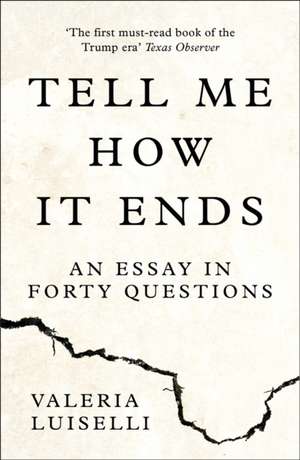
Tell Me How it Ends
Autor Valeria Luisellien Limba Engleză Paperback – 5 oct 2017
Acest eseu literar semnat de Valeria Luiselli reprezintă o mărturie documentară și o critică socială tăioasă asupra sistemului de justiție american în raport cu minorii neînsoțiți care traversează granița. Observăm cum structura cărții este dictată de cele patruzeci de întrebări din chestionarul de admisie pe care autoarea l-a administrat în calitate de traducător voluntar la curtea federală de imigrare din New York. Notăm cu interes felul în care această experiență directă a servit drept fundație etică și narativă pentru lucrările sale ulterioare. Dacă în Faces in the Crowd exploram identitatea prin prisma ficțiunii suprarealiste, iar în The Story of My Teeth ne întâlneam cu o proză ludică, Tell Me How It Ends marchează o tranziție către o scriitură angajată politic. Apreciem rigoarea cu care autoarea analizează contrastul dintre retorica politică și destinele individuale ale copiilor din Honduras sau Guatemala. Această lucrare oferă contextul factual necesar pentru a înțelege mai profund temele din Lost Children Archive, romanul său de succes nominalizat la Booker Prize, ambele titluri formând un diptic esențial despre migrație și criza umanitară de la granița dintre SUA și Mexic. Textul nu caută soluții simpliste, ci expune fragilitatea firelor umane care ne conectează, într-un format concis și percutant.
Preț: 70.84 lei
Carte disponibilă
Livrare economică 29 octombrie-12 noiembrie
Livrare express 14-20 octombrie pentru 15.74 lei
Specificații
ISBN-10: 0008271925
Pagini: 128
Dimensiuni: 131 x 196 x 15 mm
Greutate: 0.12 kg
Editura: HarperCollins Publishers
V-ar putea interesa
-
 Lost Children ArchiveValeria LuiselliPreț: 78.80 lei
 -
 Dear America: Young Readers' EditionJose Antonio VargasPreț: 56.85 lei
 -
 Somewhere We Are Human \ Donde Somos HumanosReyna GrandePreț: 122.89 lei
 -
 The Land of Open GravesJason De LeonPreț: 216.25 lei
 -
 Child ISteve TasanePreț: 56.59 lei
 -
 UndocumentedAviva ChomskyPreț: 97.49 lei
 -
 Life Undocumented: Latinx Youth Navigating Place and BelongingEdelina M. BurciagaPreț: 223.92 lei
 -
 Journey - My Story of MigrationLuis Onofre ValenciaPreț: 94.29 leiNou
 -
 Illegal: A Disappeared NovelFrancisco X. StorkPreț: 144.30 lei
 -
 Preț: 113.08 lei
 -
 UndocumentedDuncan TonatiuhPreț: 125.74 lei
 -
 Unaccompanied Children in America: A Reference HandbookRobert G. Hasson, III-45%Preț: 295.90 lei533.99 lei
 -
 The Distance Between UsReyna GrandePreț: 59.31 lei
 -
 What Strange ParadiseOmar El Akkad-35%Preț: 40.05 lei61.68 lei
 -
 The CrossroadsAlexandra Diaz-18%Preț: 53.75 lei65.53 lei
 -
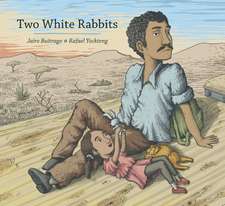 Two White RabbitsJairo BuitragoPreț: 116.96 lei
 -
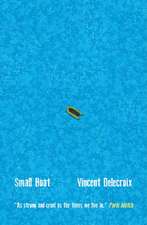 Small BoatVincent DelecroixPreț: 91.82 lei
 -
 Camila's StoryLouise AllenPreț: 69.30 lei
 -
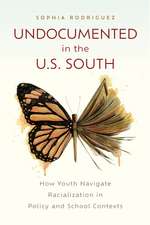 Preț: 172.97 lei
De ce să citești această carte
Recomandăm această carte cititorilor interesați de sociologie, drepturile omului și politică internațională. Este o lectură esențială pentru a înțelege mecanismele birocratice din spatele crizei migrației, oferind o perspectivă umană asupra unei teme adesea reduse la statistici. Câștigați o înțelegere profundă a contextului american actual prin vocea uneia dintre cele mai relevante scriitoare contemporane.
Despre autor
Valeria Luiselli s-a născut în Mexico City în 1983 și a crescut în Africa de Sud, experiența sa multiculturală influențându-i direct opera. Recunoscută de National Book Foundation în cadrul programului '5 under 35', a debutat cu Faces in the Crowd, volum care i-a adus premiul Los Angeles Times Art Seidenbaum. Eseurile și ficțiunile sale au fost traduse în numeroase limbi, apărând în publicații prestigioase precum The New York Times sau Granta. Munca sa îmbină documentarul cu literatura de înaltă ținută, fiind o voce critică importantă în peisajul literar actual.
Descriere
Recenzii
“In the warrens of New York City’s federal immigration court, an adolescent boy from Honduras confronts a thoroughly confused immigration bureaucracy with the help of his translator, who is the author of this book. He is just one of thousands of immigrant children longing for permanence in this country, but we get to see him up close. With Valeria Luiselli as our guide, we navigate the corridors of a system that tries and fails to reconcile America’s long-standing welcome of the poor, the terrorized, and the adventurous with its current fear and mistrust of immigrants. In the frightening year of 2017 this is a most necessary book, and a unique one, from a writer whose clear-eyed intelligence and marvelous literary imagination make every one of her narratives a compelling read.”—Alma Guillermoprieto
“Compelling and urgent, Tell Me How It Ends gives a face and a name to the hundreds of thousands who have committed the innocent crime of geography: being born in a certain time and place. The bureaucratic labyrinth of immigration, the dangers of searching for a better life, all of this and more is contained in this brief and profound work. Tell Me How It Ends is not just relevant, it’s essential.”—Mark Haber, Brazos Bookstore
“In the hours Valeria Luiselli spends at the immigration courts in NYC, her duty is to listen to children tell her stories about their scars and how they got them. Like a morbid game show, the children’s answers determine their fate. The grand prize? Permanent citizenship, if all goes well. The alternative? Deportation. Bonus: due to the volume of cases, the standard intake form forgives only those who have the most gruesome traumas, wounds that they can show—and of course, the language to speak about them. Part treatise, part memoir, part call-to-action, Tell Me How It Ends inspires not through a stiff stance of authority, but with the curiosity and humility Luiselli has long since established. It may not cure your panic, but it sure as hell won’t feed it.”—Annalia Luna, Brazos Bookstore
“Valeria Luiselli’s Tell Me How It Ends is an important reminder that words matter. The questions we ask of others are built upon a foundation of assumptions about the past and expectations for the future. Appealing to the language of the United States’ fraught immigration policy, Luiselli exposes the cracks in this foundation. Herself an immigrant, she highlights the human cost of its brokenness, as well as the hope that it (rather than walls) might be rebuilt.”—Brad Johnson, Diesel Bookstore
“With gifted prose and a compassionate but penetrating gaze, Luiselli personalizes the ongoing plight of Latin American child migrants in the United States. Her own immersion as a translator informs a trenchant first-hand account of the labyrinthine legal processes and inevitable bureaucratic indifference faced by undocumented youth. Humane yet often horrifying, Tell Me How It Ends offers a compelling, intimate look at a continuing crisis—and its ongoing cost in an age of increasing urgency.”—Jeremy Garber, Powell’s Books
“Valeria Luiselli’s extended essay on her volunteer work translating for child immigrants confronts with compassion and honesty the problem of the North American refugee crisis. It’s a rare thing: a book everyone should read.”—Stephen Sparks, Point Reyes Books
“‘Tell me how it ends,’ the young daughter says to the mother. Valeria Luiselli uses this query, said of the heartbreaking, infuriating situation involving ‘undocumented’ Central American children and the legal system they encounter here that she movingly chronicles in this powerful essay. She helps call to question where we as people, as a people, are with innocent children, who or what is ‘alien,’ even the business of who is American, given that she casts this as a connective scenario, with what happens in Tegucigalpa being related to what happens in Hempstead, New York. In this we are all Americans, finally. Imagine being put into court systems without the language to speak, much less the adult language of law. And while this essay is brilliant for exactly what it depicts, it helps open larger questions, which we’re ever more on the precipice of now, of where all of this will go, how all of this might end. Is this a story, or is this beyond a story? Valeria Luiselli is one of those brave and eloquent enough to help us see.”—Rick Simonson, Elliott Bay Book Company
“Valeria Luiselli’s Tell Me How It Ends helped me see the crisis undocumented immigrants, especially children coming from Mexico and Central America, are facing in our country in much the same way Michelle Alexander’s The New Jim Crow helped me see how slavery’s legacy is being perpetuated in the mass incarceration of black Americans. As someone who has read every one of Luiselli’s books, I expected her writing here to be erudite and elegant, and it is, of course it is, but what I did not expect was for her writing to be this immediate and this personal. I did not expect to be hit this hard emotionally, to feel every fear and every longing in the deepest part of who I am. I can’t remember the last time I read something and had this kind of physical reaction. I felt this book in the tug behind my eyes, in these hands shaking, in this heart beating too quickly. This is a work I will share with everyone I know. This is something every American needs to face, and to feel.”—Kenneth Coble, King’s Books
“In an essay as bracing as it is searing, the incomparable Valeria Luiselli explores the 2014 immigration crisis. Luiselli writes with a clarity that underscores the nightmarish conditions and nonsensical bureaucracy undocumented children face on their passage to America and toward U.S. citizenship. Tell Me How It Ends evokes empathy as it educates. It is a vital contribution to the body of post-Trump work being published in early 2017.”—Katharine Solheim, Unabridged Books