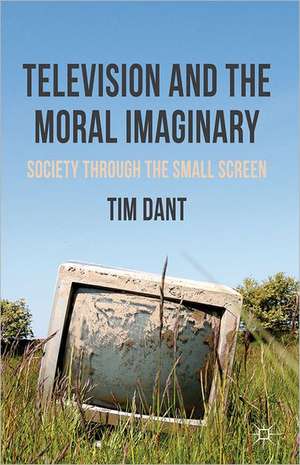
Television and the Moral Imaginary
Autor T. Danten Limba Engleză Hardback – 31 aug 2012
Preț: 643.71 lei
Preț vechi: 757.31 lei
-15%
Puncte Express: 966
Carte tipărită la comandă
Livrare economică 08-22 decembrie
Livrare prin curier în România Termenul estimat este afișat lângă disponibilitate.
Transport gratuit pentru acest produs Plată online sau ramburs, în funcție de opțiunile comenzii.
Retur gratuit în 14 zile Comandă securizată și suport în română.
Specificații
ISBN-13: 9780230234819
ISBN-10: 023023481X
Pagini: 247
Ilustrații: VIII, 247 p.
Dimensiuni: 140 x 218 x 23 mm
Greutate: 0.45 kg
Ediția:2012 edition
Editura: Palgrave Macmillan UK
Locul publicării:London, United Kingdom
ISBN-10: 023023481X
Pagini: 247
Ilustrații: VIII, 247 p.
Dimensiuni: 140 x 218 x 23 mm
Greutate: 0.45 kg
Ediția:2012 edition
Editura: Palgrave Macmillan UK
Locul publicării:London, United Kingdom
V-ar putea interesa
-
 Islam, Security and Television NewsC. FloodPreț: 394.88 lei
-
 Public Service Media and Policy in EuropeK. DondersPreț: 393.20 lei
-
 Media and DemocracyJames CurranPreț: 408.00 lei
-
 Preț: 395.84 lei
-
 An Introduction to Television StudiesJonathan BignellPreț: 338.25 lei
-
 Preț: 489.39 lei
-
 Reality TVMisha Kavka-17%Preț: 175.07 lei210.48 lei
-
 The MakeoverKatherine SenderPreț: 277.36 lei
-
 The HBO EffectDr. Dean J. DeFino-41%Preț: 116.77 lei197.55 lei
-
 Media Power and the Transformation of WarKenneth A LoparoPreț: 405.15 lei
Cuprins
Introduction - the Small Screen and Morality Morality on Television Sociology and the Moral Order Televisuality: Style and the Small Screen The Phenomenology of Television Society and the Small Screen Mediating Morality Television and the Imaginary Conclusion Endnotes References Index
Recenzii
"Dant's Television and the Moral Imaginary represents a welcome contribution to television studies and serves as a bit of a palliative for the decades of television scholarship that would reduce the medium to the Rodney Dangerfield of media platforms. In fact, Dant's appreciable work represents what's good about emergent television scholarship in the digital age." - David Craig, International Journal of Communication (2013)
Notă biografică
TIM DANT is a professor of Sociology at Lancaster University, UK, and has published books on material culture, critical theory and the sociology of knowledge. He is currently interested in phenomenological approaches to understanding culture and the moral turn in sociological theory.