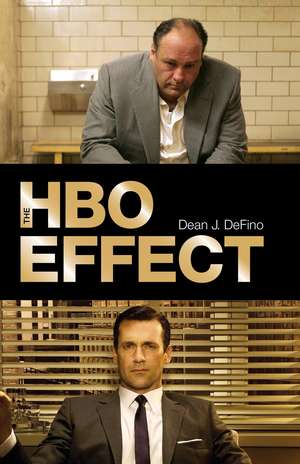
The HBO Effect
Autor Dr. Dean J. DeFinoen Limba Engleză Paperback – 16 ian 2014
The HBO Effect examines this rich and unique history for clues to its remarkable impact upon television and popular culture. It's time to take a wide-angle look at HBO as a producer of American culture.
Preț: 116.77 lei
Preț vechi: 197.55 lei
-41%
Puncte Express: 175
Carte tipărită la comandă
Livrare economică 28 noiembrie-12 decembrie
Livrare prin curier în România Termenul estimat este afișat lângă disponibilitate.
Transport gratuit de la 400.00 lei Plată online sau ramburs, în funcție de opțiunile comenzii.
Retur gratuit în 14 zile Comandă securizată și suport în română.
Specificații
ISBN-13: 9780826421302
ISBN-10: 082642130X
Pagini: 256
Ilustrații: 25 illus
Dimensiuni: 140 x 216 x 14 mm
Greutate: 0.34 kg
Editura: Bloomsbury Publishing
Colecția Bloomsbury Academic
Locul publicării:New York, United States
ISBN-10: 082642130X
Pagini: 256
Ilustrații: 25 illus
Dimensiuni: 140 x 216 x 14 mm
Greutate: 0.34 kg
Editura: Bloomsbury Publishing
Colecția Bloomsbury Academic
Locul publicării:New York, United States
V-ar putea interesa
-
 -15%Preț: 643.71 lei757.31 lei
 -
 Islam, Security and Television NewsC. FloodPreț: 394.88 lei
 -
 Public Service Media and Policy in EuropeK. DondersPreț: 393.20 lei
 -
 History and the MediaD. Cannadine-18%Preț: 747.20 lei911.21 lei
 -
 Preț: 395.84 lei
 -
 An Introduction to Television StudiesJonathan BignellPreț: 338.25 lei
 -
 Guardians of Power: The Myth of the Liberal MediaDavid EdwardsPreț: 208.66 lei
 -
 Mediated: How the Media Shape the World Around YouThomas de Zengotita-28%Preț: 83.93 lei116.38 lei
 -
 Media DiscourseMary Talbot-17%Preț: 182.67 lei218.86 lei
 -
 Reality TVMisha Kavka-17%Preț: 175.07 lei210.48 lei
 -
 The MakeoverKatherine SenderPreț: 277.36 lei
 -
 Media Power and the Transformation of WarKenneth A LoparoPreț: 405.15 lei
 -
 Analysing Newspapers: An Approach from Critical Discourse AnalysisDr John E. RichardsonPreț: 256.34 lei
Cuprins
Acknowledgements
1. The Visible Effect
2. A Great Notion
3. The Caterpillar
4. Everything. Everyone. Everywhere. Ends.
5. Changing the Conversation
6. Serious Naked Pictures
7. Win or Die
Notes
Bibliography
Index
Index
1. The Visible Effect
2. A Great Notion
3. The Caterpillar
4. Everything. Everyone. Everywhere. Ends.
5. Changing the Conversation
6. Serious Naked Pictures
7. Win or Die
Notes
Bibliography
Index
Index
Recenzii
This book turns the HBO story inside out and productively repositions what we think we know about the premium pay-TV company within a broader historical and institutional history of US culture and television.
The HBO Effect is not the first book on HBO, but 'it's not TV' criticism in any ordinary sense. It's water cooler study criticism that will have scholars of the medium and serious viewers buzzing about this well written, engaging, funny, and constantly surprising investigation. Dean J. DeFino succeeds brilliantly in establishing his central contention: that HBO 'is itself a by-product of [the] long history [of television], not some aberration.'
Summarized.
In The HBO Effect, DeFino (Iona College) demonstrates that HBO is fully embedded within a long history of "quality television" storytelling and uses its positions to take risks and walk the line between complexity and popularity. The book notes HBO so-called showrunners created "quality television" for networks long before working with HBO. Although the book can be applauded for its attention to early stand-up comedy and "sex-docs" like Cathouse, which others often ignore, DeFino's focus on character studies and comparative analysis (for example, a lengthy comparison of The West Wing and The Sopranos) does not provide much in terms of cable history that cannot be found elsewhere thoughtful television criticism, but the book could have been strengthened by engaging more thoroughly with scholarship that tackles issues of narrative complexity and industry studies. Less-experiences readers will likely enjoy the book, but specialists will leave wanting more."-Summing Up: Recommended. Lower-division undergraduates; general readers.--
The HBO Effect is not the first book on HBO, but 'it's not TV' criticism in any ordinary sense. It's water cooler study criticism that will have scholars of the medium and serious viewers buzzing about this well written, engaging, funny, and constantly surprising investigation. Dean J. DeFino succeeds brilliantly in establishing his central contention: that HBO 'is itself a by-product of [the] long history [of television], not some aberration.'
Summarized.
In The HBO Effect, DeFino (Iona College) demonstrates that HBO is fully embedded within a long history of "quality television" storytelling and uses its positions to take risks and walk the line between complexity and popularity. The book notes HBO so-called showrunners created "quality television" for networks long before working with HBO. Although the book can be applauded for its attention to early stand-up comedy and "sex-docs" like Cathouse, which others often ignore, DeFino's focus on character studies and comparative analysis (for example, a lengthy comparison of The West Wing and The Sopranos) does not provide much in terms of cable history that cannot be found elsewhere thoughtful television criticism, but the book could have been strengthened by engaging more thoroughly with scholarship that tackles issues of narrative complexity and industry studies. Less-experiences readers will likely enjoy the book, but specialists will leave wanting more."-Summing Up: Recommended. Lower-division undergraduates; general readers.--