Telecommunications Network Management
Editat de Salah Aidarous, Thomas Plevyaken Limba Engleză Hardback – 31 dec 1997
Preț: 1314.50 lei
Preț vechi: 1444.50 lei
-9%
Puncte Express: 1972
Carte tipărită la comandă
Livrare economică 08-22 decembrie
Livrare prin curier în România Termenul estimat este afișat lângă disponibilitate.
Transport gratuit pentru acest produs Plată online sau ramburs, în funcție de opțiunile comenzii.
Retur gratuit în 14 zile Comandă securizată și suport în română.
Specificații
ISBN-13: 9780780334540
ISBN-10: 078033454X
Pagini: 344
Dimensiuni: 183 x 260 x 23 mm
Greutate: 0.85 kg
Editura: Wiley
Locul publicării:Hoboken, United States
ISBN-10: 078033454X
Pagini: 344
Dimensiuni: 183 x 260 x 23 mm
Greutate: 0.85 kg
Editura: Wiley
Locul publicării:Hoboken, United States
V-ar putea interesa
-
 -19%Preț: 526.43 lei649.92 lei
 -
 -9%Preț: 805.66 lei885.34 lei
 -
 Managing IP NetworksSalah Aidarous-20%Preț: 1009.51 lei1261.89 lei
 -
 Telecommunications Network Management Into the 21st CenturySalah Aidarous-9%Preț: 1314.25 lei1444.23 lei
 -
 Power System Transient AnalysisEiichi Haginomori-9%Preț: 757.60 lei832.52 lei
 -
 The Fully Integrated EngineerSteven T CerriPreț: 362.35 lei
 -
 Hvdc GridsDirk van Hertem-9%Preț: 889.82 lei977.82 lei
 -
 Chipless RFID SensorsNemai Chandra Karmakar-9%Preț: 807.89 lei887.79 lei
 -
 Foundations for Microstrip Circuit DesignTerry C Edwards-9%Preț: 969.84 lei1065.76 lei
 -
 -9%Preț: 840.20 lei923.30 lei
 -
 -27%Preț: 822.57 lei1126.81 lei
 -
 Interference AnalysisJohn Pahl-9%Preț: 868.41 lei954.29 lei
 -
 Cyber-Risk InformaticsMehmet Sahinoglu-20%Preț: 1038.94 lei1298.68 lei
 -
 -20%Preț: 536.45 lei670.56 lei
 -
 -27%Preț: 814.15 lei1115.27 lei
 -
 Grounding and ShieldingRalph Morrison-9%Preț: 721.52 lei792.88 lei
 -
 Exploring Raspberry PiDerek Molloy-20%Preț: 196.43 lei245.53 lei
 -
 Lean Computing for the CloudEric Bauer-20%Preț: 522.41 lei653.01 lei
Textul de pe ultima copertă
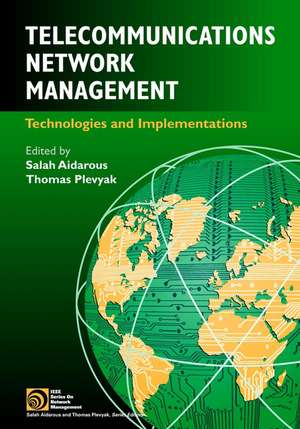
Electrical Engineering Telecommunications Network Management: Technologies and Implementations A follow–up to Telecommunications Network Management into the 21st Century: Techniques, Standards, Technologies, and Applications (IEEE Press 1994), this collection of original chapters written by leading experts in the field brings together a full range of applications topics in telecommunications network management. Telecommunications Network Management illustrates how related technology advancements in the telecommunications and computing industries can help engineers achieve cost–effective, end–to–end management of networks. The reader will understand how information modeling and distributed management help to simplify network representation, introduce computing platforms, and reduce operations costs. This book will help engineers and technical managers who face the challenge of integrating multiple technologies, working with multiple vendors, and identifying different management requirements. Topics covered include: Information modeling New software paradigms Distributed management Management of CATV and wireless networks Software applications lifecycle
Cuprins
Guest Introduction. TMN Today: Challenges and Opportunities ( Mauhzio Decina, Politecnico di Milano/CEFRIEL, Italy ). Editors′ Introduction. Implement Complexity to Realize Simplicity ( Salah Aidamus, NEC America, USA; Thomas Plevyak, Bell Atlantic, USA ). Chapter 1 Information Modeling and Its Role in Network Management ( Lakshmi Raman, ADC Telecommunications, USA ). 1.1 Introduction. 1.2 Information Modeling Made Easy. 1.3 Communicating Management Information. 1.4 Message–Based Paradigm. 1.5 Object–Oriented Paradigm. 1.6 Foundations of Information Modeling. 1.7 E–R Approach. 1.8 Object–Oriented Design. 1.9 Information Modeling Principles. 1.10 Managed Object Class Definition. 1.11 Systems Management Operations. 1.12 Management Information Base (MIB). 1.13 Extending Managed Object Class Definition. 1.14 Allomorphism. 1.15 Naming Managed Objects. 1.16 Modeling Relationships. 1.17 Representing Information Models. 1.18 Differences in Information Modeling Principles. 1.19 Examples of Information Models for TMN. 1.20 TMN Modeling Efforts. 1.21 Event Report Management. 1.22 Cross–Connection Model. 1.23 Performance Monitoring Framework. 1.24 Information Models in Standards. 1.25 Example Information Models for Data Communications. 1.26 Conformance and Interoperability. 1.27 Conformance Statements. 1.28 Profiles and Interoperability. 1.29 Considerations for Interoperable TMN Interfaces. 1.30 Future Directions. 1.31 Distributed Processing and TMN. 1.32 Open Distributed Processing. 1.33 Open Distributed Management Architecture. 1.34 Common Object Request Broker Architecture (CORBA). 1.35 Summary. References. Chapter 2 OSI Systems Management, Internet SNMP, and ODP/OMG CORBA as Technologies for Telecommunications Network Management ( George Pavlou, University College London, UK ). 2.1 Introduction and Overview. 2.2 Management Information Models. 2.3 Access and Distribution Paradigm. 2.4 Various Other Issues. 2.5 Interworking and Coexistence. 2.6 Summary and the Future. Acknowledgments. References. Chapter 3 Management Platforms ( George Pauthner, Alcatel Telecom, Germany; Jerry Power, Alcatel Telecom, USA ). 3.1 Introduction. 3.2 The Well–Designed Platform System. 3.3 Methods and Tools. 3.4 Standards and Platform Building Blocks. 3.5 Case Study: Openview, ALMAP, and the 1320. 3.6 Summary and Outlook. References. Chapter 4 Management of Personal Communications Services (PCS) Networks ( Vijay K. Garg, Lucent Technologies, Bell Labs, USA ). 4.1 Introduction. 4.2 Management Approaches for the PCS Network. 4.3 Reference Model for the North American PCS System. 4.4 Requirements for PCS Network Management. 4.5 Management Goals for PCS Networks. 4.6 Management Functions of PCS Networks. 47 Summary. References. Chapter 5 Managing Mobile Networks: From Cellular Systems to Satellite Networks ( Yechiam Yemini, Columbia University, USA; Geoffrey Moss, Motorola, USA ). 5.1 Introduction. 5.2 An Overview of Mobile Networks. 5.3 Managing the Elements. 5.4 Managing the Network Layer. 5.5 Managing the Application Services Layer. 5.6 Conclusions. References. Chapter 6 Management of CATV Networks ( John Brouse, Jones Intercahle, USA; Mohamed Beshir, Nortel, Canada ). 6.1 Introduction. 6.2 Industry History. 6.3 The Modern CATV Network. 6.4 Management of Existing Networks. 6.5 Future Network Characteristics. 6.6 Implications for the CATV Industry. 6.7 Demand Placed on Network Management. 6.8 Future Network Management Systems. 6.9 Other CATV Management Systems. 6.10 Operations Systems (OSs). References. Chapter 7 Architectural Integrity as a Countermeasure to Complexity in the Telecommunications Management System Life Cycle ( MikeAhrens, Bellcore, USA ). 7.1 Introduction. 7.2 TMSs in the Context of the S&NI Life Cycle. 7.3 Architectural Integrity as a Countermeasure to Complexity. 7.4 The Role of Learning and Memory in Countering Complexity. 7.5 The Significance of Coupling Operational and Conceptual Learning. 7.6 Improving Handoffs in the Waterfall Model. 7.7 Putting it All Together: The Design for Complexity. Chapter 8 The Impact of Telecommunications in Europe and the Requirement for Network Management ( Enrico Bagnasco, CSELT, Italy; Marina Geymonat, CSELT, Italy ). 8.1 Introduction. 8.2 The Past and Present Network Management Scenario in Europe. 8.3 TMN in Europe. 8.4 Initiatives Sponsored by the European Commission. 8.5 Initiatives Sponsored by European Operators. 8.6 The European Telecommunications Standard Institute (ETSI). 8.7 Pan–European TMN Laboratories: The EURESCOM Experience. 8.8 Relationships with International Standardization Bodies. References. Index. About the Editors.
Notă biografică
Salah Aidarous is the Director of Product Planning at the Network Management Division of NEC America, working on the planning and development of integrated network management systems. Prior to NEC, he was with Nortel Technology (formerly BNR) working on a broad range of assignments in telecommunications networks and services planning and development. Dr. Aidarous is a senior editor of IEEE Network magazine, senior editor of the Journal on Network and Systems Management , chairman of the Technical Committee on Information Infrastructure (TCII), and coeditor and an author of Telecommunications Network Management into the 21st Century: Techniques, Standards, Technologies, and Applications . Thomas Plevyak is the president of the IEEE Communications Society. His two–year term of office began 1 January 1998. Mr. Plevyak is an IEEE Fellow, the past director of Publications of the IEEE Communications Society, and a former editor–in–chief of IEEE Communications magazine. He retired after 28 years with Bell Laboratories and AT&T Network Systems (now Lucent Technologies), and is now responsible for operations and network management standards for Bell Atlantic in Arlington, Virginia. Mr. Plevyak is former vice–chairman of the Inter–American Telecommunications Commission (CITEL), Permanent Consultative Committee 1 (PCC.1), a unit of the Organization of American States. He is coeditor and an author of Telecommunications Network Management into the 21st Century: Techniques, Standards, Technologies, and Applications .