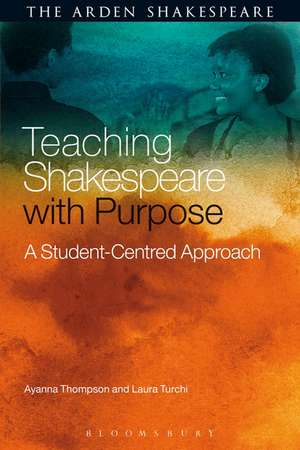
Teaching Shakespeare with Purpose: A Student-Centred Approach
Autor Professor Ayanna Thompson, Laura Turchien Limba Engleză Hardback – 28 ian 2016
Subliniem aplicabilitatea imediată a volumului Teaching Shakespeare with Purpose, o lucrare care reconfigurează predarea operelor shakespeariene pentru sala de curs a secolului XXI. În loc să trateze textele ca pe niște artefacte imuabile ale civilizației vestice, Professor Ayanna Thompson și Laura Turchi propun un model de descoperire centrat pe student, transformând piesele de teatru în vehicule pentru explorarea colaborativă a normelor socio-culturale și a retoricii.
Considerăm că structura logică a cărții facilitează o progresie pedagogică riguroasă. Primele capitole stabilesc cadrul teoretic ('Framing'), în timp ce secțiunile mediane abordează elemente specifice precum limbajul arhaic și contextul istoric. Finalul lucrării se concentrează pe soluții pragmatice, de la elaborarea subiectelor pentru eseuri până la combaterea „tiraniei resurselor”, oferind exemple concrete de activități și analize de text. Această abordare reflectă expertiza Professor Ayanna Thompson, a cărei operă anterioară, precum Blackface sau studiul despre Shakespeare in the Theatre: Peter Sellars, a explorat constant tensiunile dintre inovația scenică, identitate și accesibilitatea textului clasic.
Comparabil cu Teaching Shakespeare into the Twenty-First Century în rigurozitate, volumul de față este însă actualizat pentru sensibilitățile pedagogice contemporane, punând un accent mai mare pe vocea studentului decât pe autoritatea profesorului-expert. Față de Teaching Shakespeare de Rex Gibson, care se concentrează pe învățarea activă în școli, această apariție din seria The Arden Shakespeare oferă un aparat critic mai dens, adaptat pentru învățământul terțiar, unde analiza critică a rasei, genului și performanței devine esențială.
Preț: 729.50 lei
Preț vechi: 954.16 lei
-24%
Carte tipărită la comandă
Livrare economică 07-21 decembrie
Specificații
ISBN-10: 1472599624
Pagini: 192
Ilustrații: black & white illustrations
Dimensiuni: 156 x 234 x 15 mm
Greutate: 0.45 kg
Editura: Bloomsbury Publishing
Colecția The Arden Shakespeare
Locul publicării:London, United Kingdom
V-ar putea interesa
-
 The Art of FictionDavid Lodge-19%Preț: 63.70 lei78.72 lei
 -
 Murder Most Foul: Hamlet Through the AgesDavid Bevington-14%Preț: 289.97 lei338.29 lei
 -
 The Oxford Handbook of ShakespeareArthur F Kinney-17%Preț: 329.47 lei398.56 lei
 -
 -31%Preț: 770.40 lei1121.49 lei
 -
 Shakespeare's Tragedies: A Very Short IntroductionStanley Wells-19%Preț: 57.23 lei70.82 lei
 -
 The Bible in ShakespeareHannibal Hamlin-16%Preț: 332.41 lei396.64 lei
 -
 Shakespeare's Binding LanguageJohn Kerrigan-12%Preț: 296.19 lei336.98 lei
 -
 The Oxford Handbook of PragmaticsYan Huang-17%Preț: 385.97 lei464.90 lei
 -
 Shakespeare's Nature: From Cultivation to CultureCharlotte Scott-30%Preț: 748.54 lei1071.35 lei
 -
 The Oxford Handbook of Shakespeare and PerformanceJames C. Bulman-31%Preț: 1056.89 lei1540.03 lei
 -
 Women of WillTina PackerPreț: 134.09 lei
 -
 Naming Thy NameElaine ScarryPreț: 130.20 lei
 -
 Preț: 240.35 lei
 -
 Magic(al) RealismMaggie Ann BowersPreț: 276.39 lei
 -
 Literary TranslationChantal WrightPreț: 407.04 lei
 -
 The Victorian NovelBarbara DennisPreț: 206.96 lei
 -
 Feminist Literary CriticismMary Eagleton-15%Preț: 440.15 lei517.83 lei
 -
 Discourse and IdentityBethan Benwell-16%Preț: 202.18 lei241.56 lei
 -
 -17%Preț: 125.95 lei152.64 lei
 -
 How Science Proved Edward de Vere was William ShakespeareDavid L. RoperPreț: 165.79 lei
 -
 The Language of HumorAlleen Pace NilsenPreț: 299.13 lei
 -
 Translation Quality Assessment: Past and PresentJuliane House-15%Preț: 449.09 lei528.35 lei
 -
 Preț: 398.86 lei
 -
 English Literature in ContextPaul PoplawskiPreț: 257.82 lei
 -
 The Languages of Humor: Verbal, Visual, and Physical HumorProfessor Arie Sover-34%Preț: 858.54 lei1299.39 lei
 -
 Music, Text and TranslationDr Helen Julia Minors-16%Preț: 277.79 lei329.43 lei
 -
 Unreading ShakespeareDavid P. GontarPreț: 226.56 lei
 -
 -8%Preț: 581.55 lei632.12 lei
De ce să citești această carte
Recomandăm această lucrare cadrelor didactice din învățământul universitar care doresc să revitalizeze cursurile de literatură engleză. Cititorul câștigă o metodologie clară pentru a preda piesele lui Shakespeare nu ca pe niște texte „moarte”, ci ca pe organisme vii, adaptabile. Este un instrument esențial pentru a trece de la prelegerea tradițională la un seminar interactiv, unde studenții devin co-exploratori ai textului.
Descriere
Because Shakespeare's plays are excellent vehicles for many topics -history, socio-cultural norms and mores, vocabulary, rhetoric, literary tropes and terminology, performance history, performance strategies - it is tempting to teach his plays as though they are good for teaching everything. This lens-free approach, however, often centres the classroom on the teacher as the expert and renders Shakespeare's plays as fixed, determined, and dead. Teaching Shakespeare with Purpose shows teachers how to approach Shakespeare's works as vehicles for collaborative exploration, to develop intentional frames for discovery, and to release the texts from over-determined interpretations. In other words, this book presents how to teach Shakespeare's plays as living, breathing, and evolving texts.
Cuprins
Chapter Two: Finding Your Purpose and Putting It into Action: Framing
Chapter Three: 'Ancient English': Shakespeare's Language
Chapter Four: Embodiment: What Is It (Not)?
Chapter Five: History: What Time Are You Thinking About?
Chapter Six: Writing Assignments with a Purpose
Chapter Seven: Assessment with a Purpose
Chapter Eight: The Tyranny of Resources
Bibliography
Index
Recenzii
Teaching Shakespeare with Purpose is not just a practical guide but an argument for the continued relevance of Shakespeare survey courses . Each chapter grounds the teaching theory in practical examples from a model class. The chapters are full of helpful activities including model close readings, themes, and questions from the plays selected (each chapter relies on a different one to model the pedagogy discussed). This approach is advantageous since it provides value for readers who may only have time to read a chapter or two. As well, the pedagogical process described is adaptable to any set of plays. Thompson and Turchi discuss framing, guided questions, entry points, and close readings that allow any teacher the structure she needs to get started on designing her Introduction to Shakespeare course while preserving an individual's pedagogical strengths and the freedom to pick any of the plays . As someone working on an 'Introduction to Shakespeare' class for the first time, this book was a must read if only for the way that it helped put the task of design, teaching, and assessment, in perspective. However, the authors demystify and clarify the purpose of all of the aspects of an introductory course in a way that is not overbearing. Their argument is always student-centered and asks us to make choices about how we approach any aspect of the play (be it the history, the language, or the writing assignments we pick) in order to enhance the experience for the students. In this way, they have given readers a good model not just for the teaching of an 'Introduction to Shakespeare' course but other literature courses as well.