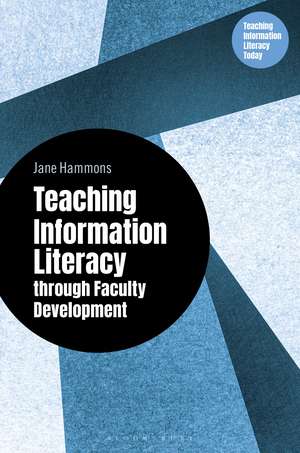
Teaching Information Literacy through Faculty Development: Libraries Unlimited Series for Teaching Information Literacy Today
Autor Jane Hammonsen Limba Engleză Paperback – 8 ian 2026
Academic librarians devote significant effort to teaching information literacy, often in "one-shot" sessions. However, the one-shot has received criticism for its pedagogical ineffectiveness and its impact on librarians' professional status and personal well-being.
This resource provides an overview of an alternative approach, the faculty-focused model, also known as the "teach the teachers" or "train the trainers" approach. In this model, librarians concentrate their efforts primarily on faculty development, which has the potential to allow them to develop more scalable, sustainable, and impactful information literacy programs. This practical guide explores the benefits and concerns associated with the model, gives examples of library-led faculty development initiatives and librarian involvement in campus-level faculty development, and offers recommendations for building faculty development into an information literacy program. Librarians will appreciate the book's guidance on making the mental shift necessary to adopt a more faculty-focused approach and its willingness to address concerns that librarians may have about the model.



Preț: 393.38 lei
Preț vechi: 469.11 lei
-16%
Puncte Express: 590
Carte disponibilă
Livrare economică 17 noiembrie-01 decembrie
Livrare express 31 octombrie-06 noiembrie pentru 108.24 lei
Livrare prin curier în România Termenul estimat este afișat lângă disponibilitate.
Transport gratuit de la 400.00 lei Plată online sau ramburs, în funcție de opțiunile comenzii.
Retur gratuit în 14 zile Comandă securizată și suport în română.
Specificații
ISBN-13: 9798216186403
Pagini: 272
Dimensiuni: 154 x 232 x 20 mm
Greutate: 0.34 kg
Editura: Bloomsbury Publishing
Colecția Bloomsbury Libraries Unlimited
Seria Libraries Unlimited Series for Teaching Information Literacy Today
Locul publicării:New York, United States
Pagini: 272
Dimensiuni: 154 x 232 x 20 mm
Greutate: 0.34 kg
Editura: Bloomsbury Publishing
Colecția Bloomsbury Libraries Unlimited
Seria Libraries Unlimited Series for Teaching Information Literacy Today
Locul publicării:New York, United States
V-ar putea interesa
-
 Preț: 114.43 lei
 -
 -30%Preț: 450.54 lei648.01 lei
 -
 Facilitating for LearningDavid AllenPreț: 208.16 lei
 -
 -23%Preț: 516.66 lei670.98 lei
 -
 Preț: 386.30 leiRecomandat
 -
 -12%Preț: 124.42 lei140.94 lei
 -
 Preț: 321.32 lei
 -
 Reflective Teaching in Higher EducationPaul Ashwin-13%Preț: 275.14 lei317.75 lei
 -
 -9%Preț: 113.10 lei124.79 lei
 -
 News Literacy Across the Undergraduate CurriculumAmy M. Damico-32%Preț: 373.15 lei552.54 lei
 -
 These 6 ThingsDave StuartPreț: 259.75 lei
 -
 Librarians as Researchers: Developing our Scholarly IdentitiesPaul C. Campbell-16%Preț: 357.75 lei426.71 lei
 -
 From Chaos to Order: Addressing Cognitive Overload in the Learning JourneyCourtney McAllister-16%Preț: 395.49 lei472.13 lei
 -
 -18%Preț: 66.11 lei80.15 leiRecomandat
 -
 The Academic Teaching Librarian's HandbookClaire McGuinness-19%Preț: 474.47 lei585.77 lei
 -
 -8%Preț: 462.03 lei502.21 lei
 -
 -18%Preț: 1154.11 lei1407.45 lei
Cuprins
1. An Introduction to the Faculty-Focused Approach to Information Literacy
2. Why Teach Faculty? Arguments in Support of the Faculty-Focused Approach
3. But What About.? Concerns about the Faculty-Focused Approach
4. Library-Led Faculty Development: Examples from the Literature
5. Building an Information Literacy-Focused Faculty Development Program: Getting Started
6. Expanding and Sustaining an Information Literacy Faculty Development Program
7. Adopting the Faculty-Focused Approach Across the Profession: A Discussion
8. Still Teaching Information Literacy: Shifting Your Mindset
Index
2. Why Teach Faculty? Arguments in Support of the Faculty-Focused Approach
3. But What About.? Concerns about the Faculty-Focused Approach
4. Library-Led Faculty Development: Examples from the Literature
5. Building an Information Literacy-Focused Faculty Development Program: Getting Started
6. Expanding and Sustaining an Information Literacy Faculty Development Program
7. Adopting the Faculty-Focused Approach Across the Profession: A Discussion
8. Still Teaching Information Literacy: Shifting Your Mindset
Index
Recenzii
Hammons' book is a well-written, pertinent contribution to information literacy scholarship. Not only does Hammons survey and critically interact with information literacy scholarship, especially as it pertains to faculty-focused development, but she also introduces her readers to the field of faculty development and demonstrates ,how this model fits within it.
Jane Hammons has gifted us with a practical, well-researched plan to enable librarians to enter the development field with confidence. As a leader in faculty information literacy instruction development, her deep understanding of both librarian and faculty culture makes the prospect of librarians doing faculty development both possible and inviting. Well done!
In this much-needed book, Hammons offers a carefully crafted argument for information literacy through faculty development that is grounded in research and supported by clear and practical examples to help librarians put the advice into action.
In her new book, Jane Hammons enters the dialogue around the critique of one-shots with a sharp-eyed, deeply informed guide for what comes next. Part manifesto, part practical roadmap, this book reimagines information literacy through the lens of faculty development with clarity, nuance, and zero illusions of easy fixes. Teaching Information Literacy through Faculty Development examines the assumptions behind traditional library instruction and makes a compelling case for faculty development as a forward-looking, sustainable alternative. Hammons doesn't romanticize faculty development as a singular solution, but rather as a strategic approach that aligns with the evolving role of librarians as partners in teaching and learning. Drawing on scholarly literature, case studies, and her own professional experience, Hammons charts a flexible, practical path forward that is rooted in relationships, pedagogy, and lasting impact.
Whether you're a new librarian or a seasoned professional, this book delivers a versatile blueprint that is adaptable to pedagogical models such as the ACRL Framework, Informed Learning, Backward Design, or Decoding the Disciplines. At its core, the book offers a persuasive answer to a pressing question: What becomes of the librarian's instructional role as we move beyond the one-shot? Hammons' response centers around librarians as educational partners who prioritize relational work, curricular integration, and meaningful impact on student learning. Anyone using Hammons' guide will realize that shifting our focus to faculty development doesn't have to mean letting go of our educational mission, but it might just be how we finally achieve it.
If you want to know how you can bring information literacy education to more students at your university, this is the book for you. Teaching Information Literacy Through Faculty Development offers a thorough and thoughtful examination of librarians undertaking faculty development to integrate information literacy into curricula. With insightful institutional examples and a valuable list of considerations, the book provides both the "how" and the "why" for librarians interested in faculty development. Based on my many years of experience working with faculty to incorporate information literacy into university courses, I highly recommend this book as a guide for advancing and expanding information literacy in higher education.
This book serves as an exemplar of a library science book. Even readers not actively interested in changing their instruction model would find wisdom and insights from Hammons exploration of the current state of information literacy education through her thorough engagement with the writing of our field . Highly recommended for academic librarians and LIS education programs.
Jane Hammons has gifted us with a practical, well-researched plan to enable librarians to enter the development field with confidence. As a leader in faculty information literacy instruction development, her deep understanding of both librarian and faculty culture makes the prospect of librarians doing faculty development both possible and inviting. Well done!
In this much-needed book, Hammons offers a carefully crafted argument for information literacy through faculty development that is grounded in research and supported by clear and practical examples to help librarians put the advice into action.
In her new book, Jane Hammons enters the dialogue around the critique of one-shots with a sharp-eyed, deeply informed guide for what comes next. Part manifesto, part practical roadmap, this book reimagines information literacy through the lens of faculty development with clarity, nuance, and zero illusions of easy fixes. Teaching Information Literacy through Faculty Development examines the assumptions behind traditional library instruction and makes a compelling case for faculty development as a forward-looking, sustainable alternative. Hammons doesn't romanticize faculty development as a singular solution, but rather as a strategic approach that aligns with the evolving role of librarians as partners in teaching and learning. Drawing on scholarly literature, case studies, and her own professional experience, Hammons charts a flexible, practical path forward that is rooted in relationships, pedagogy, and lasting impact.
Whether you're a new librarian or a seasoned professional, this book delivers a versatile blueprint that is adaptable to pedagogical models such as the ACRL Framework, Informed Learning, Backward Design, or Decoding the Disciplines. At its core, the book offers a persuasive answer to a pressing question: What becomes of the librarian's instructional role as we move beyond the one-shot? Hammons' response centers around librarians as educational partners who prioritize relational work, curricular integration, and meaningful impact on student learning. Anyone using Hammons' guide will realize that shifting our focus to faculty development doesn't have to mean letting go of our educational mission, but it might just be how we finally achieve it.
If you want to know how you can bring information literacy education to more students at your university, this is the book for you. Teaching Information Literacy Through Faculty Development offers a thorough and thoughtful examination of librarians undertaking faculty development to integrate information literacy into curricula. With insightful institutional examples and a valuable list of considerations, the book provides both the "how" and the "why" for librarians interested in faculty development. Based on my many years of experience working with faculty to incorporate information literacy into university courses, I highly recommend this book as a guide for advancing and expanding information literacy in higher education.
This book serves as an exemplar of a library science book. Even readers not actively interested in changing their instruction model would find wisdom and insights from Hammons exploration of the current state of information literacy education through her thorough engagement with the writing of our field . Highly recommended for academic librarians and LIS education programs.