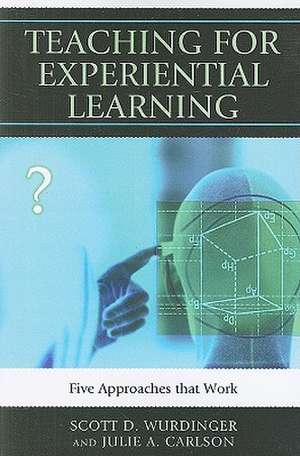
Teaching for Experiential Learning: Five Approaches That Work
Autor Scott D. Wurdinger, Julie A. Carlsonen Limba Engleză Paperback – 16 dec 2009
Preț: 279.78 lei
Preț vechi: 369.61 lei
-24%
Puncte Express: 420
Carte tipărită la comandă
Livrare economică 21 noiembrie-05 decembrie
Livrare prin curier în România Termenul estimat este afișat lângă disponibilitate.
Transport gratuit de la 400.00 lei Plată online sau ramburs, în funcție de opțiunile comenzii.
Retur gratuit în 14 zile Comandă securizată și suport în română.
Specificații
ISBN-13: 9781607093688
ISBN-10: 1607093685
Pagini: 117
Dimensiuni: 156 x 233 x 8 mm
Greutate: 0.2 kg
Editura: Bloomsbury Publishing
Colecția R&L Education
Locul publicării:New York, United States
ISBN-10: 1607093685
Pagini: 117
Dimensiuni: 156 x 233 x 8 mm
Greutate: 0.2 kg
Editura: Bloomsbury Publishing
Colecția R&L Education
Locul publicării:New York, United States
V-ar putea interesa
-
 The Capacity to ShareA. Hickling-Hudson-8%Preț: 544.90 lei592.28 lei
 -
 Preț: 202.43 lei
 -
 Education Outcomes and Poverty: A ReassessmentChristopher Colclough-18%Preț: 1249.94 lei1524.31 lei
 -
 -18%Preț: 1371.38 lei1672.41 lei
 -
 -15%Preț: 424.28 lei499.14 lei
 -
 -18%Preț: 1257.26 lei1533.24 lei
 -
 -18%Preț: 1368.56 lei1668.97 lei
 -
 -18%Preț: 160.78 lei195.04 lei
 -
 Does Religious Education Work?: A Multi-dimensional InvestigationProfessor James C. Conroy-33%Preț: 962.48 lei1432.46 lei
 -
 Teaching as the Practice of WisdomDavid Smith-17%Preț: 206.30 lei247.80 lei
 -
 School BluesDaniel Pennac-27%Preț: 67.78 lei92.80 lei
Recenzii
This is an excellent book that broadens the concept of experiential learning methodologies, situating them within developmental pedagogies.
Wurdinger and Carlson clearly understand that experiential education is a broad concept that is not narrowly defined to a specific methodology or programmatic manifestation. This is a commendable effort to develop language that experiential educators from very different perspectives can use to talk with one another and to the broader world of educational policy making in general.
The book provides conceptual understanding and is nonprescriptive in the delivery of theory and knowledge about this growing field that is crossing different academic content borders.... Written in a user-friendly style, this book is quite easy to read and is useful for different audiences.... Recommended.
After reading the book I find the approaches unassailable. The author's of this book have discovered five major themes of importance if the education system in America wants to get it right: 1. Motivation and interest is always the key to learning 2. Learning is much more complex than regurgitating facts 3. Applying, doing and producing enhances long-term memory and productivity 4. Schools and teachers that use the experiential methods discussed in this book produce a different and superior set of skills than do schools that are using traditional delivery methods 5. This superior set of skills is not measured by NCLB and AYP measurements. Research and experience as discussed in this book prove that experiential forms of learning are superior in many ways. And the author's also point out that schools as presently structured can move in this direction. Or, if not, there are ways to create schools that restructure to accommodate experiential learning. What are you waiting for??
Wurdinger and Carlson clearly understand that experiential education is a broad concept that is not narrowly defined to a specific methodology or programmatic manifestation. This is a commendable effort to develop language that experiential educators from very different perspectives can use to talk with one another and to the broader world of educational policy making in general.
The book provides conceptual understanding and is nonprescriptive in the delivery of theory and knowledge about this growing field that is crossing different academic content borders.... Written in a user-friendly style, this book is quite easy to read and is useful for different audiences.... Recommended.
After reading the book I find the approaches unassailable. The author's of this book have discovered five major themes of importance if the education system in America wants to get it right: 1. Motivation and interest is always the key to learning 2. Learning is much more complex than regurgitating facts 3. Applying, doing and producing enhances long-term memory and productivity 4. Schools and teachers that use the experiential methods discussed in this book produce a different and superior set of skills than do schools that are using traditional delivery methods 5. This superior set of skills is not measured by NCLB and AYP measurements. Research and experience as discussed in this book prove that experiential forms of learning are superior in many ways. And the author's also point out that schools as presently structured can move in this direction. Or, if not, there are ways to create schools that restructure to accommodate experiential learning. What are you waiting for??