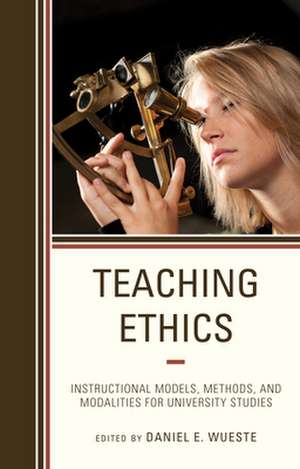
Teaching Ethics: Instructional Models, Methods, and Modalities for University Studies: Teaching Ethics across the American Educational Experience
Editat de Daniel E. Wuesteen Limba Engleză Paperback – 30 sep 2021
| Toate formatele și edițiile | Preț | Express |
|---|---|---|
| Paperback (1) | 244.04 lei 6-8 săpt. | |
| Bloomsbury Publishing – 30 sep 2021 | 244.04 lei 6-8 săpt. | |
| Hardback (1) | 469.14 lei 6-8 săpt. | |
| Bloomsbury Publishing – 30 sep 2021 | 469.14 lei 6-8 săpt. |

Preț: 244.04 lei
Preț vechi: 315.71 lei
-23%
Puncte Express: 366
Preț estimativ în valută:
43.19€ • 50.48$ • 37.50£
43.19€ • 50.48$ • 37.50£
Carte tipărită la comandă
Livrare economică 19 februarie-05 martie
Preluare comenzi: 021 569.72.76
Specificații
ISBN-13: 9781475846737
ISBN-10: 1475846738
Pagini: 206
Dimensiuni: 154 x 218 x 12 mm
Greutate: 0.33 kg
Editura: Bloomsbury Publishing
Colecția Rowman & Littlefield Publishers
Seria Teaching Ethics across the American Educational Experience
Locul publicării:New York, United States
ISBN-10: 1475846738
Pagini: 206
Dimensiuni: 154 x 218 x 12 mm
Greutate: 0.33 kg
Editura: Bloomsbury Publishing
Colecția Rowman & Littlefield Publishers
Seria Teaching Ethics across the American Educational Experience
Locul publicării:New York, United States
V-ar putea interesa
-
 -8%Preț: 339.66 lei369.20 lei
 -
 -23%Preț: 272.96 lei353.05 lei
 -
 -26%Preț: 322.01 lei433.37 lei
 -
 -31%Preț: 846.63 lei1235.86 lei
 -
 -15%Preț: 507.69 lei597.28 lei
 -
 -27%Preț: 2413.91 lei3306.72 lei
 -
 Post-PhD Career TrajectoriesLynn McAlpinePreț: 401.11 lei
 -
 -21%Preț: 266.12 lei336.52 lei
 -
 -19%Preț: 337.90 lei416.93 lei
 -
 -26%Preț: 385.78 lei519.70 lei
 -
 Studio Teaching in Higher Education: Selected Design CasesElizabeth Boling-21%Preț: 252.96 lei320.07 lei
 -
 -23%Preț: 270.40 lei351.65 lei
 -
 -19%Preț: 304.13 lei375.85 lei
 -
 -21%Preț: 275.89 lei351.14 lei
 -
 College MediaGregory Adamo-23%Preț: 615.15 lei798.90 lei
 -
 -18%Preț: 315.18 lei386.69 lei
 -
 Continuity and Innovation in Honors College CurriculaRobert Grover-28%Preț: 167.63 lei231.49 lei
 -
 -21%Preț: 220.31 lei279.01 lei
 -
 -21%Preț: 227.59 lei287.63 lei
 -
 -22%Preț: 179.17 lei231.02 lei
 -
 Preț: 418.10 lei
 -
 Preț: 367.85 lei
 -
 Preț: 366.40 lei
 -
 -15%Preț: 674.78 lei793.86 lei
 -
 -18%Preț: 865.25 lei1055.18 lei
Cuprins
Series Preface - Dominic P. Scibilia
Foreword-Elaine Englehardt
Introduction-Daniel Wueste
Section 1: Setting the Philosophical Context
Dominic P. Scibilia
Chapter 1: Cognition and Conation: A Potent Alliance in Teaching Ethical Judgment
Daniel Wueste
Section 2: Persons as Moral Agents: Instructional Models
Dominic P. Scibilia
Chapter 2: Dialogue and Ethics in the Classroom
Michael Burroughs
Chapter 3: Study Abroad Strategies for Bringing Home the Complexity of Moral Judgments
Sandra Borden
Chapter 4: Ethics through Literature
Dennis Cooley
Section 3: Ethical Leaders: Instructional Models
Dominic P. Scibilia
Chapter 5: Teaching Applied Ethics and Triple Bottom-Line Leadership with an Integrated Undergraduate Capstone Course
Ronald L. Dufresne and David S. Steingard
Chapter 6: Teaching Reflective Decision-Making - Exercises for Navigating Ethical Dilemmas
Elizabeth A. Luckman and C. K. Gunsalus
Chapter 7: Ethics and Social Change
Lisa Kretz
Section 4: Moral Reasoning: Instructional Methods
Dominic P. Scibilia
Chapter 8: Methods for Developing Moral Judgment at the Undergraduate Level
Alan Preti
Chapter 9: Using an Ethics Bowl Competition in the Classroom to Teach Ethical Theory
Patrick Croskery
Chapter 10: Integrating Behavioral Ethics with Ethics Unwrapped
Cara Biasucci
Authors' Biographies
Foreword-Elaine Englehardt
Introduction-Daniel Wueste
Section 1: Setting the Philosophical Context
Dominic P. Scibilia
Chapter 1: Cognition and Conation: A Potent Alliance in Teaching Ethical Judgment
Daniel Wueste
Section 2: Persons as Moral Agents: Instructional Models
Dominic P. Scibilia
Chapter 2: Dialogue and Ethics in the Classroom
Michael Burroughs
Chapter 3: Study Abroad Strategies for Bringing Home the Complexity of Moral Judgments
Sandra Borden
Chapter 4: Ethics through Literature
Dennis Cooley
Section 3: Ethical Leaders: Instructional Models
Dominic P. Scibilia
Chapter 5: Teaching Applied Ethics and Triple Bottom-Line Leadership with an Integrated Undergraduate Capstone Course
Ronald L. Dufresne and David S. Steingard
Chapter 6: Teaching Reflective Decision-Making - Exercises for Navigating Ethical Dilemmas
Elizabeth A. Luckman and C. K. Gunsalus
Chapter 7: Ethics and Social Change
Lisa Kretz
Section 4: Moral Reasoning: Instructional Methods
Dominic P. Scibilia
Chapter 8: Methods for Developing Moral Judgment at the Undergraduate Level
Alan Preti
Chapter 9: Using an Ethics Bowl Competition in the Classroom to Teach Ethical Theory
Patrick Croskery
Chapter 10: Integrating Behavioral Ethics with Ethics Unwrapped
Cara Biasucci
Authors' Biographies
Recenzii
This is the best book on the subject I've read - it corrects a major deficiency in our ethics pedagogy. Instead of a focus on reasoning alone, the essays present a fuller view that takes account of the role of the emotions and imagination in ethical judgment and moral commitment, and rethink our traditional concept of the student from a reason-centered to an agency-centered account, making ethics more relevant to the world in which our students live.
A much needed volume for faculty, program directors, administrators, and assessment officers that presents the first comprehensive approach to instructional methods for the teaching of ethics at the university level in decades. The highly respected authors present a swath of practical activities and approaches for teaching ethics both within stand-alone courses and the study of ethical issues infused throughout the curriculum. Of particular note is the lengthy appendix, which includes examples of many of the classroom activities and assignments discussed in the chapters. Ethics educators will discover a gold mine of valuable ideas to bolster their current practice, enhance their pedagogy, or inspire revision in light of these "best practices" of teaching ethics.
Teaching Ethics: Instructional Models, Methods and Modalities for University Studies is an excellent collection that offers specific guidance for instructors of ethics, whether they be ethicists themselves or professional faculty tasked with integrating ethics education into their courses. The first several essays helpfully create the context for re-imagining ethics education. It is not solely an intellectual endeavor; the heart, as several contributors point out, must also be engaged. The thoughtfulness and creativity of these master teachers will impress even the most experienced pedagogue. A professor of ethics will come away from this collection with a deeper appreciation for both the limits and the possibilities of engaging students in the important endeavor of examining the pursuit of a life well lived.
A much needed volume for faculty, program directors, administrators, and assessment officers that presents the first comprehensive approach to instructional methods for the teaching of ethics at the university level in decades. The highly respected authors present a swath of practical activities and approaches for teaching ethics both within stand-alone courses and the study of ethical issues infused throughout the curriculum. Of particular note is the lengthy appendix, which includes examples of many of the classroom activities and assignments discussed in the chapters. Ethics educators will discover a gold mine of valuable ideas to bolster their current practice, enhance their pedagogy, or inspire revision in light of these "best practices" of teaching ethics.
Teaching Ethics: Instructional Models, Methods and Modalities for University Studies is an excellent collection that offers specific guidance for instructors of ethics, whether they be ethicists themselves or professional faculty tasked with integrating ethics education into their courses. The first several essays helpfully create the context for re-imagining ethics education. It is not solely an intellectual endeavor; the heart, as several contributors point out, must also be engaged. The thoughtfulness and creativity of these master teachers will impress even the most experienced pedagogue. A professor of ethics will come away from this collection with a deeper appreciation for both the limits and the possibilities of engaging students in the important endeavor of examining the pursuit of a life well lived.