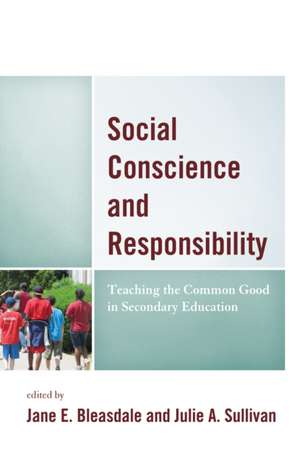
Social Conscience and Responsibility: Teaching the Common Good in Secondary Education: Teaching Ethics across the American Educational Experience
Editat de Jane E. Bleasdale, Julie A. Sullivanen Limba Engleză Paperback – 29 feb 2020
In this volume we will focus on how educators in high schools (grades 9-12) can incorporate the teaching of ethics effectively across all disciplines (Sciences, Humanities, Arts, Math and Technology).
The introduction of the book will be a foundational description of ethics - what it means to study ethics and to be an ethical person.

Preț: 176.52 lei
Preț vechi: 237.25 lei
-26%
Puncte Express: 265
Carte tipărită la comandă
Livrare economică 30 noiembrie-14 decembrie
Livrare prin curier în România Termenul estimat este afișat lângă disponibilitate.
Transport gratuit de la 400.00 lei Plată online sau ramburs, în funcție de opțiunile comenzii.
Retur gratuit în 14 zile Comandă securizată și suport în română.
Specificații
ISBN-13: 9781475846928
ISBN-10: 1475846924
Pagini: 120
Dimensiuni: 152 x 223 x 10 mm
Greutate: 0.21 kg
Editura: Bloomsbury Publishing
Colecția Rowman & Littlefield
Seria Teaching Ethics across the American Educational Experience
Locul publicării:New York, United States
ISBN-10: 1475846924
Pagini: 120
Dimensiuni: 152 x 223 x 10 mm
Greutate: 0.21 kg
Editura: Bloomsbury Publishing
Colecția Rowman & Littlefield
Seria Teaching Ethics across the American Educational Experience
Locul publicării:New York, United States
Cuprins
Series Preface - Dominic Scibilia
Foreword - Michael Duffy
Introduction - Jane Bleasdale
Chapter 1 Ethics -some words on writing - Julie A. Sullivan
Interlude - Jane Bleasdale
Chapter 2 Processing our beliefs - Nancy James
Interlude - Jane Bleasdale
Chapter 3 Humanistic social emotional learning -Margaret Peterson
Interlude - Jane Bleasdale
Chapter 4 Teaching digital ethics - Nicole Cuadro
Interlude - Jane Bleasdale
Chapter 5 Espousing equity and inclusion in an english class - Austin Pidgeon
Interlude - Jane Bleasdale
Chapter 6 Ethical decision making from the roman catholic tradition - Alex McMillan
Interlude - Jane Bleasdale
Chapter 7 US History: an ethical perspective - Tricia Land.
Interlude - Jane Bleasdale
Chapter 8 Ethics in mathematics class discussions - Robert Bonfiglio
Interlude - Jane Bleasdale
Chapter 9. Healthcare: ethics for adolescents - Rich Marfuggi
Interlude - Jane Bleasdale
Epilogue - Dominic Scibilia
Foreword - Michael Duffy
Introduction - Jane Bleasdale
Chapter 1 Ethics -some words on writing - Julie A. Sullivan
Interlude - Jane Bleasdale
Chapter 2 Processing our beliefs - Nancy James
Interlude - Jane Bleasdale
Chapter 3 Humanistic social emotional learning -Margaret Peterson
Interlude - Jane Bleasdale
Chapter 4 Teaching digital ethics - Nicole Cuadro
Interlude - Jane Bleasdale
Chapter 5 Espousing equity and inclusion in an english class - Austin Pidgeon
Interlude - Jane Bleasdale
Chapter 6 Ethical decision making from the roman catholic tradition - Alex McMillan
Interlude - Jane Bleasdale
Chapter 7 US History: an ethical perspective - Tricia Land.
Interlude - Jane Bleasdale
Chapter 8 Ethics in mathematics class discussions - Robert Bonfiglio
Interlude - Jane Bleasdale
Chapter 9. Healthcare: ethics for adolescents - Rich Marfuggi
Interlude - Jane Bleasdale
Epilogue - Dominic Scibilia
Recenzii
Attending to social-emotional learning in content-area instruction is one component of ethical teaching. Another is ensuring that students have the knowledge and tools to make ethical decisions that uphold commitments to their family, neighbors, classmates, and future colleagues. Social Conscience and Responsibility addresses both. Editors Bleasdale and Sullivan (both, Univ. of San Francisco) have assembled a set of resources that can inform the teaching of ethics across disciplines in secondary education. This is not a book that sermonizes on what it means to be ethical; rather, each chapter provides practical strategies and detailed lesson plans for adaptation in classrooms. Light on theory and heavy on tools, this is a useful text for practitioners in search of ideas about how to lead engaging lessons that meet students where they are and support them in developing their empathy, ability to reason, and appreciation for moral considerations. At the same time, the opening chapter provides insight into the moral imperatives that teachers must acknowledge in supporting and assessing students as writers, a key consideration to be made when applying any of the lessons provided in a classroom context. Summing Up: Recommended. Professionals.
This book is a critical resource that helps educators identify the approach and practice of developing engaged citizens who learn with the greater good in mind. The chapters introduce processes for ethical decision making and provide practical examples that demonstrate how to put values, ethics, and religious principles into accessible well-designed units of study including case study and reflection. Each of the chapters are grounded on a deep belief that diversity of perspectives, class, race/ethnicity and faith are a benefit to learning contexts and lead to more equity in society.
This book makes an important contribution to evolving discourse on the need, meaning and application of ethics in education. At a time of increased awareness, on the one hand, of persistent social and educational disparities, and on the other hand, of overt acts of divisiveness, the chapters in this book offer educators with timely and tangible ways in which they can integrate into curriculum and instruction, a critical reading of reality, while enabling students to utilize universal values and ethical stances in imagining new and transformative possibilities. The book also highlights ways in which educational institutions with religious affiliations, have an additional responsibility to leverage a values-, ethics-, morals-centered education that taps into students' intellectual and spiritual capacities in their quest for justice, while at the same time engaging in a productive critique of the various ways in which each of these terms has come to be understood in discourse and practice. An important resource for educators across disciplines and contexts seeking to promote the type of education that leads to social change.
This book encourages teachers to acknowledge their own need for reflection even before the actual instructional process begins. As a former teacher of Christian Ethics and now as one who assists in the formation of teachers, I consider self-reflection to be crucial to the teaching and learning process. I appreciate the invitation to engage teachers in self-reflection with their students on ethical topics which are uncomfortable but deserve the attention of both teacher and student. I believe our students learn to express themselves when grappling with challenging topics because their teachers are willing to enter into the struggle with them.
This book truly allows teachers and students to reflect upon their own personal values and ethics in a time when federal administration is failing to do so. Learners participate in deep, meaningful and sometimes challenging activities that move their thinking and actions from fairness to equity. Teachers are encouraged to find space for students to interact with such thoughts and ideas from personal biases and privilege to engaging in action for social justice. From a practical point of view, as an educational administrator, I see great value in teachers becoming familiar with this book in order to weave it into their curriculum where true change can happen.
Lamenting the apathy of today's high school students is so ingrained in American society that it has become something of a trope. Thoughtful educators, however, recognize that "the apathy problem" is more about the limitations of an archaic institution than the humans who inhabit it. Teenagers, in this view, are not inherently disengaged; they are disengaged from school because school is most often a place which devalues their identities, ideas, and capabilities. In point of fact, adolescent learners are hungry to grapple with complex questions and will do so readily if educators can muster the courage and tools to support them in doing so. This line of reasoning is beautifully centered in Social Conscience and Responsibility:Teaching the Common Good in Secondary Education.
This book is a critical resource that helps educators identify the approach and practice of developing engaged citizens who learn with the greater good in mind. The chapters introduce processes for ethical decision making and provide practical examples that demonstrate how to put values, ethics, and religious principles into accessible well-designed units of study including case study and reflection. Each of the chapters are grounded on a deep belief that diversity of perspectives, class, race/ethnicity and faith are a benefit to learning contexts and lead to more equity in society.
This book makes an important contribution to evolving discourse on the need, meaning and application of ethics in education. At a time of increased awareness, on the one hand, of persistent social and educational disparities, and on the other hand, of overt acts of divisiveness, the chapters in this book offer educators with timely and tangible ways in which they can integrate into curriculum and instruction, a critical reading of reality, while enabling students to utilize universal values and ethical stances in imagining new and transformative possibilities. The book also highlights ways in which educational institutions with religious affiliations, have an additional responsibility to leverage a values-, ethics-, morals-centered education that taps into students' intellectual and spiritual capacities in their quest for justice, while at the same time engaging in a productive critique of the various ways in which each of these terms has come to be understood in discourse and practice. An important resource for educators across disciplines and contexts seeking to promote the type of education that leads to social change.
This book encourages teachers to acknowledge their own need for reflection even before the actual instructional process begins. As a former teacher of Christian Ethics and now as one who assists in the formation of teachers, I consider self-reflection to be crucial to the teaching and learning process. I appreciate the invitation to engage teachers in self-reflection with their students on ethical topics which are uncomfortable but deserve the attention of both teacher and student. I believe our students learn to express themselves when grappling with challenging topics because their teachers are willing to enter into the struggle with them.
This book truly allows teachers and students to reflect upon their own personal values and ethics in a time when federal administration is failing to do so. Learners participate in deep, meaningful and sometimes challenging activities that move their thinking and actions from fairness to equity. Teachers are encouraged to find space for students to interact with such thoughts and ideas from personal biases and privilege to engaging in action for social justice. From a practical point of view, as an educational administrator, I see great value in teachers becoming familiar with this book in order to weave it into their curriculum where true change can happen.
Lamenting the apathy of today's high school students is so ingrained in American society that it has become something of a trope. Thoughtful educators, however, recognize that "the apathy problem" is more about the limitations of an archaic institution than the humans who inhabit it. Teenagers, in this view, are not inherently disengaged; they are disengaged from school because school is most often a place which devalues their identities, ideas, and capabilities. In point of fact, adolescent learners are hungry to grapple with complex questions and will do so readily if educators can muster the courage and tools to support them in doing so. This line of reasoning is beautifully centered in Social Conscience and Responsibility:Teaching the Common Good in Secondary Education.