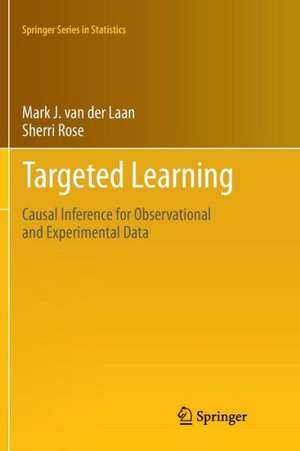
Targeted Learning: Springer Series in Statistics
Autor Mark J. Van Der Laan, Sherri Roseen Limba Engleză Paperback – aug 2013
This book is aimed at both statisticians and applied researchers interested in causal inference and general effect estimation for observational and experimental data. Part I is an accessible introduction to super learning and the targeted maximum likelihood estimator, including related concepts necessary to understand and apply these methods. Parts II-IX handle complex data structures and topics applied researchers will immediately recognize from their own research, including time-to-event outcomes, direct and indirect effects, positivity violations, case-control studies, censored data, longitudinal data, and genomic studies.
Din seria Springer Series in Statistics
- 15%
 Preț: 640.35 lei
 - 20%
 Preț: 546.54 lei
 - 18%
 Preț: 991.51 lei
 - 18%
 Preț: 1090.44 lei
 - 18%
 Preț: 909.25 lei
 - 18%
 Preț: 988.03 lei
 - 18%
 Preț: 1429.06 lei
 - 5%
 Preț: 1480.28 lei
 - 15%
 Preț: 673.74 lei
 - 18%
 Preț: 1128.88 lei
 - 18%
 Preț: 940.61 lei
 - 15%
 Preț: 663.81 lei
 - 18%
 Preț: 1369.10 lei
 - 18%
 Preț: 1000.64 lei
 -
 Preț: 393.53 lei
 - 18%
 Preț: 911.08 lei
 - 18%
 Preț: 988.40 lei
 - 18%
 Preț: 1293.99 lei
 - 18%
 Preț: 992.48 lei
 - 15%
 Preț: 667.64 lei
 - 15%
 Preț: 663.36 lei
 - 18%
 Preț: 1148.21 lei
 - 15%
 Preț: 664.69 lei
 - 18%
 Preț: 1597.63 lei
 - 18%
 Preț: 751.06 lei
 - 15%
 Preț: 663.36 lei
 - 18%
 Preț: 1160.96 lei
 - 18%
 Preț: 922.58 lei
 - 15%
 Preț: 628.72 lei
 - 18%
 Preț: 997.98 lei
 - 15%
 Preț: 666.00 lei
 - 15%
 Preț: 668.53 lei
 - 18%
 Preț: 1108.15 lei
 - 18%
 Preț: 1606.27 lei
 - 18%
 Preț: 1150.28 lei
 - 15%
 Preț: 678.42 lei
 - 15%
 Preț: 669.04 lei
 - 18%
 Preț: 1611.20 lei
 - 20%
 Preț: 1370.05 lei
 - 18%
 Preț: 927.93 lei
 - 18%
 Preț: 1438.75 lei
 - 18%
 Preț: 1368.25 lei
 - 18%
 Preț: 980.26 lei
 - 18%
 Preț: 2167.11 lei
 - 15%
 Preț: 521.02 lei
 - 15%
 Preț: 673.63 lei
 - 18%
 Preț: 2061.70 lei
 - 18%
 Preț: 814.56 lei
 - 15%
 Preț: 667.91 lei
 - 18%
 Preț: 1223.93 lei
Preț: 1233.99 lei
Preț vechi: 1504.86 lei
-18%
Puncte Express: 1851
Carte tipărită la comandă
Livrare economică 24 noiembrie-08 decembrie
Livrare prin curier în România Termenul estimat este afișat lângă disponibilitate.
Transport gratuit pentru acest produs Plată online sau ramburs, în funcție de opțiunile comenzii.
Retur gratuit în 14 zile Comandă securizată și suport în română.
Specificații
ISBN-13: 9781461429111
ISBN-10: 1461429110
Pagini: 700
Ilustrații: LXXII, 628 p.
Dimensiuni: 155 x 235 x 38 mm
Greutate: 0.96 kg
Ediția:2011
Editura: Springer
Colecția Springer Series in Statistics
Seria Springer Series in Statistics
Locul publicării:New York, NY, United States
ISBN-10: 1461429110
Pagini: 700
Ilustrații: LXXII, 628 p.
Dimensiuni: 155 x 235 x 38 mm
Greutate: 0.96 kg
Ediția:2011
Editura: Springer
Colecția Springer Series in Statistics
Seria Springer Series in Statistics
Locul publicării:New York, NY, United States
V-ar putea interesa
-
 Probability: A Very Short IntroductionJohn Haigh-21%Preț: 55.66 lei70.23 lei
 -
 Lakin, S: How to Use StatisticsSteve LakinPreț: 127.98 lei
 -
 Feynman-Kac FormulaePierre Del Moral-18%Preț: 1168.39 lei1424.86 lei
 -
 Probability Through ProblemsMarek Capiński-18%Preț: 1029.18 lei1255.10 lei
 -
 Efficient and Adaptive Estimation for Semiparametric ModelsPeter J. Bickel-20%Preț: 775.81 lei969.76 lei
 -
 Elements of Large-Sample TheoryE L Lehmann-18%Preț: 965.61 lei1177.58 lei
 -
 Elementary Statistics TablesHenry NeavePreț: 366.13 lei
 -
 ANOVA and ANCOVA 2eRutherford-9%Preț: 767.52 lei843.43 lei
 -
 Financial and Sports GamblingWilliam S Mallios-9%Preț: 748.05 lei822.03 lei
 -
 The Principle of RelativityE. CunnighamPreț: 309.38 lei
 -
 Negative Binomial RegressionJoseph M. Hilbe-11%Preț: 654.97 lei735.92 lei
 -
 Preț: 310.23 lei
 -
 Bayesian Analysis Made Simple: An Excel GUI for WinBUGSPhil Woodward-18%Preț: 1125.63 lei1372.71 lei
 -
 Asymptotic Theory of Statistics and ProbabilityAnirban Dasgupta-15%Preț: 611.34 lei719.22 lei
 -
 Séminaire de Probabilités XLVICatherine Donati-MartinPreț: 405.14 lei
 -
 Concentration Inequalities and Model SelectionPascal Massart-15%Preț: 477.23 lei561.45 lei
 -
 Fluctuations in Markov ProcessesTomasz Komorowski-15%Preț: 655.08 lei770.67 lei
Public țintă
ResearchCuprins
Models, Inference, and Truth.- The Open Problem.- Defining the Model and Parameter.- Super Learning.- Introduction to TMLE.- Understanding TMLE.- Why TMLE?.- Bounded Continuous Outcomes.- Direct Effects and Effect Among the Treated.- Marginal Structural Models.- Positivity.- Robust Analysis of RCTs Using Generalized Linear Models.- Targeted ANCOVA Estimator in RCTs.- Independent Case-Control Studies.- Why Match? Matched Case-Control Studies.- Nested Case-Control Risk Score Prediction.- Super Learning for Right-Censored Data.- RCTs with Time-to-Event Outcomes.- RCTs with Time-to-Event Outcomes and Effect Modification Parameters.- C-TMLE of an Additive Point Treatment Effect.- C-TMLE for Time-to-Event Outcomes.- Propensity-Score-Based Estimators and C-TMLE.- Targeted Methods for Biomarker Discovery.- Finding Quantitative Trait Loci Genes.- Case Study: Longitudinal HIV Cohort Data.- Probability of Success of an In Vitro Fertilization Program.- Individualized Antiretroviral Initiation Rules.- Cross-Validated Targeted Minimum-Loss-Based Estimation.- Targeted Bayesian Learning.- TMLE in Adaptive Group Sequential Covariate Adjusted RCTs.- Foundations of TMLE.- Introduction to R Code Implementation.
Recenzii
From the reviews:
“This book is a timely fit and is expected to draw much attention from researchers in the field of causal inference. The book explains the concept of targeted learning, which is an enhanced procedure for estimating targeted causal estimands under the potential outcome framework. … Excellent summaries of complex estimation procedures and methods are ubiquitous, which will be helpful for the nontechnical readers of the book. … This book appears to be a useful reference for Ph.D. students in biostatistics programs.” (Joseph Kang, Journal of the American Statistical Association, June, 2013)
“This book is a timely fit and is expected to draw much attention from researchers in the field of causal inference. The book explains the concept of targeted learning, which is an enhanced procedure for estimating targeted causal estimands under the potential outcome framework. … Excellent summaries of complex estimation procedures and methods are ubiquitous, which will be helpful for the nontechnical readers of the book. … This book appears to be a useful reference for Ph.D. students in biostatistics programs.” (Joseph Kang, Journal of the American Statistical Association, June, 2013)
Notă biografică
Mark van der Laan, PhD, is Jiann-Ping Hsu/Karl E. Peace Professor of Biostatistics and Statistics at UC Berkeley. His research interests include statistical methods in genomics, survival analysis, censored data, machine learning, semiparametric models, causal inference, and targeted learning. His applied research involves applications in HIV and safety analysis, among others. He has published over 250 journal articles, 4 books, and one handbook on big data. Dr. van der Laan is also co-founder and co-editor of the International Journal of Biostatistics and the Journal of Causal Inference and associate editor of a variety of journals. Dr. van der Laan received the 2004 Mortimer Spiegelman Award, the 2005 Van Dantzig Award, the 2005 COPSS Snedecor Award, the 2005 COPSS Presidential Award, and has graduated over 40 PhD students in biostatistics or statistics.
Sherri Rose, PhD, is Associate Professor of Health Care Policy (Biostatistics) at Harvard Medical School. Her work is centered on developing and integrating innovative statistical approaches to advance human health. Dr. Rose's methodological research focuses on nonparametric machine learning for causal inference and prediction. She has made major contributions to the development and application of targeted learning estimators, as well as adaptations to super learning for varied scientific problems. Within health policy, Dr. Rose works on comparative effectiveness research, health program impact evaluation, and computational health economics. She co-leads the Health Policy Data Science Lab and currently serves as an associate editor for the Journal of the American Statistical Association and Biostatistics.
Textul de pe ultima copertă
The statistics profession is at a unique point in history. The need for valid statistical tools is greater than ever; data sets are massive, often measuring hundreds of thousands of measurements for a single subject. The field is ready to move towards clear objective benchmarks under which tools can be evaluated. Targeted learning allows (1) the full generalization and utilization of cross-validation as an estimator selection tool so that the subjective choices made by humans are now made by the machine, and (2) targeting the fitting of the probability distribution of the data toward the target parameter representing the scientific question of interest.
This book is aimed at both statisticians and applied researchers interested in causal inference and general effect estimation for observational and experimental data. Part I is an accessible introduction to super learning and the targeted maximum likelihood estimator, including related concepts necessary to understand and apply these methods. Parts II-IX handle complex data structures and topics applied researchers will immediately recognize from their own research, including time-to-event outcomes, direct and indirect effects, positivity violations, case-control studies, censored data, longitudinal data, and genomic studies.
"Targeted Learning, by Mark J. van der Laan and Sherri Rose, fills a much needed gap in statistical and causal inference. It protects us from wasting computational, analytical, and data resources on irrelevant aspects of a problem and teaches us how to focus on what is relevant – answering questions that researchers truly care about."
-Judea Pearl, Computer Science Department, University of California, Los Angeles
"In summary, this book should be on the shelf of every investigator who conducts observational research and randomized controlled trials. The concepts and methodology are foundational for causal inference and at the same time staytrue to what the data at hand can say about the questions that motivate their collection."
-Ira B. Tager, Division of Epidemiology, University of California, Berkeley
This book is aimed at both statisticians and applied researchers interested in causal inference and general effect estimation for observational and experimental data. Part I is an accessible introduction to super learning and the targeted maximum likelihood estimator, including related concepts necessary to understand and apply these methods. Parts II-IX handle complex data structures and topics applied researchers will immediately recognize from their own research, including time-to-event outcomes, direct and indirect effects, positivity violations, case-control studies, censored data, longitudinal data, and genomic studies.
"Targeted Learning, by Mark J. van der Laan and Sherri Rose, fills a much needed gap in statistical and causal inference. It protects us from wasting computational, analytical, and data resources on irrelevant aspects of a problem and teaches us how to focus on what is relevant – answering questions that researchers truly care about."
-Judea Pearl, Computer Science Department, University of California, Los Angeles
"In summary, this book should be on the shelf of every investigator who conducts observational research and randomized controlled trials. The concepts and methodology are foundational for causal inference and at the same time staytrue to what the data at hand can say about the questions that motivate their collection."
-Ira B. Tager, Division of Epidemiology, University of California, Berkeley
Caracteristici
Establishes causal inference methodology that incorporates the benefits of machine learning with statistical inference Presentation combines accessibility with the method's rigorous grounding in statistical theory Demonstrates targeted learning in epidemiological, medical, and genomic experimental and observational studies that include informative dropout, missingness, time-dependent confounding, and case-control sampling Includes supplementary material: sn.pub/extras