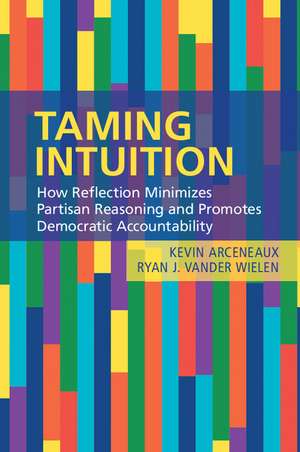
Taming Intuition
Autor Kevin Arceneaux, Ryan J Vander Wielenen Limba Engleză Paperback – 11 aug 2017
Ceea ce aduce nou Taming Intuition în peisajul științelor politice contemporane este Modelul Intuitionist al Raționamentului Politic, o structură teoretică menită să explice de ce unii alegători reușesc să taxeze derapajele politicienilor, în timp ce alții rămân captivi loialităților de partid. Apreciem modul în care Kevin Arceneaux și Ryan J. Vander Wielen depășesc simpla constatare a polarizării, investigând mecanismele cognitive care permit sau blochează auto-corecția în fața informațiilor noi. Autorii demonstrează că succesul guvernanței democratice nu depinde doar de accesul la informație, ci de voința cognitivă a individului de a-și chestiona propriile intuiții. Lucrarea este comparabilă cu The Ambivalent Partisan de Howard G. Lavine în ceea ce privește rigoarea analizei psihologice, dar este actualizată pentru a răspunde provocărilor specifice ale „motivației direcționate” (motivated reasoning) într-un climat politic tot mai fragmentat. În timp ce Howard G. Lavine se concentrează pe compromisurile dintre deciziile facile și consistența cognitivă, Kevin Arceneaux pune accentul pe procesul de reflecție ca instrument de diminuare a raționamentului partizan. Această abordare continuă preocupările autorului din The House that Fox News Built?, unde analiza influența mass-media asupra elitelor, mutând acum lupa asupra capacității electoratului de a exercita o responsabilitate democratică reală. Structura cărții, susținută de numeroase tabele și ilustrații, facilitează înțelegerea modului în care diferențele individuale de personalitate și forța atașamentelor politice dictează calitatea actului democratic.
Preț: 283.44 lei
Carte tipărită la comandă
Livrare economică 25 mai-08 iunie
Specificații
ISBN-10: 1108400310
Pagini: 260
Ilustrații: 32 b/w illus. 27 tables
Dimensiuni: 152 x 229 x 16 mm
Greutate: 0.43 kg
Editura: Cambridge University Press
Locul publicării:New York, United States
V-ar putea interesa
-
 -6%Preț: 546.14 lei581.22 lei
 -
 -9%Preț: 255.89 lei282.07 lei
 -
 -10%Preț: 361.67 lei403.70 lei
 -
 -5%Preț: 515.57 lei542.71 lei
 -
 Consciousness and Moral ResponsibilityNeil Levy-31%Preț: 355.52 lei514.37 lei
 -
 Utilitarianism: A Very Short IntroductionKatarzyna de Lazari-Radek-21%Preț: 53.41 lei67.74 lei
 -
 -20%Preț: 535.50 lei669.81 lei
 -
 Virtue and Law in Plato and BeyondJulia Annas-11%Preț: 489.12 lei549.57 lei
 -
 Neuroethics: Anticipating the futureJudy Illes-33%Preț: 736.44 lei1099.54 lei
 -
 -16%Preț: 502.79 lei598.11 lei
 -
 -30%Preț: 339.56 lei488.49 lei
 -
 -27%Preț: 258.92 lei355.74 lei
 -
 -21%Preț: 231.72 lei294.57 lei
 -
 Philosophical Progress: In Defence of a Reasonable OptimismDaniel Stoljar-31%Preț: 368.96 lei533.29 lei
 -
 Oxford Studies in Metaethics 12Russ Shafer-Landau-23%Preț: 276.01 lei359.10 lei
 -
 -33%Preț: 571.29 lei856.10 lei
 -
 Doing and Allowing HarmFiona Woollard-34%Preț: 549.65 lei827.88 lei
 -
 Thinking about BriberyPhilip M Nichols-24%Preț: 268.53 lei354.82 lei
 -
 -14%Preț: 694.53 lei807.59 lei
 -
 The Cambridge Handbook of Evolutionary EthicsMichael RusePreț: 250.96 lei
 -
 -15%Preț: 421.71 lei496.13 lei
 -
 The Blackwell Guide to Kant's EthicsThomas E HillPreț: 334.68 lei
 -
 Cognitive Disability Its ChallengeEva Feder KittayPreț: 239.54 lei
De ce să citești această carte
Această carte este esențială pentru studenții și cercetătorii în științe politice care doresc să înțeleagă fundamentele psihologice ale votului rațional. Cititorul va obține o perspectivă clară asupra modului în care reflecția poate învinge prejudecata partizană, oferind un argument teoretic solid pentru importanța educației civice și a gândirii critice în menținerea sănătății sistemelor democratice.
Despre autor
Kevin Arceneaux este profesor asociat de științe politice și membru afiliat al Institutului pentru Afaceri Publice din cadrul Universității Temple. Cercetările sale se concentrează pe intersecția dintre psihologia politică și comportamentul alegătorilor, explorând modul în care trăsăturile individuale și mediul informațional influențează deciziile publice. A publicat lucrări de referință despre impactul știrilor partizane, fiind recunoscut pentru utilizarea metodelor de cercetare cvasi-experimentale și a datelor observaționale în studiul elitelor politice americane.
Descriere scurtă
Cuprins
Recenzii
'In this remarkable book, Arceneaux and Vander Wielen apply dual-process models of how people think to questions of how they reason about politics. They develop and refine a powerful conceptual model and then provide insightful, innovative empirical tests. I have long been looking for a book like this one that integrates recent insights about human cognition with long-standing questions about how voters think. This ambitious, thought-provoking research should be read by anyone who wants to understand the role of intuition and reflection in voter decision-making.' Daniel Hopkins, University of Pennsylvania
'This book takes on one of the most important political questions of our time. Its central argument, and the evidence presented in support of it, is exciting and provocative. To date, no one has figured out how to reduce the myriad information-processing biases identified by Motivated Reasoning Theory that produce the polarization and lack of compromise plaguing our current politics. Unfortunately, giving people new and credible information in particular, and even education in general, often exacerbates these biases. The more subtle answer offered by Arceneaux and Vander Wielen is that those with the ability to coolly reflect on controversial topics can avoid making these common mistakes. Now if we can only figure out how to train people to hold such a rare combination of curiosity and cool-headedness! Taming Intuition will, at the very least, be an important voice in an important debate.' Nicholas Valentino, University of Michigan