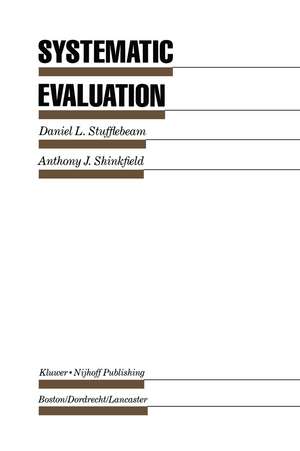
Systematic Evaluation: Evaluation in Education and Human Services, cartea 8
Autor D. L. Stufflebeam, Anthony J. Shinkfielden Limba Engleză Paperback – 18 noi 2011
Din seria Evaluation in Education and Human Services
-
 Preț: 376.15 lei
 - 18%
 Preț: 961.83 lei
 - 15%
 Preț: 660.75 lei
 -
 Preț: 376.77 lei
 -
 Preț: 372.70 lei
 - 15%
 Preț: 666.73 lei
 -
 Preț: 370.91 lei
 - 15%
 Preț: 665.10 lei
 -
 Preț: 375.91 lei
 -
 Preț: 382.10 lei
 -
 Preț: 376.77 lei
 -
 Preț: 376.59 lei
 -
 Preț: 399.67 lei
 - 15%
 Preț: 661.94 lei
 -
 Preț: 385.44 lei
 - 15%
 Preț: 667.74 lei
 - 18%
 Preț: 1262.17 lei
 - 18%
 Preț: 986.73 lei
 -
 Preț: 380.57 lei
 - 15%
 Preț: 663.36 lei
 - 15%
 Preț: 666.00 lei
 - 18%
 Preț: 1270.35 lei
 -
 Preț: 399.46 lei
 -
 Preț: 371.45 lei
 - 18%
 Preț: 1263.75 lei
 - 15%
 Preț: 666.00 lei
 -
 Preț: 382.53 lei
 - 15%
 Preț: 666.00 lei
 - 15%
 Preț: 670.12 lei
 -
 Preț: 378.44 lei
 - 15%
 Preț: 666.56 lei
 - 18%
 Preț: 1260.59 lei
 - 15%
 Preț: 663.81 lei
 - 18%
 Preț: 985.52 lei
Preț: 379.34 lei
Puncte Express: 569
Carte tipărită la comandă
Livrare economică 07-21 decembrie
Livrare prin curier în România Termenul estimat este afișat lângă disponibilitate.
Transport gratuit de la 400.00 lei Plată online sau ramburs, în funcție de opțiunile comenzii.
Retur gratuit în 14 zile Comandă securizată și suport în română.
Specificații
ISBN-13: 9789401089951
ISBN-10: 9401089957
Pagini: 364
Ilustrații: 368 p.
Dimensiuni: 152 x 229 x 20 mm
Greutate: 0.53 kg
Ediția:1985
Editura: Springer
Colecția Evaluation in Education and Human Services
Seria Evaluation in Education and Human Services
Locul publicării:Dordrecht, Netherlands
ISBN-10: 9401089957
Pagini: 364
Ilustrații: 368 p.
Dimensiuni: 152 x 229 x 20 mm
Greutate: 0.53 kg
Ediția:1985
Editura: Springer
Colecția Evaluation in Education and Human Services
Seria Evaluation in Education and Human Services
Locul publicării:Dordrecht, Netherlands
V-ar putea interesa
-
 -29%Preț: 136.05 lei191.08 lei
 -
 -23%Preț: 411.74 lei534.73 lei
 -
 Leaders of Their Own LearningRon BergerPreț: 186.92 lei
 -
 Teacher's Skills Tests for DummiesColin BeveridgePreț: 172.02 lei
 -
 Five Dimensions of QualityLinda SuskiePreț: 339.01 lei
 -
 EMT Exam For Dummies with Online PracticeArthur Hsieh-5%Preț: 213.62 lei224.86 lei
 -
 Assessment for EducationVal KlenowskiPreț: 356.91 lei
 -
 Learning AnalyticsBrandon White-18%Preț: 1031.10 lei1257.44 lei
Public țintă
ResearchCuprins
1 Introduction to Evaluation.- Objectives.- What Is Evaluation?.- Methods.- Standards.- History.- Roles in Evaluation Work.- Knowledge Test for Unit 1.- Application Exercise.- Questions Without Answers.- References.- 2 An Analysis of Alternative Approaches to Evaluation.- Objectives.- Alternative Conceptualizations of Evaluation.- Pseudoevaluation.- Quasievaluations.- True Evaluations.- Conclusion.- Knowledge Test for Unit 2.- Application Exercises.- Questions Without Answers.- References.- 3 Objectives-oriented Evaluation: The Tylerian Tradition.- Objectives.- The Intention of the Tylerian Approach.- Some Limitations of the Tylerian Approach.- Metfessel and Michael: An Extension of the Tylerian Approach.- Knowledge Test for Unit 2.- Application Exercises.- Questions Without Answers.- References.- 4 Edward A. Suchman and the Scientific Approach to Evaluation.- Objectives.- Conceptual Aspects of Evaluation.- Methodological Aspects of Evaluation.- Evaluation and Program Administration.- Knowledge Test for Unit 4.- Questions Without Answers.- References.- 5 Cronbach’s Designing Evaluations: A Synopsis.- Objectives.- to the Issues.- Cronbach’s Concepts of the Elements in an Evaluation Design: Uto.- Planning for Communication.- The Promise of Evaluation.- Knowledge Test for Unit 5.- Application Exercises.- Questions Without Answers.- References.- 6 Stufflebeam’s Improvement-oriented Evaluation.- Objectives.- Some Personal History.- Development of the CIPP Model.- The PDK Study Committee’s Elaboration of CIPP Evaluation.- CIPP Compared to Other Recent Evaluation Proposals.- CIPP as a Strategy for Improving Systems.- An Overview of CIPP Categories.- Designing Evaluations.- Metaevaluation and Standards.- Conclusion.- Knowledge Test for Unit 6.- Application Exercises.-Questions Without Answers.- References.- 7 Stake’s Client-centered Approach to Evaluation.- Objectives.- The Countenance Statement of Evaluation.- Format for Data Collection.- Responsive Evaluation.- General Observations.- Knowledge Test for Unit 7.- Application Exercises.- Questions Without Answers.- References.- 8 T.R. Owens, R.L. Wolf: An Adversary Approach to Evaluation.- Objectives.- Intention of the Adversary Model.- One Form of the Adversary Approach: Wolf’s Judicial Model.- Pros and Cons of Adversary Evaluation.- Knowledge Test for Unit 8.- Application Exercises.- Questions Without Answers.- References.- 9 Illuminative Evaluation: The Holistic Approach.- Objectives.- Traditional Evaluation: Seeds of Doubt.- Stake’s Concept of Evaluation as Portrayal.- Illuminative Evaluation: A Social-Anthropological Paradigm.- The Context of Educational Programs.- Organization and Methods of Illuminative Evaluation.- Reporting and Decision Making.- Problems Associated with Illuminative Evaluation.- Knowledge Test for Unit 9.- Application Exercises.- Questions Without Answers.- References.- 10 Michael Scrlven’s Consumer-Oriented Approach to Evaluation.- Objectives.- Evaluation Defined.- Critique of Other Persuasions.- Formative and Summative Evaluation.- Amateur versus Professional Evaluation.- Intrinsic and Payoff Evaluation.- Goal-free Evaluation.- Needs Assessment.- The Key Evaluation Checklist.- Metaevaluation.- Evaluation Ideologies.- Professionalization of Evaluation.- Knowledge Test for Unit 10.- Application Exercises.- Questions Without Answers.- References.- Indexes.