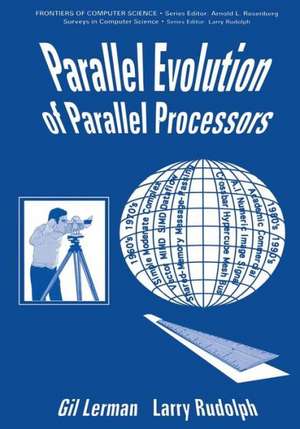
Parallel Evolution of Parallel Processors
Autor G. Lerman, L. Rudolphen Limba Engleză Paperback – 17 mar 2013
Preț: 349.73 lei
Preț vechi: 437.16 lei
-20%
Puncte Express: 525
Carte tipărită la comandă
Livrare economică 25 noiembrie-09 decembrie
Livrare prin curier în România Termenul estimat este afișat lângă disponibilitate.
Transport gratuit de la 400.00 lei Plată online sau ramburs, în funcție de opțiunile comenzii.
Retur gratuit în 14 zile Comandă securizată și suport în română.
Specificații
ISBN-13: 9781461362371
ISBN-10: 1461362377
Pagini: 270
Ilustrații: XIII, 270 p.
Dimensiuni: 178 x 254 x 16 mm
Greutate: 0.55 kg
Ediția:Softcover Reprint of the Original 1st 1993 edition
Editura: Springer Us
Locul publicării:New York, NY, United States
ISBN-10: 1461362377
Pagini: 270
Ilustrații: XIII, 270 p.
Dimensiuni: 178 x 254 x 16 mm
Greutate: 0.55 kg
Ediția:Softcover Reprint of the Original 1st 1993 edition
Editura: Springer Us
Locul publicării:New York, NY, United States
V-ar putea interesa
-
 The Art of Multiprocessor ProgrammingMaurice Herlihy-40%Preț: 375.12 lei620.73 lei
 -
 -41%Preț: 457.81 lei769.47 lei
 -
 An Introduction to Parallel ProgrammingPeter Pacheco-41%Preț: 382.32 lei644.49 lei
 -
 Multicore and GPU Programming: An Integrated ApproachGerassimos Barlas-40%Preț: 530.07 lei888.37 lei
 -
 -40%Preț: 492.21 lei824.42 lei
 -
 -40%Preț: 493.63 lei823.98 lei
 -
 High Performance Computing: Modern Systems and PracticesThomas Sterling-40%Preț: 437.18 lei729.97 lei
 -
 Using Artificial Intelligence Absolute Beginner's GuideMichael Miller-20%Preț: 201.24 lei251.56 lei
 -
 Computer Science: A Very Short IntroductionSubrata Dasgupta-36%Preț: 47.92 lei75.24 lei
 -
 Principles of Computer HardwareAlan Clements-29%Preț: 602.71 lei846.14 lei
 -
 ARM System-on-Chip ArchitectureSteve Furber-23%Preț: 591.53 lei768.22 lei
 -
 -20%Preț: 574.25 lei717.80 lei
 -
 Modern Information RetrievalRicardo Baeza-Yates-20%Preț: 575.92 lei719.90 lei
 -
 -20%Preț: 580.64 lei725.81 lei
 -
 Computer Architecture: A Quantitative ApproachJohn L. Hennessy-39%Preț: 536.81 lei884.58 lei
 -
 Notes on the Synthesis of FormChristopher AlexanderPreț: 235.55 lei
 -
 -20%Preț: 134.29 lei167.85 lei
 -
 -27%Preț: 1331.22 lei1813.38 lei
 -
 Computer ArchitectureCharles Fox-35%Preț: 302.86 lei467.47 lei
 -
 Parallel ProgrammingThomas Rauber-20%Preț: 407.64 lei509.55 lei
Public țintă
ResearchCuprins
1. Introduction.- 2. Classification of Parallel Processors.- 2.1. A Brief History of Classification Schemes.- 2.2. The Classification Scheme Used in This Work.- 2.3. A Look at the Classification Characteristics.- 2.4. Information-Gathering Details.- 2.5. An Apology.- 3. Emergent Trends.- 3.1. Applications.- 3.2. Mode of Control.- 3.3. Data Exchange and Synchronization.- 3.4. The Number and Type of PEs.- 3.5. Interconnection Network.- 3.6. Memory Organization.- 3.7. Type of Constructing Institution.- 3.8. Period of Construction.- 3.9. Summary of the Correlations.- 4. Popular Machine Models.- 4.1. Exposing the Complex Patterns.- 4.2. General-Purpose Machines.- 4.3. Model IV — Image (and Signal) Processing SIMD Machines.- 4.4. Model V — Database MIMD Machines, Two Variants.- 4.5. Trends in Commercialization.- 5. The Shape of Things to Come?.- 5.1. Underlying Assumptions.- 5.2. Applications.- 5.3. Control.- 5.4. Data Exchange and Synchronization.- 5.5. Number and Type of PEs.- 5.6. Interconnection Networks.- 5.7. Memory Organization.- 5.8. Sources.- 5.9. Classification of Parallel Computers.- 5.10. Summary.- Appendix: Information about the Systems.