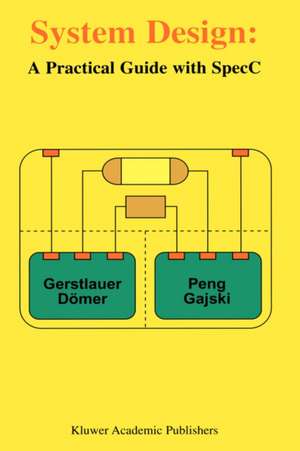
System Design
Autor Andreas Gerstlauer, Daniel D. Gajski, Junyu Peng, Rainer Dömeren Limba Engleză Hardback – 31 mai 2001
Features:
- Comprehensive introduction to and description of the SpecC language and design methodology;
- IP-centric language and methodology with focus on design reuse;
- Complete framework for system-level design from specification to implementation for SOCs and other embedded HW/SW systems.
Preț: 978.76 lei
Preț vechi: 1193.62 lei
-18%
Puncte Express: 1468
Carte tipărită la comandă
Livrare economică 27 noiembrie-11 decembrie
Livrare prin curier în România Termenul estimat este afișat lângă disponibilitate.
Transport gratuit pentru acest produs Plată online sau ramburs, în funcție de opțiunile comenzii.
Retur gratuit în 14 zile Comandă securizată și suport în română.
Specificații
ISBN-13: 9780792373872
ISBN-10: 0792373871
Pagini: 276
Ilustrații: XIII, 255 p.
Dimensiuni: 160 x 241 x 22 mm
Greutate: 0.53 kg
Ediția:2001
Editura: Springer Us
Locul publicării:New York, NY, United States
ISBN-10: 0792373871
Pagini: 276
Ilustrații: XIII, 255 p.
Dimensiuni: 160 x 241 x 22 mm
Greutate: 0.53 kg
Ediția:2001
Editura: Springer Us
Locul publicării:New York, NY, United States
V-ar putea interesa
-
 The C++ Programming LanguageBjarne Stroustrup-20%Preț: 507.21 lei634.02 lei
 -
 Python Programming for BiologyTim J. Stevens-20%Preț: 460.01 lei575.01 lei
 -
 High - Level SynthesisDaniel D. Gajski-18%Preț: 984.05 lei1200.05 lei
 -
 Beginning Programming with C++ For DummiesStephen R. Davis-20%Preț: 173.62 lei217.02 lei
 -
 Hardware-Dependent SoftwareWolfgang Ecker-15%Preț: 635.89 lei748.10 lei
 -
 Pro ASP.NET Web API SecurityBadrinarayanan Lakshmiraghavan-20%Preț: 525.86 lei657.33 lei
 -
 -20%Preț: 230.97 lei288.71 lei
 -
 -20%Preț: 156.43 lei195.54 lei
 -
 High - Level SynthesisDaniel D. Gajski-18%Preț: 952.65 lei1161.77 lei
 -
 SPECC: Specification Language and MethodologyDaniel D. Gajski-18%Preț: 909.67 lei1109.36 lei
 -
 Embedded System DesignDaniel D. GajskiPreț: 381.30 lei
 -
 Functional Programming in ScalaRunar Bjarnason-20%Preț: 340.60 lei425.75 lei
 -
 Python Programming for BeginnersJoseph Joyner-20%Preț: 53.61 lei67.02 lei
 -
 The Fortran 2003 HandbookJeanne C. Adams-20%Preț: 1530.72 lei1913.41 lei
 -
 Murachs C# 2012Joel Murach-28%Preț: 359.74 lei496.79 lei
 -
 Practical Aspects of Declarative LanguagesI. V. Ramakrishnan-20%Preț: 325.63 lei407.04 lei
 -
 -20%Preț: 313.95 lei392.44 lei
 -
 Ada: The Choice for '92Dimitris Christodoulakis-20%Preț: 328.49 lei410.62 lei
 -
 Compiler ConstructionPeter A. Fritzson-20%Preț: 330.96 lei413.70 lei
 -
 Compiler ConstructionTibor Gyimóthy-20%Preț: 325.83 lei407.29 lei
 -
 Ada 95, Quality and StyleChristine Ausnit-Hood-20%Preț: 350.21 lei437.76 lei
 -
 -20%Preț: 318.67 lei398.33 lei
Public țintă
ResearchCuprins
1. The SpecC Language.- Outline.- 1.1 Introduction.- 1.2 Computational Models.- 1.3 The SpecC Model.- 1.4 System-level Language Requirements.- 1.5 The SpecC Language.- 1.6 Summary and Conclusion.- 2. Modeling and Design with SpecC.- Outline.- 2.1 Introduction.- 2.2 Specification Model.- 2.3 Architecture Refinement.- 2.4 Architecture Model.- 2.5 Communication Synthesis.- 2.6 Communication Model.- 2.7 Backend.- 2.8. Implementation Model.- 2.9 Summary and Conclusions.- 3. Design of a GSM Vocoder.- Outline.- 3.1 Introduction.- 3.2 Specification Model.- 3.3 Architecture Exploration.- 3.4 Architecture Model.- 3.5 Communication Synthesis.- 3.6 Communication Model.- 3.7 Backend.- 3.8 Implementation Model.- 3.9 Summary & Conclusions.- 4. Design of a JBIG Encoder.- Outline.- 4.1 Introduction.- 4.2 Specification.- 4.3 Partitioning.- 4.4 Architecture Model.- 4.5 Communication model.- 4.6 JBIG Hardware Design.- 4.7 Conclusions.- 5 SpecC Design Environment.- Outline.- 5.1 Introduction.- 5.2 Refinement.- 5.3 SpecC Engine.- 5.4 Conclusions.- 6. SpecC Technology Open Consortium.- 6.1 Introduction.- 6.2 Motivation.- 6.3 The SpecC Technology Open Consortium.
Notă biografică
Embedded System Design: Modeling, Synthesis and Verification introduces a model-based approach to system level design. It presents modeling techniques for both computation and communication at different levels of abstraction, such as specification, transaction level and cycle-accurate level. It discusses synthesis methods for system level architectures, embedded software and hardware components. Using these methods, designers can develop applications with high level models, which are automatically translatable to low level implementations. This book, furthermore, describes simulation-based and formal verification methods that are essential for achieving design confidence. The book concludes with an overview of existing tools along with a design case study outlining the practice of embedded system design. Specifically, this book addresses the following topics in detail:
. System modeling at different abstraction levels
. Model-based system design
. Hardware/Software codesign
. Software and Hardware component synthesis
. System verification
This book is for groups within the embedded system community: students in courses on embedded systems, embedded application developers, system designers and managers, CAD tool developers, design automation, and system engineering.