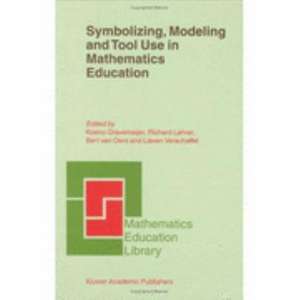
Symbolizing, Modeling and Tool Use in Mathematics Education
Editat de Koeno Gravemeijer, Richard Lehrer, Bert Van Oers, Lieven Verschaffelen Limba Engleză Hardback – 31 dec 2002
Preț: 893.16 lei
Preț vechi: 1175.21 lei
-24%
Puncte Express: 1340
Carte tipărită la comandă
Livrare economică 10-16 iunie
Specificații
ISBN-13: 9781402010323
ISBN-10: 140201032X
Pagini: 320
Ilustrații: IV, 308 p.
Dimensiuni: 215 x 303 x 23 mm
Greutate: 1.1 kg
Ediția:2003
Editura: SPRINGER NETHERLANDS
Locul publicării:Dordrecht, Netherlands
ISBN-10: 140201032X
Pagini: 320
Ilustrații: IV, 308 p.
Dimensiuni: 215 x 303 x 23 mm
Greutate: 1.1 kg
Ediția:2003
Editura: SPRINGER NETHERLANDS
Locul publicării:Dordrecht, Netherlands
V-ar putea interesa
-
 Preț: 94.15 lei
 -
 The Assessment of Learning in Engineering EducationJohn Heywood-8%Preț: 464.49 lei504.88 lei
 -
 Idea Generator, TheChris ThomasonPreț: 102.82 lei
 -
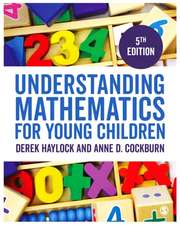 Understanding Mathematics for Young ChildrenDerek HaylockPreț: 349.46 lei
 -
 Music Education & PerceptionsEric Burgess-26%Preț: 709.07 lei954.16 lei
 -
 -20%Preț: 151.50 lei189.27 lei
 -
 Operation Order!: Black Ops - Gitmo GetawayJohn EnockPreț: 93.54 lei
 -
 Environmental LearningMark Rickinson-15%Preț: 616.83 lei725.68 lei
 -
 Communicating Science to the PublicLeo Tan Wee Hin-8%Preț: 568.51 lei617.95 lei
Public țintă
ResearchCuprins
and overview.- Preamble: from models to modeling.- Section I: Emergent modeling.- to section I: Informal representations and their improvements.- The mathematization of young children’s language.- Symbolizing space into being.- Mathematical representations as systems of notations-in-use.- Students’ Criteria for Representational Adequacy.- Transitions in emergent modeling.- Section II: The role of Models, Symbols and Tools in instructional design.- to section II: The role of Models, Symbols and Tools in instructional design.- Emergent models as an instructional design heuristic.- Modeling, Symbolizing, and Tool Use in Statistical Data Analysis.- Didactic objects and didactic models in radical constructivism.- Taking into account different views: Three brief comments on papers by Gravemeijer & Stephan, Cobb and Thompson.- Section III: Models, situated practices, and generalization.- to section III: Models, situated practices, and generalization.- On Guessing the Essential Thing.- Everyday knowledge and mathematical modeling of school word problems.- On the development of human representional competence from and evolutionary point of view: From Episodic To Virtual Culture.- Modeling Reasoning.