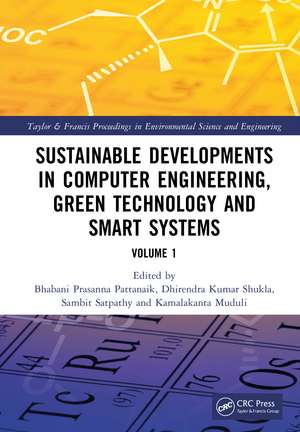
Sustainable Developments in Computer Engineering, Green Technology and Smart Systems: Volume 1: Taylor and Francis Proceedings in Environmental Science and Engineering
Editat de Bhabani Prasanna Pattanaik, Dhirendra Kumar Shukla, Sambit Satpathy, Kamalakanta Mudulien Limba Engleză Hardback – 21 iul 2026
The chapters in this volume provide an integrated analysis of energy-efficient, environmentally sustainable and technologically resilient building systems. Combining foundational principles with applied methodologies, the book addresses contemporary challenges in intelligent automation, sustainable communication networks, secure digital infrastructures and smart industrial applications.
By integrating interdisciplinary research with real-world applications, this publication serves as a valuable resource for researchers, practitioners and policymakers committed to shaping sustainable technological ecosystems for the future.



Preț: 1513.98 lei
Preț vechi: 2155.36 lei
-30% Nou
Puncte Express: 2271
Carte indisponibilă temporar
Doresc să fiu notificat când acest titlu va fi disponibil:
Se trimite...
Specificații
ISBN-13: 9781041247210
ISBN-10: 1041247214
Pagini: 1118
Dimensiuni: 174 x 246 mm
Greutate: 2.23 kg
Ediția:1
Editura: CRC Press
Colecția CRC Press
Seria Taylor and Francis Proceedings in Environmental Science and Engineering
ISBN-10: 1041247214
Pagini: 1118
Dimensiuni: 174 x 246 mm
Greutate: 2.23 kg
Ediția:1
Editura: CRC Press
Colecția CRC Press
Seria Taylor and Francis Proceedings in Environmental Science and Engineering
Public țintă
Academic, Postgraduate, and Professional ReferenceCuprins
1. Multi-Level Chaotic DNA Encryption with Big Data Analytics for Next-Generation Cyber security 2. Comparative Evaluation of Transformer and CNN–RNN Hybrid Architectures for Emotion Recognition Using EEG and Multimodal Physiological Signals 3. DC Performance Analysis of Spacer Engineered Nanosheet-FET for Low-Power and High-Speed Applications 4. Dynamic Performance Comparison of Valley and Peak-Current Mode Modulated Synchronous Buck Converters 5. Federated Reinforcement Learning Framework for Self-Healing Intent-Based SDN in Smart IoT Networks 6. AI-Based Smart Civic Issue Detection and Complaint System 7. A Digital Marketplace for Craftspeople to Repair and Restore the Broken Products using Chatbot 8. IoT–Fog Scheduling for Real-Time Healthcare Systems Privacy-Preserving 9. Intelligent Energy-Aware Live VM Migration in Cloud Computing Using Machine Learning Techniques 10. An Enhanced Approach and Sustainability: Rock Hyrax-based Live VM Migration Framework 11. Intelligent Load Balancing Using Machine Learning for Wikipedia Web Traffic in Kubernetes 12. Tuberculosis Diseases Detection in X-Ray Images 13. Using Object Detection Model YOLOv12 14. Smart Memory Assistants for Alzheimer's Patients: A Review of Offline Approaches 15. Algorithmic Time and Task Management Using Google Calendar API 16. Fog-Enabled AI Silos for Robotics Healthcare over 6G Networks: Architectures, Security, and Future Frontiers 17. Speech Emotion Recognition Enhancement Using Wav2Vec 2.0: A Comparative Study Against Conventional Feature-Based Techniques on the TESS Dataset 18. MARKET PLACE: FOR STARTUP ECOSYSTEM WITH AI IMPLEMENTATION 19. Harmonics in Thyristor Controlled Reactors: A Short Survey 20. WELORAD: A Novel Hybrid Ensemble Model for Early Lung Cancer Prediction 21. Intersectional Determinants of Cardiovascular Health 22. Hypergraph-based Anomaly Detection in Industrial Control Systems using Hyper-GCN 23. AI in Breast Cancer Detection and Diagnosis: Challenges and Future Direction 24. Generative AI–Driven Framework for Adversarial Attack Detection and Robust Model Training 25. A Robust Algorithm For Secure Communication Messengers 26. INTERVU: AN AI-POWERED MOCK INTERVIEW PLATFORM WITH RESUME RECOMMENDATION 27. Mental Health Monitoring Through Social Media with AI 28. Multimodal Misinformation Detection: A Comprehensive Systematic Review of Methods and Challenges 29. Real-Time Detection and Classification of Crop Diseases Using YOLO 30. IoT-Enabled Adaptive Ambulance Routing and Hospital Allocation using Intelligent Traffic Control 31. Multi-factor authentication scheme for Secured Online Transaction in a cloud environment 32. ANALYSIS OF A ZOOM-OFDM BASED COMMUNICATION SYSTEM 33. Interactive Algorithm Visualization 34. Data-Driven Insights and Predictive Modelling of Crimes Against Women in India 35. Planning Using Deep Reinforcement Learning and Patient Digital Twins in Oncology 36. Design and Simulation of a Dielectric Resonator Antenna with Applications in AI-Empowered Sustainable Energy Systems 37. AlumniConnect: Alumni as Allies and Mentors 38. Energy-Driven Adaptive Routing Protocol (EDARP): A Lightweight Routing Approach for Sustainable IoT Networks 39. Predicting YouTube Advertisement Views Through Machine Learning 40. "Vision-Enabled Smart Energy Management for Humans and Animals in Indoor Environments 41. An Emergency SOS framework using AI techniques for Modern Policing 42. An Enhanced ConvNeXt-V2 and Mamba Hybrid Model for Detecting Reckless Driving Behaviour on Grayscale Driving Dataset 43. Robust Human Activity Recognition through Hybrid Deep Feature Learning using SURF-CNN Model 44. A Cutting-Edge Analysis of Various Machine Learning Algorithms for Fake Reviews Detection 45. Smart skin cancer detection 46. A Hybrid Machine Learning Framework Integrating Feature Selection and Ensemble Techniques for Accurate Diabetes Prediction Systems 47. TRINETRA-Tribal Rights Intelligence Network for Empowerement through Technology, Research and Analysis 48. Machine Learning-Based Network Intrusion Detection Systems 49. Brain Tumor Diagnosis from MRI: A Deep Learning Ensemble Approach 50. A Hybrid Feature DBN and CNN Stacking Framework for Breast Cancer Histopathology 51. Secure Computational Pipeline for Skin Disorder Detection Using Intelligent Segmentation Methods 52. Deep Learning Approaches for Offline Handwritten Signature Verification: Accuracy, Robustness, and Efficiency Assessment 53. Hyperparameter-Tuned Ensemble Model for Cardiovascular Disease Detection Using Optuna and GridSearchCV 54. Accelerating Cancer Drug Synergy Prediction Using Machine Learning 55. SocialTrade: A Smart P2P Marketplace with AI Integration 56. Detecting Machine-Generated Tweets Using FastText-Based CNN and XGBoost Models 57. Fake Product Identification System Using Blockchain 58. AI-Driven Phishing Detection using Natural Language Processing (NLP) and Advanced URL Analysis 59. SkinQINN: A Quantum-Inspired Hybrid Neural Network for Robust Skin Cancer Diagnosis 60. KAVALYA: Knowledge-Aware Verification and Adaptive Learning for Validated Content Generation 61. AMLID: An Adaptive Multi-Layered Deep Learning Framework for Intelligent Intrusion Detection 62. Precision Viscosity Measurement System for Industrial Applications 63. A Novel Hybrid Framework Approach for Topic Based Sentiment Analysis on Tweets of Indian Railways 64. Enhancing FANET QoS Through Adaptive Route Timeout Optimization: A Multi-Metric Investigation 65. HYGIEIA: A HYBRID AI FRAMEWORK FOR DERMATOLOGICAL CLASSIFICATION AND DIABETES RISK STRATIFICATION 66. FashioLens: Real-Time Virtual Outfit Visualization 67. A Novel and Innovative, Deep Learning and Non-Subsampled Shearlet Transform based, Hybrid Noise Reduction Technique for coloured Images 68. Smart Traffic Solutions: Integrating IoT, Computer Vision, and Machine Learning for Urban Transport 69. Saarthi: AI-Driven Unified Framework for Intelligent Job Matching and Personalized Career Path Optimization. 70. Predicting File Types from User Behavior: An Ensemble Learning Approach with Advanced Feature Engineering 71. Determining Penetration in Activated Gas Shielded Metal Arc Welding using Artificial Neural Networks 72. Assessment of Mental Health on Anxiety, Depression and Stress using Machine Learning Models 73. A Robust Technique for Breaking CAPTCHAs through an Intelligent Application of Neural Network Aided by AI-Based Supervised Learning 74. An Interactive Robot Mascot and Virtual Avatar Using AI/ML Technology for Enriching River-Centric Community Engagement in Namami Gange 75. DEEP LEARNING-DRIVEN PREDICTION MODEL FOR ANTIVIRAL–HPV PROTEIN INTERACTIONS USING AMINO ACID SEQUENCE FREQUENCY ENCODING 76. UrbanInfraAI: A Policy-Grounded Geospatial RAG Framework for Scalable AI-Assisted Urban Planning 77. Hybridized Artificial Intelligence modelling for runoff estimation 78. An Automated Method for Detecting Islanding in Distributed Generation Systems with a Small Non-Detection Zone 79. Intelligent and Bio- Inspired Systems for Early Cervical Cancer detection 80. Medi-Track: AI-Assisted Inventory Management for Medical Stores 81. Coral Quest: A Sensory-Friendly Digital Application for Emotional Regulation in Children with ASD and ADHD 82. A Comparative Analysis on NOx Reduction by EGR and SCR Using Ferromanganese Nodule and Urea Injection in a Single-Cylinder Diesel Engine 83. Blockchain Based Security System for Digital Health Records 84. Real-time NPK and Environmental Monitoring using IoT Sensors for ML-based Soil Clustering 85. Apnaa Saathi: A Local-Service Booking Application 86. An Explainable Deep Learning Framework for Classifying Network Attacks in Cybersecurity 87. Stroke Risk Prediction using Machine Learning 88. Comparative analysis of historical inscription using OCR methods 89. Revolutionising Farming with AI-Enhanced Image Processing: 6G Communication for Real-Time Crop Health Monitoring 90. Unpaired Medical Image Translation and Detection: Using CycleGAN to make medical images and find brain tumours 91. AI-Powered Pneumonia and Cancer Detection With Visual Explanations 92. Single Step Ahead Assessment of Solar Irradiation Forecasting Using Neural Network Framework with various combination of Meteorological Parameters with Preprocessing Techniques 93. Predicting Alzheimer's Disease Occurrence: A Multivariate Logistic Regression Approach Using OASIS Brain Data 94. Comparative Study for Security of Cloud Computing Using Machine Learning Techniques. 95. Performance Analysis of Nutrient Recovery and NDVI-Based Plant Stress Detection in AI-Enhanced Hydroponic Systems 96. "Optimizing Ophthalmic Diagnosis: Lightweight Deep Learning for Retinal Health" 97. Brain Tumor Segmentation with Improved and Enhanced Hierarchical Graph Neural Supervoxel Generation 98. Healthcare-Related Large-Scale Specific Data Analytics through Data Mining and Classification Procedures 99. BACKBONE ATTENTION-ENHANCED INCEPTIONNET FOR SEGMENTATION-DRIVEN CLASSIFICATION OF PLANT LEAF DISEASES 100. Privacy Preserving using Federated Learning and Echo Networks In 6g- Edge Intelligent Network 101. Computational Intelligence -Driven Federated Learning Framework using D2D- Enabled Swarm Collaboration in Large Scale IoT Networks 102. VIP DEVELOPMENT FOR AXI4 PROTOCOL USING UNIVERSAL VERIFICATION OF METHODOLOGY (UVM) 103. SMART CITY DATA MANAGEMENT THROUGH REGIONAL COMPUTING 104. SecurIP: Smart Contract-Driven IP Registration and Licensing on Blockchain 105. An Enhanced Lightweight Convolutional Neural Network for Recognizing Facial Emotions 106. A Sliding Window Based Machine Learning Framework for Early Sepsis Prediction 107. Contextual Representation Learning for Automatic Short Answer Grading on an Educational Dataset 108. Hand Talk: AI-Powered Sign Language Translator 109. Privacy Preservation in Data Mining Through Combinational Logic Operations 110. Bayesian -Optimized Domain Adversarial Neural Network Learning for Cross-Institutional Robustness in Gastrointestinal Cancer Detection 111. A Hybrid Swin Transformer - CapsNet Model with Multi-Objective Optimization for Cancer Detection in Gastroendoscopy 112. Bio-Inspired Multimodal Fusion Algorithm for Robust Speech Enhancement in Smart Healthcare Devices 113. Autonomous Solar-Powered Farming And Monitoring Unit 114. LAD-IDS: LightGBM-Assisted Density-based Intrusion Detection System for High-Fidelity Threat Scoring in IoT Networks 115. Hybrid Deep Learning Model for Multimodal Emotion Recognition 116. A Descriptive analysis on the security status of Women in Virudhunagar district using Tableau: a step towards attaining SDG:5 117. Deep Learning based Automatic Recognition of Tamil Sign Language 118. Towards Data-Efficient NLP: Comparative Evaluation of Meta-Learning Techniques for Semi-Supervised Text Classification 119. SOCIAL MEDIA NETWORK ANALYSIS BASED CYBER CRIMINAL NODE IDENTIFICATION 120. Blockchain Assisted Trustworthy Ensemble Model for Anomaly Detection in Industrial Cyber Physical Systems 121. Developing a Neural Machine Translation Tool for Kokborok-to-English: A Step Toward Preserving Indigenous Languages 122. Open Source API Firewall-Advanced Protection for REST and GraphQL 123. Predicting Competitor Network Migration: A Multi-Output Forecasting Model 124. Smart Green Sense using IOT 125. Face Biometric Authentication System for ATM Using Deep Learning 126. Embedded Sensor System with Web Dashboard for Aquarium Water Quality Analysis: A Review 127. PalmPay: A Palmprint-Based Biometric Payment Authentication System 128. A Machine Learning-Based Book Recommendation System 129. AComparative Evaluation of Traditional and Deep Learning Models for Email Spam Classification 130. IoT BASED SMART DOSING SYSTEM FOR HYDROPONIC AGRICULTURE 131. Body Posture Recognition Based on Deep Learning Using MediaPipe, OpenCV 132. IoT Based Hand Gesture Detection Lightning System Using ESP32-CAM 133. IoT-Based Crop & Soil Health Monitoring System Using LoRa 134. IoT based Leaf diseases detection system using ESP-32 Cam 135. IoT-Based Environment Monitoring System with a Smart Notification System 136. IoT Based Plant Growth Monitoring Using Esp Cam 137. IoT-Based Heart Monitoring System Using ECG with Notification and Heart Attack Prediction 138. Identification of Anthracnose through Hybrid Deep Learning Model Mobi-Res-Net 139. IoT-Smart Street Lighting with inbuilt Power management: A Pathway to Sustainable Urban Infrastructure 140. Light Monitoring System for Smart Photosynthesis in Agriculture 141. IoT-Based Gas Leakage Detection and Prediction in Smart Kitchen 142. Object Detection system Using ESP32-WEB CAM 143. A Hybrid Deep Learning and Quantum-Inspired Swarm Model for Green Distributed Query Processing 144. Face Recognition Using Convolutional Neural Networks on Real-Time Custom Dataset 145. Blockchain and AI-Integrated Algorithmic Trading Framework for Cryptocurrencies 146. FUSION IMPLEMNTATION OF MOBILE AND RES-NETWORKS IN DEEP LEARNING TO DETECT FUNGAL INFECTION TO HAVE GOOD YEILDING OF FARMERS 147. IoT-Based Smart Nutrient Dispensing System with Dripping System 148. Robust Energy Consumption Forecasting for the Steel Industry using Time series, Deep Learning, and Neural-ODE-RNN Models 149. Exploring the Efficacy of Machine Learning Techniques in Rice Disease Identification: A Comparative Study 150. IoT based Smart Healthcare Disease Prediction 151. Artificial Intelligence (AI) in IoT-Based Ed-Tech and Smart Learning Systems 152. Robust Human Activity Recognition through Hybrid Deep Feature Learning using SURF-CNN Model 153. IoT-BASED INTELLIGENT GAS DETECTION & NOTIFICATION USING ESP32 IN FOOD STORAGE 154. AI-Driven Crop Disease Prediction and Detection Management System 155. Leveraging IoT and GPS Technologies for Comprehensive Women's Safety in Real-Time 156. InsightScan : An AI Chatbot for Enhanced Document Exploration and Understanding 157. Customer Segmentation Using RFM Analysis and HDBSCAN Clustering 158. An Intelligent Chatbot System for Museum Ticket Booking and Entry Management 159. Strength Enhancement of nano-cement composite using Artificial Neural Network 160. Machine Learning Approaches for Personalized Diet Recommendation: A Systematic Approach 161. Flood Forecasting and AR Based Risk Visualization System 162. Next Generation Small Object Detection With GSO-YOLOv8 And Generative AI 163. IOT-BASED SINGLE-PHASE POWER FAILURE MONITORING SYSTEM WITH WEB NOTIFICATION 164. INTELLIGENT DEEP LEARNING SYSTEM FOR MONITORING WORKERS IN HIGH-RISK AREAS 165. A Lightweight Hybrid Efficient Approach for Precise Q-Onset and S-Offset Detection: Extending Pan–Tompkins with MWI and Morphological Refinement 166. Signature Verification using Structural Feature Extracted from the Signature's Contour 167. Non network intensive record keeping system for SHG 168. Analysis of Reduction in Carbon Emission with Effective Use of Solar Energy 169. Mathematical Modelling of Sensitivity Analysis of Load-Frequency Control of Power System 170. Comparison of Efficient Machine Learning and Ensemble Based Models for the Early Prediction of Zoonotic Diseases 171. Transformer-Based Leaf Disease Detection with Severity Grading and Temporal Progression Forecasting 172. An Interpretable Machine Learning Framework for Real Time Ransomware Prevention in Enterprise Environments 173. Computational Drug Repurposing Utilizing AI: A Comprehensive Review of Techniques and Applications
Notă biografică
Bhabani Prasanna Pattanaik is currently working as Principal and Professor at the Department of Mechanical Engineering, Hooghly Engineering & Technology College, Hooghly, West Bengal. He received his Ph.D. in Mechanical Engineering from National Institute of Technology, Silchar, Assam, in 2018. Prior to his Ph.D., he completed M. Tech (Heat Power Engineering) with first class from Jadavpur University, Kolkata, in 2002, and B. E. (Mechanical Engineering) with first class from Orissa Engineering College, Utkal University, Bhubaneswar, in 2000. He possesses more than 18 years of teaching, research and administrative experience at various reputed organizations.
Dhirendra Kumar Shukla is a Professor at the School of Computer Science and Engineering, Galgotias University, Greater Noida. He has more than 14 years of academic and research experience in cloud computing, artificial intelligence, blockchain, IoT, and healthcare analytics. He completed his Ph.D. in Computer Engineering from MNNIT Allahabad, India, and earned his M.Tech. in Software Engineering from MNNIT Allahabad and B.Tech. in Computer Science and Engineering from RGPV, Bhopal, Madhya Pradesh, India.
Sambit Satpathy is currently working as Associate Professor at the Department of CSE, Galgotias College of Engineering & Technology. He received his Ph.D. degree in Computer Engineering from the National Institute of Technology, Agartala, and MTech in Computer Science and Engineering (Embedded System Design) from Sambalpur University Institute of Information Technology, SUIIT, Burla. He completed his Bachelor of Engineering from BPUT, Odisha. He has approximately 9 years of teaching and research experience.
Kamalakanta Muduli is presently working as Associate Professor and Head of the School of Mechanical Engineering, Papua New Guinea University of Technology, Lae, Morobe Province, Papua New Guinea. He is also a Visiting Researcher at University of Derby, UK. He has obtained his PhD from School of Mechanical Sciences, IIT Bhubaneswar, Orissa, India. He has over 20 years of academic experience in Universities in India and Papua New Guinea.
Dhirendra Kumar Shukla is a Professor at the School of Computer Science and Engineering, Galgotias University, Greater Noida. He has more than 14 years of academic and research experience in cloud computing, artificial intelligence, blockchain, IoT, and healthcare analytics. He completed his Ph.D. in Computer Engineering from MNNIT Allahabad, India, and earned his M.Tech. in Software Engineering from MNNIT Allahabad and B.Tech. in Computer Science and Engineering from RGPV, Bhopal, Madhya Pradesh, India.
Sambit Satpathy is currently working as Associate Professor at the Department of CSE, Galgotias College of Engineering & Technology. He received his Ph.D. degree in Computer Engineering from the National Institute of Technology, Agartala, and MTech in Computer Science and Engineering (Embedded System Design) from Sambalpur University Institute of Information Technology, SUIIT, Burla. He completed his Bachelor of Engineering from BPUT, Odisha. He has approximately 9 years of teaching and research experience.
Kamalakanta Muduli is presently working as Associate Professor and Head of the School of Mechanical Engineering, Papua New Guinea University of Technology, Lae, Morobe Province, Papua New Guinea. He is also a Visiting Researcher at University of Derby, UK. He has obtained his PhD from School of Mechanical Sciences, IIT Bhubaneswar, Orissa, India. He has over 20 years of academic experience in Universities in India and Papua New Guinea.
Descriere
This book brings together groundbreaking contemporary insights and intelligent technological solutions in the fields of computer engineering, green computing, smart systems, artificial intelligence, Internet of Things, data science, and cybersecurity.