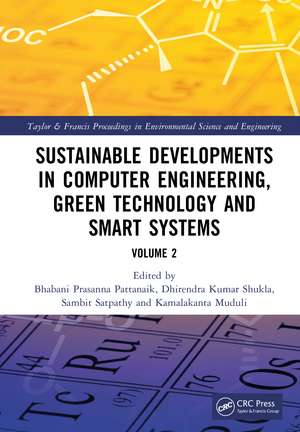
Sustainable Developments in Computer Engineering, Green Technology and Smart Systems: Volume 2: Taylor and Francis Proceedings in Environmental Science and Engineering
Editat de Bhabani Prasanna Pattanaik, Dhirendra Kumar Shukla, Sambit Satpathy, Kamalakanta Mudulien Limba Engleză Hardback – 21 iul 2026
The chapters in this volume provide an integrated analysis of energy-efficient, environmentally sustainable, and technologically resilient building systems. Combining foundational principles with applied methodologies, the book addresses contemporary challenges in intelligent automation, sustainable communication networks, secure digital infrastructures, and smart industrial applications.
By integrating interdisciplinary research with real-world applications, this publication serves as a valuable resource for researchers, practitioners, and policymakers committed to shaping sustainable technological ecosystems for the future.



Preț: 1549.82 lei
Preț vechi: 2191.17 lei
-29% Nou
Puncte Express: 2325
Carte indisponibilă temporar
Doresc să fiu notificat când acest titlu va fi disponibil:
Se trimite...
Specificații
ISBN-13: 9781041248323
ISBN-10: 1041248326
Pagini: 1110
Dimensiuni: 174 x 246 mm
Greutate: 2.21 kg
Ediția:1
Editura: CRC Press
Colecția CRC Press
Seria Taylor and Francis Proceedings in Environmental Science and Engineering
ISBN-10: 1041248326
Pagini: 1110
Dimensiuni: 174 x 246 mm
Greutate: 2.21 kg
Ediția:1
Editura: CRC Press
Colecția CRC Press
Seria Taylor and Francis Proceedings in Environmental Science and Engineering
Public țintă
Academic, Postgraduate, and Professional ReferenceCuprins
174. Machine Learning Empowered Stock Market Strategies: A Research Question–Driven Literature Survey 175. Emperical Analysis of Machine Learning Techniques for Water Quality Prediction 176. PREDICTIVE MAINTENANCE OF AIRCRAFT ENGINES USING MACHINE LEARNING APPROACHES 177. Analysis of Machine Learning based algorithm in the early detection of Parkinson's disease using Random Forest 178. Classification of Shrimp Diseases With Hybrid Extraction of CNN -VGG Function Using XG Boost 179. Ecological Sustainability for Monitoring Terrestrial Biodiversity with Artificial Intelligence 180. Federated GenAI Architecture for Privacy-Preserving Risk Scoring in Financial Institutions 181. A Hybrid CNN–LSTM Deep Learning Model for Accurate Crop Leaf Disease Classification in Complex Imaging Environments 182. Design of a DC Drive along with Grid Synchronization aspects of DC Motor fed Alternator 183. A Hybrid Edge-Native Architecture for Autonomous eCommerce Agents 184. ProPlanet: An Intelligent Gamified Sustainability Platform for Behavioural Transformation and Environmental Impact Quantification 185. Classification and Comparison of Retinal Eye Disease Detection from OCT Images 186. AI-Powered Healthcare Consultation and Doctor Matching System 187. AI-Driven Optimization of Hybrid Renewable Energy Systems: Techniques, Challenges, and Future Research Directions 188. Serverless, AI-Driven Framework for Next-Generation Learning Management Systems: A Comprehensive Review and Future Research Directions 189. Face recognition-based portable attendance system with liveness detection 190. Hindi Named Entity Recognition, Translation and Correction using Sequence to Sequence Model 191. Early Diagnosis of Autism Spectrum Disorder in Toddlers Through Machine Learning Methods 192. Performance Analysis of FTO/ZnO/RbGeI3/RbGeBr3/NiO Perovskite Solar Cell Achieving 27.98% PCE 193. A Unified Security and Recovery-Aware Scheduling Architecture for Reliable IoT–Edge–Cloud Computing 194. Intelligent Systems for Predictive Healthcare: Analysis and Forecasting of Diseases 195. Leveraging AI for Precise Cost Estimation for Software Projects 196. Entangled Assets: A Framework for Privacy-Preserving Fraud Detection via Quantum Federated Learning 197. Secure Device Authentication and Access Control Mechanisms in Modern IoT Ecosystems 198. Efficient Breast Cancer Subtype Classification Using Multimodal-to-Unimodal Knowledge Distillation 199. An Integrated YOLOv8-SEG and EfficientNet-B0 Framework for Tomato Leaf Disease Detection 200. BitChat-Powered Zero-Trust Governance Framework for AI-Native Multi-Cloud Infrastructure: A Decentralized Protocol for Real-Time Compliance and Telemetry Exchange 201. Bridging Flexibility and Immutability: Context-Aware Ledger Systems for Dynamic Healthcare Information Protection 202. Crystal Edge Graph Attention-Driven Content-Based Movie Recommendation System 203. Intelligent Job Matching System: A Hybrid Approach Combining Machine Learning and Semantic Analysis for Enhanced Career Portal Efficiency 204. GeoPulse 205. Scenario-Based Generation and Reduction for Renewable Energy Uncertainty in Sustainable Microgrids 206. Serverless ML Pipelines: Deploying AI models in serverless cloud environments 207. Optimizing Self-Driving Car Performance Through Modern Computer Vision and Sensor Fusion 208. Empirical Analysis of Machine Learning Techniques for predicting water quality 209. Research Assistant using Langchain 210. Analysis of Cybersecurity Threats and Security Modeling Approaches 211. A Deep Learning Framework for Automated Liver Segmentation for Surgical Planning: A Case Study on Misleading Metrics 212. Task Conflict, Team Competencies and Workforce Agility in Green Electric Vehicle Technology Adoption 213. A Unified Approach to State Space based Modelling and Control of Zeta Converter using Dolphin Creative Thinking–Based Optimization Algorithm 214. Decentralized Federated AI Model Training for Skin Disease Diagnosis 215. A Deep Reinforcement Learning framework for Home Energy Management Systems 216. Development of Autonomous Driving Agent System using Intelligent Reinforcement Learning Model 217. Blockchain-Based Secure Electronic Voting Systems: A Comprehensive Review and Future Research Directions 218. Transforming Eearly Cardiovascular Risk Evaluation Through AI-Driven Modeling 219. Skin Disease Classification Using Hybrid Machine Learning Techniques 220. BlockAuth - A blockchain-based Decentralized Identity Management System for Secure access Control in IoT Networks 221. PM2.5 Air Quality Forecasting with Hybrid Quantum-Firefly Optimization using Machine Learning 222. Probabilities of Reliability Modelling of Generative AI Systems for Machine Learning Operations Pipeline 223. Federated Proximal Guided DRL framework for Early-Stage Alzheimer Detection 224. APPLICATION OF SEAGULL SWARM OPTIMIZATION FOR WATER QUALITY PREDICTION 225. Text to Video Conversion of PIB Releases using AI/ML 226. Lightweight payload encoding method for OCPP in EV Charging Infrastructure 227. Assessing the Efficacy of Classical and Hybrid Quantum Machine Learning Algorithms for Land Use and Land Cover Classification over West Bengal Region using Satellite Data 228. Real-Time Facial Expression Identification for Depression Detection using Fuzzy Logic 229. Design and Development of a Multilingual Mobile Accessibility Application for Hearing and Speech Impaired Users in India. 230. Blockchain for Educational Certificates: A Review of Trends, Technologies, and Research Challenges 231. A Review of Diffusion Models for Image Inpainting 232. Explainable Deep Learning Framework for Early Crop Disease Severity Estimation from Leaf Images 233. Sustainable developments in MPA design for 2.4/5/6 GHz Wi-Fi applications 234. Interpretable Text Clustering: Methods and Case Study Analysis 235. Scheme Seva 236. CARBONET: An IoT-Enabled Smart Indoor Air Quality Management System with Multi-Factor Comfort Index & Emergency Ventilation Alerts 237. IoT-Based Smart Agriculture System for Plant Disease Detection 238. Sustainable Generative AI Acceleration Using FPGA-Based Autoencoder Architecture 239. A Review of Deep Learning for Diabetic Retinopathy Grading & Progression 240. Real-Time Disaster Resource Allocation Using Multi-Agent Reinforcement Learning and Graph Neural Networks on Crisis Communication Data 241. AI-Driven Unsupervised Embedding-Based Analysis of Social Media Data for Disaster Response 242. Enhancing Learning Efficiency using GPT-Based AI Platforms 243. Anonymous and Linkable Privacy Preserving Machine Learning for Medical Inference using Paillier Encryption and Linkable Ring Signatures 244. A Deep Learning–Based Multimodal Cyberbullying Detection Framework Using DistilBERT ResNet50 and Cross-Modal Attention 245. Reinforcement Learning-Based Adaptive Control for Self-Driving Cars in Urban Traffic 246. A Machine Learning Framework for Automated Identification of Plant Leaf Diseases Using CNN 247. Thyroid Disease Classification using Random Forest with Explainable AI Integration 248. Earthquake Alert Prediction Using Machine Learning 249. Application of swarm and quantum behaved swarm optimization techniques for water quality prediction 250. Agriculture Crop Prediction Using Artificial Neural Network and Multivariate Regression 251. A Comparative Analysis of LLM-Generated vs. Human-Written Resumes in Automated Hiring Pipelines 252. Using Zero-Knowledge Proofs Integrated with Homomorphic Encryption for Enhanced Clinical Trial Cohorts based on Blockchain-secured Patient Data 253. Emerging Machine Learning Applications in Canine Disease Prediction: A Comprehensive Survey 254. Modelling and Analysis of Renewable Energy Integration and Electric Vehicle Impact on Microgrid Performance: A PSO-Based MPPT and ANFIS-Controlled Battery Approach 255. Design and Implementation of mm-Wave MIMO Antenna for AR&VR Applications 256. TSM-BASED HYBRID ACCIDENT DETECTION AND YOLOV9 ALERTING USING IOT SENSORS DEEP LEARNING MODELS 257. Quantum resistance blockcahin framework 258. Prototype Framework of Cyber-Physical Model to Provide Smart Street Lighting System Ensuring Energy Management and Human-centric Adaptable Lighting Environment 259. Bias Detection and Fairness Optimization in Large Language Models 260. Performance analysis of an InceptionV3 Deep learning model for Rice-Leaf Disease Recognition 261. AI-Powered Interactive Learning Management System for Primary Education Environments 262. CUWO-NLWVT: Classification of Underwater Objects using Novel Light Weight Vision Transformer 263. Smart parking system: An IoT based Automated Parking and monitoring solution 264. Artificial Neural Network Modelling for Environmentally Sustainable Speed Control in automobile 265. A Multi-Layer Perceptron Based Framework for Enhanced Handwritten Digit Recognition 266. Sentiment Analysis using Lexical analysis and Machine Learning based approaches 267. AI-BASED SMART MIRROR USING ARDUINO AND MACHINE LEARNING 268. Review of Securing the Patients Data Over Cloud 269. A novel design towards customizable and adaptable VR based 3D Modelling Software 270. A Systematic Review of Deep Learning-Based Methods for Image Retrieval 271. An IoT and GPS-Integrated Smart Parking System for Sustainable Urban Mobility 272. ANOMALY DETECTION AND ROOT CAUSE ANALYSIS IN CLOUD-NATIVE MICROSERVICES USING LARGE LANGUAGE MODELS AND BAYESIAN NETWORKS 273. Grad-CAM Interpreted MRI-Based Classification ofAlzheimer's Disease using Deep Transfer Learning 274. Adaptive Learning Systems Driven by Deep Learning-Enabled EEG Cognitive State & Stroke Assessment Application 275. EMG-Based Triggering of a Rapid-Actuation Protective Shield with GSM-Enabled Emergency Alerts 276. A Secure and Scalable Blockchain based Model for Electronic Medical Records (EMRs) and Healthcare. 277. SecurePay- A Real Time UPI Fraud Detection System Using Artificial Neural Network 278. Feature importance analysis of an IoT-based smart soil monitoring system for precision agriculture 279. An Enhanced Lightweight Encryption Method with Data Authentication in Internet of Things(IoT) 280. Explainable Deep Learning for Sustainable Development in Retail Forecasting: A Computational Evaluation on the Champagne Sales Dataset 281. An Image-based Machine Learning Approach for Sugarcane Leaf Diseases Identification and Classification 282. Automated Weed Detection in Agriculture using Artificial Intelligence 283. A Decentralized Architecture for Supply Chain Visibility: Integrating Blockchain, Smart Contracts, and IoT 284. Smart Irrigation System for Precision Farming 285. Deep Learning Driven Modeling for Classification of Alzheimer's disease and Dementia Using Brain EEG Signals: A Comprehensive Review 286. Malicious URL Detection Using Machine Learning Techniques 287. A YOLO-based Deep Learning System for Automated Road Traffic Violation Detection and Enforcement 288. AI-BASED TRAFFIC LIGHT MANAGEMENT SYSTEM 289. On the Effect of a Bio-Friendly Cutting Fluid During Turning of Aluminium Base Composite with Coated Insert 290. CodeLearn : Adaptive Learning Path System for Enhancing Programming Skills 291. A New Approach for Calculating Waiting Time of Round Robin scheduling 292. Solar Powered Electric Vehicle with V2V Wireless Charging 293. Evaluating Machine Learning Techniques for Accurate Heart Disease Diagnosis and Risk Assessment 294. Comparison between different Prediction using machine learning algorithm in Breast Cancer 295. Quantum Computing-Based Architecture to Deploy Microservices over VANET for Critical Services 296. Quantum-Inspired Framework for connected vehicular communication to deploy Emergency Services 297. An Integrated Approach for phishing detection using XGBoost and Random Forest 298. A Hybrid CNN–GRU Model used for IoT-Enabled Blood Glucose Forecasting Monitoring System 299. A Comprehensive Survey and Critique of Video Analysis with Multimodal Large Language Models: Challenges, Opportunities, and Future Directions 300. A HEALTHCARE-ORIENTED NORMALIZED ENCRYPTION MODEL 301. Design and Fabrication of a Motorized Upper-Limb Exoskeleton with Android-controlled Using a Pulley System for Physiotherapy Applications 302. Comparative Study of Surface Texturing Patterns for Enhanced Hydrodynamic Thrust Bearing Performance 303. Doctor-in-the-Loop Radiology Assistant with Deep Learning 304. Probabilistic Monte Carlo DCF Valuation Using LSTM Forecasting and Quantile Regression Terminal Multiples 305. A cost-effective Plant Health Monitoring System for Gardeners and Small-scale Farmers 306. A Lightweight and Illumination-Adaptive Deep Learning Model to Enhance the Situation Awareness in Challenging Defence Environments 307. 6G, IoT, and Edge AI for Smart Cities: Architecture, Applications, Challenges, and Future Directions - A Review 308. Ocular Toxoplasmosis Classification Using Minimal Preprocessing and Class-Weighted CNNs 309. AI Based Medical Plant Detection and 3D Reconstruction 310. AI-POWERED SYMPTOM-BASED DISEASE PREDICTION AND PERSONALISED HEALTH RECOMMENDATION 311. AI-Based Acoustic Rail Defect Detection System 312. Blockchain-Federated Deep Neural Network for Privacy-Preserving Healthcare Anomaly Detection 313. A Compact IoT-Based Tracking and SOS Alert System with Audio Surveillance 314. An Adaptive AI Platform for Personalized Financial Risk Management 315. Optimizing CRDI Engine Performance and Emissions Using Oxygenated and Hydrogen Dual Fuels 316. Detecting AI-Generated Deepfake Text with a Hybrid Convolutional Recurrent Attention Model 317. Discussion of a Hybrid CNN–Transformer Models for Advanced Breast Cancer Detection 318. Machine Learning–Driven Power Optimization Techniques for Integrated Circuits 319. Fox Nut (Makhana) Cultivation in Bihar: A Field-Based Assessment of Practices, Constraints, and Technological Opportunities 320. MedConEdge: A Blockchain-Assisted Trust-Driven Task Offloading Framework for Secure and Efficient Healthcare IoMT Using Edge–Fog Computing 321. AI-Driven Inclusive Digital Infrastructure: A Unified Cognitive Load Framework for Accessible Smart Education in Sustainable Cities 322. A Mobile-based Application for GST Complaint Management 323. An Intelligent Cognitive Framework for Phishing and Social Engineering Defense 324. Enhanced ATM Security Using Proximity Detection and RFID Authentication 325. The Role of AI for Renewable Energy Optimization and Smart Resource Management toward Global Sustainability 326. A Review on Impact of GST Reforms on Rooftop Solar Adoption in India: A Pathway towards Sustainable Energy Transition 327. A Comparative Review of Graph-Theoretic Encryption Schemes for Lightweight IoT Authentication 328. A Comprehensive Review on Financial Large Language Models: Data-Centric Approaches and Applications of FinGPT Framework 329. OPTIMIZED ANALYSIS OF RESEARCH ABSTRACTS THROUGH PREDICTIVE MODELLING AND MULTI-LABEL NATURAL LANGUAGE PROCESSING 330. Entropy Regularized Smart Routing Algorithm for Energy-Constrained Wireless Sensor Networks in Agriculture 331. Explainable AI for Healthcare Insurance Fraud Detection 332. Smart Next-Gen Approach in Precision Agriculture Using XGBoost Based Federated Learning for Crop Prediction. 333. A Secure Method for Information Hiding in RGB Image using LSB Embedding Based on Spiral Scanning and Randomly Selected Pixel Bits. 334. Using Apriori Algorithm to Analyze Symptoms of COVID-19. 335. Deep Learning Models for Indian Sign Language Recognition 336. Enhancement of Mechanical and Thermal Characteristics of Benzoylated Vetiver Fiber/Epoxy Composites. 337. TextCNN–BiGRU with Trainable Random Embeddings for IMDB Movie Review Sentiment Classification 338. Optimized Bias and Toxic Content Identification Through TF-IDF Modellling and API-Assisted Evaluation 339. A Research Analysis on Machine Learning Algorithms for Intrusion Detection 340. Sahara: Enhancing Emergency Management with Mobile Ad-Hoc Networks 341. Edge-Optimized TinyML Framework for Post-Harvest Apple Grading and Quality Assessment 342. Reinforcement Learning for Personalized Candidate Assessment Paths 343. An Intelligent Hybrid Framework for AI-Based Resume Evaluation and Feedback. 344. HASS-AE: HYBRID ADAPTIVE SPECTRAL–SPATIAL AUTOENCODER FOR UNMIXING AWARE HSI COMPRESSION WITH ABUNDANCE AWARE LATENT ENCODING 345. CNN–Autocorrelation Fusion for Intelligent Spectrum Sensing in Cognitive Radio
Notă biografică
Bhabani Prasanna Pattanaik is currently working as Principal and Professor at the Department of Mechanical Engineering, Hooghly Engineering & Technology College, Hooghly, West Bengal. He received his Ph.D. in Mechanical Engineering from National Institute of Technology, Silchar, Assam, in 2018. Prior to his Ph.D., he completed M. Tech (Heat Power Engineering) with first class from Jadavpur University, Kolkata, in 2002, and B. E. (Mechanical Engineering) with first class from Orissa Engineering College, Utkal University, Bhubaneswar, in 2000. He possesses more than 18 years of teaching, research and administrative experience at various reputed organizations.
Dhirendra Kumar Shukla is a Professor at the School of Computer Science and Engineering, Galgotias University, Greater Noida. He has more than 14 years of academic and research experience in cloud computing, artificial intelligence, blockchain, IoT, and healthcare analytics. He completed his Ph.D. in Computer Engineering from MNNIT Allahabad, India, and earned his M.Tech. in Software Engineering from MNNIT Allahabad and B.Tech. in Computer Science and Engineering from RGPV, Bhopal, Madhya Pradesh, India.
Sambit Satpathy is currently working as Associate Professor at the Department of CSE, Galgotias College of Engineering & Technology. He received his Ph.D. degree in Computer Engineering from the National Institute of Technology, Agartala, and MTech in Computer Science and Engineering (Embedded System Design) from Sambalpur University Institute of Information Technology, SUIIT, Burla. He completed his Bachelor of Engineering from BPUT, Odisha. He has approximately 9 years of teaching and research experience.
Kamalakanta Muduli is presently working as Associate Professor and Head of the School of Mechanical Engineering, Papua New Guinea University of Technology, Lae, Morobe Province, Papua New Guinea. He is also a Visiting Researcher at University of Derby, UK. He has obtained his PhD from School of Mechanical Sciences, IIT Bhubaneswar, Orissa, India. He has over 20 years of academic experience in Universities in India and Papua New Guinea.
Dhirendra Kumar Shukla is a Professor at the School of Computer Science and Engineering, Galgotias University, Greater Noida. He has more than 14 years of academic and research experience in cloud computing, artificial intelligence, blockchain, IoT, and healthcare analytics. He completed his Ph.D. in Computer Engineering from MNNIT Allahabad, India, and earned his M.Tech. in Software Engineering from MNNIT Allahabad and B.Tech. in Computer Science and Engineering from RGPV, Bhopal, Madhya Pradesh, India.
Sambit Satpathy is currently working as Associate Professor at the Department of CSE, Galgotias College of Engineering & Technology. He received his Ph.D. degree in Computer Engineering from the National Institute of Technology, Agartala, and MTech in Computer Science and Engineering (Embedded System Design) from Sambalpur University Institute of Information Technology, SUIIT, Burla. He completed his Bachelor of Engineering from BPUT, Odisha. He has approximately 9 years of teaching and research experience.
Kamalakanta Muduli is presently working as Associate Professor and Head of the School of Mechanical Engineering, Papua New Guinea University of Technology, Lae, Morobe Province, Papua New Guinea. He is also a Visiting Researcher at University of Derby, UK. He has obtained his PhD from School of Mechanical Sciences, IIT Bhubaneswar, Orissa, India. He has over 20 years of academic experience in Universities in India and Papua New Guinea.
Descriere
This book brings together groundbreaking contemporary insights and intelligent technological solutions in the fields of computer engineering, green computing, smart systems, artificial intelligence, Internet of Things, data science, and cybersecurity.